

Narcissist vs sociopath vs borderline personality — understanding the differences between these three conditions is critical for your emotional safety, your healing, and your ability to recognize what you’re actually dealing with in a relationship. Most people throw these terms around without understanding what they mean, which creates dangerous misdiagnosis. A narcissist is made through childhood trauma and horrific parenting. A sociopath involves a criminal element. A borderline personality was abandoned so severely that the authentic self cannot be accessed. And here’s what most teachers miss entirely: the person you’re calling a narcissist is probably a falsely empowered codependent — and that distinction could save your relationship or your sanity.
TL;DR: Narcissists are made through childhood trauma and overindulgent or severely neglectful parenting — they are not born. Sociopaths must involve a criminal element. Psychopaths are born without empathy. Borderline personalities were abandoned so deeply that the authentic self is nearly unreachable. Most importantly, the person you’re calling a narcissist is likely a falsely empowered codependent who can heal — and knowing this difference changes everything.
What Is a Narcissist? The DSM Definition Most People Get Wrong
The first thing to understand: all of us have narcissism in us. Narcissism exists on a spectrum. A certain level of healthy self-interest is normal and necessary for survival. What we’re talking about here is far out on that spectrum — a pattern so entrenched it becomes a disorder.
According to the DSM (Diagnostic and Statistical Manual), for someone to be classified as a narcissist, five of nine specific characteristics must be present: a grandiose sense of self-importance, preoccupation with fantasies of unlimited success or power, belief that they are special and unique, need for excessive admiration, sense of entitlement, interpersonal exploitation, lack of empathy, envy of others, and arrogant behaviors.
But here’s the key that changes everything: these personality traits must be relatively stable across time and consistent across situations. In other words, they don’t have “moments” of these traits — this is them all day, every day. It would be extremely rare for them to not exhibit these traits. Those rare moments are the exceptions.
That’s you if you’ve been labeling someone a narcissist because they had a bad month or went through a selfish phase — that’s not narcissism. That might be a survival persona in crisis.
These traits must also be present without addiction. If someone only exhibits narcissistic behaviors while drunk or high, that’s the addiction driving the behavior — not narcissistic personality disorder. This distinction matters enormously.
Anchor Teaching: Narcissism is a trait, not a chemical imbalance or psychological disorder in the traditional sense. It stems from severe childhood abuse and neglect, leaving the narcissist insecure and needing constant outside validation. A narcissist will feel guilt and shame — primarily shame — when they do something wrong, because they fear others’ thoughts. It’s an external condition, not an internal one.
The most significant distinction: narcissists are made, not born. Parents create narcissists through either extreme overindulgence and spoiling, or significant under-indulgence and neglect. The spoiling parents give their children everything, rescue them from consequences, and focus heavily on appearance and achievement. The neglectful parents strip the child of emotional safety entirely. Both create a child who builds a falsely empowered survival persona to manage unbearable shame. If you’re a parent noticing these patterns, this guide on the narcissistic child dynamic can help.
That’s the foundation most people miss — the narcissist didn’t choose to be this way. Their childhood created a survival persona so powerful it consumed their authentic self.
The Misdiagnosis Epidemic: Narcissist vs. Falsely Empowered Codependent
If you want to go deeper on this, I walk through the full framework in this video: Identifying Narcissists, Sociopaths, Psychopaths & Borderline Personalities.
Here’s what most narcissism teachers get dangerously wrong: they’re calling people narcissists when they’re actually falsely empowered codependents. And if you don’t know the difference, you could be with somebody you could have a relationship with — but you’ve miscategorized them and missed your shot.
A narcissist is like the desert. It is almost always hot. Always filled with sand. The landscape is almost always the same. It is extremely rare that there’s rain, clouds, or any change at all. Their behavior is consistent — the same personality, the same traits, the same patterns across every situation and relationship.
A falsely empowered codependent is like Denver, Colorado. Winter in Denver is six to eight months long — that’s a long period that might look like narcissism. But then spring arrives. Spring in Denver is fantastic, but it also has the most violent storms. It looks even more like narcissism — now they’re dumping more snow. But then summer comes: calm, relaxing breezes. July is basically sunny for a full month.
That’s the distinction most people miss entirely — a falsely empowered codependent goes through seasons. They have moments of warmth, calm, and genuine connection that a narcissist simply does not have.
Anchor Teaching: Given the proper information, many falsely empowered codependents will seek help. They’ll get into truth and reality, address their childhood trauma and codependence, and mature out of it. A true narcissist’s personality traits are relatively stable across time and consistent across situations. The falsely empowered codependent can look very similar but can touch the underlying pain — they may not admit to it, but they can feel it. The narcissist almost never feels it.
Sound familiar? If the person you’re calling a narcissist has moments of genuine vulnerability, remorse, or warmth — they might be a falsely empowered codependent who can heal. That changes everything.
What Is a Sociopath? The Criminal Element Nobody Mentions
The critical distinction with sociopaths that almost nobody discusses: to be a sociopath, there must be a criminal element involved. You can have every narcissistic trait in the book, but if they’re not breaking the law, they’re not a sociopath. Please don’t let people throw that term around unless they’re talking about a criminal element.
Killing, robbing, fraud — these are obvious crimes of sociopaths. But there are many closeted examples: tax evasion, financial exploitation, escorting, sex trafficking, and manipulation schemes that cross legal boundaries. Many sociopaths redefine what they do so it’s perceived better by the public.
Like narcissists, sociopaths are made, not born. They learned to be con artists. They were trained not to be empathetic — often by a parent who punished emotional expression. “Stop crying or I’ll give you something to cry about.” Their reality and emotions were systematically stripped. They act first and think later. They have inconsistent work histories.
That’s you if you’ve been calling your manipulative ex a sociopath — unless they broke the law, that term doesn’t apply. Words matter. Accurate labels lead to accurate healing.
Sociopaths often use aliases, including on social media. Everything for them is a game — they love to outthink you. They’re chameleons who find what they like about someone and drain it. They gaslight to the point where you feel you need to record your conversations. And when you narrow down the problem, they start all over again. A sociopath will leave a relationship with zero emotion — done and over, no looking back.
That’s the sociopath — the narcissist taken to a criminal level. If there’s no criminal element, it’s not sociopathy.
What Is a Psychopath? Born Without Empathy
Every psychopath is a narcissist — but not every narcissist is a psychopath. This distinction is essential. Psychopaths represent the extreme end of the personality disorder spectrum, and unlike narcissists, they are born this way.
Psychopaths completely lack empathy at a neurological level. They could pass a polygraph test while lying straight to your face. The part of their brain that produces the chemical reaction when normal people lie simply doesn’t activate. In brain scans, there is absolutely no empathetic activity. They do not feel fear or stress. They can watch death unfold in front of them without flinching.
Anchor Teaching: The psychopath is the one exception to the “made, not born” principle. Psychopaths are born with a neurological deficit that prevents empathy, guilt, shame, and remorse from developing normally. They will show a pattern of truancy, fire-setting, cruelty to animals, or extreme behavioral problems before the age of 15. Their parents typically couldn’t do anything about it.
Psychopaths are completely entitled, lack self-esteem, and display all the narcissistic traits — plus they lack shame, remorse, and guilt entirely. The narcissist feels shame (that’s actually what drives them). The psychopath does not. That’s a fundamental neurological difference.
That’s the critical distinction — the narcissist’s behavior is driven by shame they’re running from. The psychopath has no shame to run from. Their autonomic nervous system doesn’t produce the same arousal response.
What Is a Borderline Personality? The Deepest Abandonment Wound
Borderline personality represents the deepest level of childhood abandonment — so severe that the authentic person cannot be found. This is the most difficult condition on this list because, in most cases, the authentic self was buried so early and so completely that recovery is extraordinarily rare.
Borderline personalities are highly victim-oriented. They use medication constantly, are chronically sick and hurt, and move from one disease or illness to the next. They very rarely maintain consistent work. They always have someone to take care of them. They doctor-shop for pills and diagnoses. They are highly psychosomatic — they focus on illness so heavily that their brain and body create somatic conditions that feel absolutely real.
They exhibit learned helplessness at its most extreme. Since they are so focused on being a victim, they are typically unwilling to do the deep work required for healing. As a result, it is nearly impossible for them to access their true selves.
That’s you if you’ve been with someone who cycles through illnesses, victim stories, and helplessness with no willingness to look at their own patterns — that depth of victimhood may indicate borderline personality, not narcissism.
An important demographic note: it is very rare for a straight male to present as borderline personality. This condition is primarily found in women and gay men. This isn’t a judgment — it’s a clinical observation about how different populations process deep childhood abandonment.
The Worst Day Cycle™: How All of These Patterns Begin
Here’s the video where I unpack this in full: What Causes Narcissistic Personality Disorder?
Every condition on this list — except psychopathy — traces back to childhood trauma processed through the Worst Day Cycle™. Understanding this four-stage loop explains how narcissists, sociopaths, and borderline personalities are created, and why you attracted one.
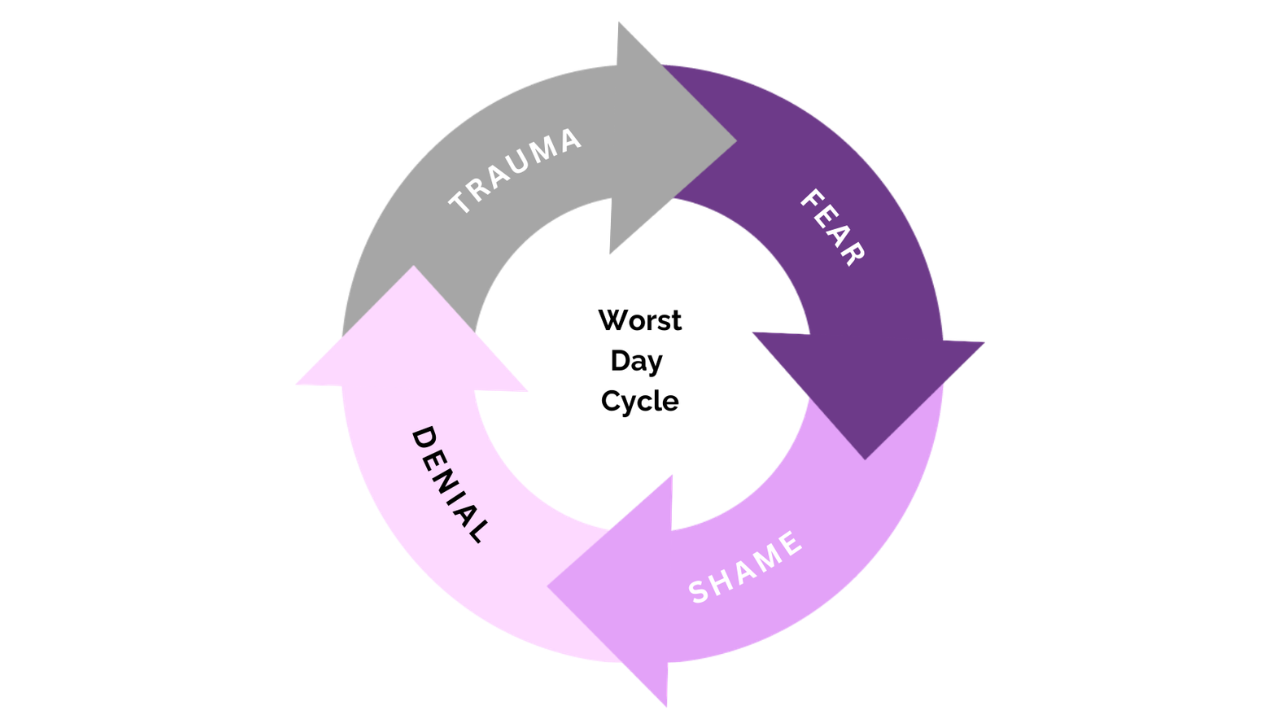
Stage 1: Trauma. Childhood trauma is any negative emotional experience that created painful meanings about yourself, others, or the world. For the narcissist, this came through either extreme overindulgence (never facing consequences, being told they were superior) or severe neglect (being stripped of emotional safety). Either way, the child’s authentic self was not honored.
Stage 2: Fear. Trauma triggers a massive chemical reaction. The hypothalamus generates chemical cocktails — cortisol, adrenaline, dopamine misfires, oxytocin confusion. The brain becomes addicted to these states because it conserves energy by repeating known patterns. It can’t tell right from wrong — only known versus unknown. Since 70%+ of childhood messaging is negative and shaming, adults repeat these painful patterns in every area of life.
That’s you if you keep ending up with the same type of person in different bodies — your brain is addicted to the known, even when the known is painful.
Stage 3: Shame. Shame is where you lost your inherent worth. Where you decided “I am the problem.” For the narcissist, shame is so unbearable that they build an entire identity to never feel it again. For the borderline, shame became their entire identity — “I am broken beyond repair.” For the sociopath, shame was beaten out of them through training and punishment.
Stage 4: Denial. To survive unbearable shame, the psyche creates a survival persona — a false identity. The narcissist’s survival persona says “I’m superior, I’m always right, I don’t need anyone.” The borderline’s survival persona says “I’m helpless, I’m sick, I need you to rescue me.” The sociopath’s survival persona says “Everyone is a game piece, and I play to win.”
Sound familiar? Every personality pattern on this page is a survival persona running the Worst Day Cycle™ without permission.
The Three Survival Personas That Mimic Personality Disorders
Before you label someone with a personality disorder, you need to understand the three survival persona types — because they often mimic narcissism, sociopathy, or borderline behavior without being any of those things.
The Falsely Empowered Survival Persona
This persona controls, dominates, and rages. They look almost identical to a narcissist on the surface. They over-function, over-achieve, and need to be right. They use anger as armor because vulnerability feels like death. But underneath the rage is terror — terror of being abandoned, of being wrong, of being exposed as the broken child they still feel like inside.
The critical difference: the falsely empowered codependent can touch their pain. They may not admit it publicly, but in safe moments — with a therapist, a trusted friend, or alone at night — they can feel the shame underneath. A true narcissist almost never can.
That’s you if you’ve been calling your partner a narcissist because they’re controlling and angry — ask yourself: do they ever show genuine vulnerability? Do they ever, even briefly, acknowledge they’re wrong? If yes, you might be with a falsely empowered codependent, not a narcissist.
The Disempowered Survival Persona
This persona collapses, people-pleases, and disappears. They can mimic borderline behavior — chronic victimhood, helplessness, inability to function independently. But the disempowered codependent still has access to their authentic self, even if it’s deeply buried. They can be reached. They can heal.
That’s you if you identify as the “nice one” who always gives too much — your niceness might be a survival strategy, not a personality trait.
The Adapted Wounded Child Survival Persona
This persona oscillates between both — sometimes controlling, sometimes collapsing. They’re unpredictable and confusing. One day they’re the narcissist; the next day they’re the victim. This oscillation can look like borderline behavior, but it’s actually a survival strategy trying every tool it learned in childhood.
That’s you if your partner seems like a completely different person depending on the day — they’re not multiple people. They’re one wounded child trying every survival strategy they have.
Anchor Teaching: Empaths and narcissists are an exact mirror of each other. Both are on two different sides of the codependent scale. Both are operating from unhealed childhood shame and just express it from completely polar opposite ends of the same power spectrum. Whether falsely empowered, disempowered, or narcissist — it’s all a power game. It’s all about regaining power because shame strips us of our inherent value and worth.
Your Role: Why You Attracted This Person
This is the part nobody wants to hear, but it’s the part that gives you your power back: nobody, no person, place, or thing gets near your life unless you allow it. Therefore, you played a part in it. This isn’t blame — this is power.
Many people think they’re with a sociopath, borderline, or narcissist, but it’s actually their own victimhood and projections creating the label. A relationship is always a two-way street. Be wary before labeling someone as one of these — you may be the one who needs help.
The Victim Position Paradox is crucial here: the victim position is a societal construct meant to protect victims, but in reality it has created a paradoxical falsely empowered position that nearly guarantees the victim will reexperience their childhood victimization, leaving them disempowered.
That’s you if you’ve spent months researching narcissism while avoiding looking at your own childhood blueprint — your obsession with diagnosing them is keeping you from healing yourself.
Your nervous system has a radar. Imagine walking into a room with 20,000 people. Only one of them is a narcissist. Your brain locks onto that one person like a radar system. Why? Because your childhood conditioned your brain to recognize that dynamic as home. That feeling of chaos, control, and emotional unavailability — your nervous system registers it as familiar, as love. It’s not bad luck. It’s not coincidence. It’s your brain doing exactly what it was trained to do.
That’s you if you keep ending up with the same type of toxic person — your nervous system is seeking the familiar, not the healthy. The work isn’t to diagnose them. The work is to rewire your radar.
The Emotional Authenticity Method™: Your 6-Step Recovery Practice
Whether you’re recovering from a relationship with a narcissist, a falsely empowered codependent, or any toxic dynamic, the Emotional Authenticity Method™ Method™ is your concrete 6-step practice for rewiring your emotional blueprint.
Step 1: Somatic Down-Regulation. When you’re triggered — replaying conversations, obsessing about your ex, spiraling into rage or grief — pause. Focus on what you can hear for 15-30 seconds. Your thinking brain cannot come online while your amygdala is running the show. If highly dysregulated, use titration: cold water on your face, step outside, hold ice.
Step 2: What am I feeling right now? Not “I’m upset about the narcissist.” Use the Feelings Wheel to name it with precision. Are you feeling abandoned? Terrified? Ashamed? Enraged? Betrayed? Emotional granularity activates your thinking brain and breaks the reactive cycle.
Step 3: Where in my body do I feel it? Emotions are biochemical events that live in your body. The tightness in your chest isn’t abstract — it’s cortisol and adrenaline. Locate it physically to ground yourself in the present moment.
Step 4: What is my earliest memory of this exact feeling? The feeling of being controlled, manipulated, or abandoned by this person likely echoes something much older. Your narcissistic partner didn’t create this wound — they activated the one that was already there from childhood.
Step 5: Who would I be if I never had this feeling again? Envision your Authentic Self — the version of you that isn’t controlled by childhood wounds. What would that person do? How would they respond? What boundaries would they set?
Step 6: Feelization. Sit in the feeling of the Authentic Self and make it strong. Don’t just picture it — feel it. Feel the confidence, the groundedness, the worthiness, the freedom. Create a new emotional chemical addiction to replace the old blueprint. Ask yourself: “How would I respond to this situation from this feeling? What would I say? What would I do?” This is the emotional blueprint remapping and rewiring step.
That’s the Emotional Authenticity Method™ — six steps to stop diagnosing them and start healing yourself.
The Authentic Self Cycle™: From Victim to Author
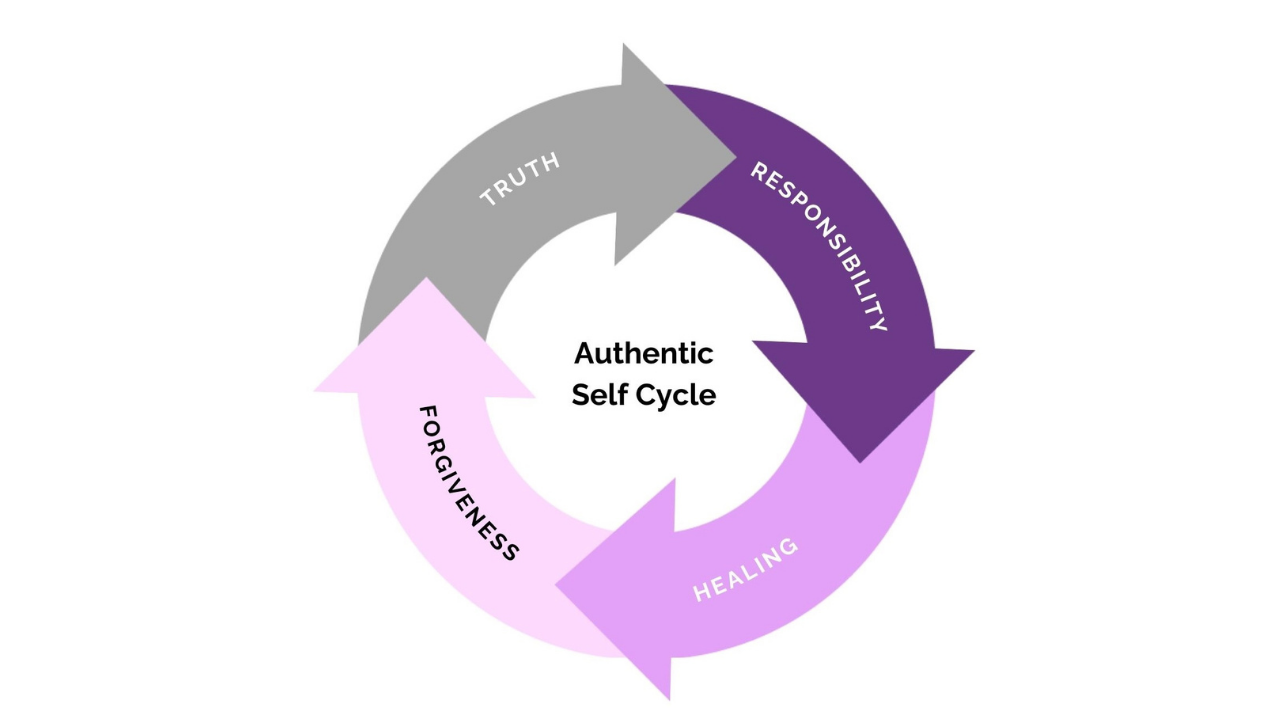
The Authentic Self Cycle™ is the healing counterpart to the Worst Day Cycle™ — a four-stage identity restoration system that transforms how you relate to toxic people permanently.
 narcissistic abuse recovery" width="600" style="max-width:100%;height:auto;" />
Stage 1: Truth. Name the blueprint. “This isn’t about today. My partner activated my childhood blueprint. The chaos, the control, the emotional unavailability — my nervous system recognized it as home, not because it’s healthy, but because it’s familiar.”
Stage 2: Responsibility. Own your emotional reactions without blame. “I chose this person because my brain is addicted to what I know. My childhood set me up for this attraction. Until I heal that wound, I’ll keep being attracted to the same type.” This is where you stop being a victim of the relationship and become the author of your recovery.
Stage 3: Healing. Rewire the emotional blueprint so healthy people stop feeling “boring” and start feeling like home. Teach your nervous system that calm is safe, consistency isn’t dull, and you don’t have to earn connection. This happens through the Emotional Authenticity Method™ and deliberate practice.
Stage 4: Forgiveness. Release the inherited emotional blueprint and reclaim your authentic self. Forgiveness isn’t about excusing what was done to you. It’s about releasing your attachment to the pain so it stops running your relationships. When you can look at the person who hurt you without rage, resentment, or longing — you’ve broken the cycle.
That’s the Authentic Self Cycle™ — the path from victim to author of your own story.
How These Patterns Show Up Across Your Life
If this is hitting close to home, here’s the video where I walk through the exact blueprint: What Is the Falsely Empowered Victim Position?
Toxic relationship dynamics don’t exist in a vacuum. The same childhood blueprint that attracted you to a narcissist, sociopath, or borderline personality shows up in every area of your life.
Family: Where the Blueprint Was Written
You’re still managing a parent’s emotions. You accept mistreatment from family because “that’s just how they are.” You can’t set boundaries without guilt. You were the peacekeeper, the fixer, or the invisible one. The dynamic with your toxic partner? It was a replay of your family system. Learn more about enmeshment and losing yourself in relationships.
That’s you if your family of origin taught you that love means chaos, control, or earning — and now you keep finding those same patterns in every relationship.
Romantic Relationships: The Repeat Cycle
This isn’t your first toxic relationship. You keep choosing partners who are emotionally unavailable, controlling, or manipulative. You confuse intensity with love. You abandon yourself to keep the peace. The faces change but the feeling stays the same. Understanding your negotiables and non-negotiables is essential for breaking this cycle.
That’s you if you’ve ever said “the chemistry was so strong” about someone who treated you terribly — that wasn’t chemistry. That was your childhood blueprint recognizing home.
Friendships: The One-Sided Pattern
You over-give in friendships. You’re the listener who never gets listened to. You accept flaky, disrespectful behavior because confrontation feels dangerous. You disappear rather than have honest conversations. The same patterns from your romantic life show up here.
That’s you if you’re exhausted from being everyone’s therapist while nobody holds space for you.
Work: The Achievement Trap
You over-function at work. You seek constant validation from authority figures. You can’t receive feedback without shame spiraling. You stay in toxic work environments the same way you stayed in the toxic relationship — because the familiar feels safer than the unknown. Building genuine self-esteem is the antidote.
Body and Health: The Score Your Body Keeps
Chronic tension, jaw clenching, stomach problems, insomnia, emotional eating, substance use — your body is keeping score of every boundary you didn’t set, every truth you swallowed, every time you abandoned yourself to keep a toxic person close.
Sound familiar? The toxic relationship wasn’t the problem — it was the symptom. The childhood blueprint underneath is what needs healing.
People Also Ask
What is the difference between a narcissist and a sociopath?
A narcissist is made through childhood trauma — overindulgent or neglectful parenting — and operates from shame, needing constant external validation. A sociopath must involve a criminal element. Both can manipulate and gaslight, but the sociopath crosses legal boundaries, uses aliases, and can leave relationships with zero emotional attachment. Narcissists are driven by shame they’re running from. Sociopaths were trained to suppress empathy entirely.
Can a narcissist change or be healed?
Because narcissism stems from childhood trauma (not a neurological defect), change is theoretically possible but extremely rare. Most narcissists cannot acknowledge their shame long enough to do the healing work. However, many people labeled as narcissists are actually falsely empowered codependents — and codependents absolutely can heal through the Authentic Self Cycle™ and the Emotional Authenticity Method™.
How do I know if my partner is a narcissist or just a difficult person?
The key question: are their problematic traits stable across time and consistent across all situations, or do they have seasons of warmth and genuine vulnerability? A narcissist is like the desert — always the same. A falsely empowered codependent is like Denver — harsh winters but real spring and summer. If your partner can ever genuinely touch their pain, they’re likely a codependent who can heal, not a true narcissist.
Why do I keep attracting narcissists?
Your childhood emotional blueprint created a neurological radar for partners who replicate your earliest pain. Your brain can’t tell right from wrong — only known versus unknown. If love felt like chaos, inconsistency, and earning in childhood, that’s exactly what your nervous system seeks in adult relationships. The work isn’t to diagnose your partners — it’s to heal the blueprint that attracts them through the Emotional Authenticity Method™.
What is the Victim Position Paradox and how does it relate to narcissistic abuse?
The Victim Position Paradox states that the victim position is a societal construct meant to protect victims, but in reality it has created a paradoxical falsely empowered position that nearly guarantees the victim will reexperience their childhood victimization, leaving them disempowered. As long as you believe you’re the innocent victim and the narcissist is the only predator, you’ll keep attracting the same person in a different body.
Is borderline personality disorder treatable?
Borderline personality represents the deepest level of childhood abandonment, where the authentic self was buried so early and completely that accessing it is extraordinarily difficult. The person is highly victim-oriented and typically unwilling to do the deep work. While professional support is always recommended, meaningful change requires the individual to move past the victim position and engage in the hard work of emotional recovery — which most borderline presentations resist.
The Bottom Line
The labels matter — but not for the reasons you think. Understanding the difference between a narcissist, sociopath, psychopath, and borderline personality isn’t about diagnosing other people. It’s about understanding yourself.
Here’s what changes everything: the person you’re calling a narcissist is probably a falsely empowered codependent. And that distinction means the relationship might be healable. Or it means you’ve been avoiding your own work by staying focused on diagnosing them.
Every hour you spend analyzing what they are is an hour you’re not looking at the only person who can heal you: yourself. The narcissist, the sociopath, the borderline — they showed you the holes in your own love for yourself. If you don’t do the work to fill those holes, you never outgrow the lesson.
Your authentic self is still in there — underneath the survival persona, beneath the shame, beyond the pain of every toxic relationship that brought you to this page. That version of you — the one who knows their worth, sets clear boundaries, and chooses relationships from wholeness instead of wound — is waiting to come home.
Stop diagnosing them. Start healing you. It starts now.
Take the Next Step
Emotional Blueprint Starter Course — Individual ($79) — Understand your emotional blueprint, identify your survival persona, and begin the work of breaking the toxic relationship cycle.
Relationship Starter Course — Couples ($79) — If you’re in a relationship with a falsely empowered codependent (not a narcissist), this program teaches you both to heal together. Learn the 10 do’s and don’ts for a great relationship.
Why We Can’t Stop Hurting Each Other ($479) — A comprehensive deep-dive into the neurobiology of toxic relationships, the Worst Day Cycle™, and the complete pathway to healing.
The Shutdown Avoidant Partner ($479) — If your partner shuts down, withdraws, or stonewalls, this program reveals the survival persona driving their behavior.
Why High Achievers Fail at Love ($479) — For the person who succeeds at work but keeps choosing toxic partners. Your falsely empowered survival persona is running the show.
Tier 1: Mapping the Blueprint ($1,379) — The complete mastermind experience. Live monthly coaching, personalized feedback, access to all courses, and a community committed to the deep work.
Recommended Reading
- Facing Codependence by Pia Mellody — The foundational text on how childhood trauma creates survival personas, codependent patterns, and the loss of authentic self.
- The Body Keeps the Score by Bessel van der Kolk — Essential reading on how trauma lives in the nervous system and why healing requires more than talk therapy.
- When the Body Says No by Gabor Maté — How emotional repression and unresolved relationship patterns manifest as physical illness.
- Codependent No More by Melody Beattie — The classic guide to setting boundaries and stopping the cycle of self-abandonment.
- The Gifts of Imperfection by Brené Brown — A guide to wholehearted living that directly counters the shame that keeps you bonded to toxic patterns.