
Metacognitive emotional regulation rewires your brain at the blueprint level by activating the anterior prefrontal cortex — the only brain region that sits between intellect and emotion. Traditional approaches like Emotional Intelligence, CBT, and mindfulness fail because they use the cognitive brain to override feelings, but Dr. Lisa Feldman Barrett’s neuroscience proves that emotions drive thoughts, not the other way around. The Emotional Authenticity Method™ Method™ created by Kenny Weiss builds new myelin on metacognitive pathways so your Authentic Self becomes your default response.
You have probably been told that the secret to a happy life and healthy relationships is “Emotional Intelligence.” You are told to be more self-aware, to pause before you speak, and to change your negative thoughts.
But if you are reading this, you already know the frustrating truth: when you are actually triggered, when your partner ignores you again, or you see that social media post, all your logic and self-awareness fly right out the window. Your heart races, your stomach drops, and you either explode in defensiveness or shut down completely.
That’s you… knowing all the right answers in therapy but becoming a completely different person the moment conflict shows up in real life.
And afterward, you sit there wondering, “Why did I do that again? I know better.”
You did it again because you have been lied to. You cannot “think” your way out of a trigger. All of your thoughts originate from your emotions, and all of your emotions were learned in childhood. You cannot simply stop your patterns because you are stuck replaying your perfectly imperfect childhood emotional blueprint software.
That’s you… reading every self-help book, memorizing every technique, and still spiraling the moment someone uses that tone of voice.
To actually regulate your thoughts and stop repeating your patterns, you have to upgrade to a completely different operating system: Metacognition.
Metacognition is the space between intellect and emotion. It is the highest form of human intelligence. Here is the neuroscience of metacognitive emotional regulation, how to build the biological brain wiring required to do it automatically, and the exact step-by-step method to stop reacting from your childhood emotional blueprint and start living from your Adult Authentic Self.
That’s you… ready to stop managing your triggers and start rewiring the brain wiring that creates them.
What Are the Three Voices in Your Head and Why Does Emotional Intelligence Fail?
To understand metacognition, you first have to understand that when you get triggered, it is not one unified “you” that is reacting.
Because all parents are perfectly imperfect, human, and limited, they made mistakes, and those mistakes create childhood emotional trauma. Most often, this happens when their emotional regulation tools were insufficient, causing them to transfer their unhealed pain into you during childhood.
This created three distinct voices operating inside your head at any given time:
1. The Child Voice: This is the part of you that holds the original wound. It operates from fear, confusion, and helplessness. It sounds panicked and needy. It says, “Please do not leave me. Please do not be mad. Please see me.”
That’s you… begging for reassurance at 2am while hating yourself for needing it.
2. The Shame Voice: This voice was built from the criticism, emotional abandonment, or impossible standards you experienced growing up. It speaks in absolutes and attacks who you are. It sounds like, “I am an idiot. I always screw things up. I am the worst partner. It is all my fault.”
That’s you… delivering a flawless presentation and spending the drive home rehearsing the one sentence you stumbled on.
For most of your life, when conflict happens, one of these two voices grabs the microphone. You either panic and cling like the wounded child, or you attack and sabotage like the shame voice. These two voices join together to create your Survival Persona, which is the reason you keep repeating your patterns. Your inner children are trying to navigate the adult world, and that is not something any child can do.
Your Survival Persona takes one of three forms. The Falsely Empowered type rages, controls, and dominates — their shame voice says “I must be in control or I’m not safe.” The Disempowered type collapses, people-pleases, and abandons their own needs — their child voice says “I must make everyone happy or I’ll be abandoned.” The Adapted Wounded Child oscillates between both depending on who they’re with — controlling at work and collapsing at home, or vice versa.
That’s you… wondering why you become a completely different person depending on whether you’re at work, at home, or with your parents.
But there is a third voice.
3. The Adult Voice: This voice is calm, grounded, and steady. It holds truth and nuance without collapsing into shame. It says, “I can see I got defensive just now. That comes from old stuff, and I am committed to changing it.”
Metacognition is simply the process of taking the microphone away from the Child and the Shame, and handing it back to the Adult. In fact, metacognition is your Authentic Self. It is the ability to step inside your own body and mind, observe the frantic chimpanzees swinging around in your brain, and say, “I am noticing a feeling right now, but I am not going to let it drive my behavior.”
What Is Myelin and Why Can’t You Think Your Way Out of a Trigger?
If metacognition is the goal, why is it so hard to do in the heat of the moment?
The answer lies in neuroscience, specifically a substance in your brain called myelin.
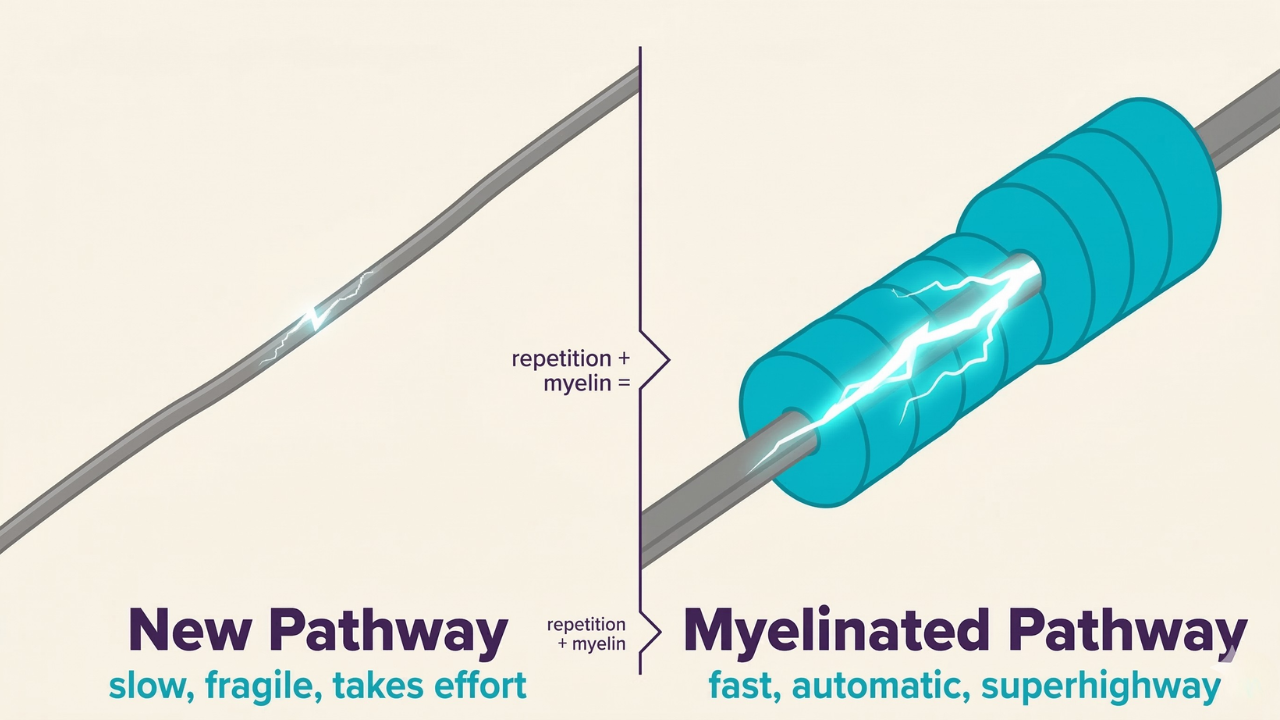
Think of the neural pathways in your brain like electrical wires. When you repeat a thought, a feeling, or a behavior over and over again, your brain wraps that specific wire in a thick layer of insulation called myelin. The more myelin a pathway has, the faster and more automatically the electrical signal travels.
When they dissected Albert Einstein’s brain, they expected to find something completely different in its structure. What they found was that his brain was heavily covered in myelin. He had fired specific circuits so intensely and so repeatedly that his brain was coated in thick insulation, allowing him to process complex thoughts automatically.
That’s you… having decades of practice at panic, shutdown, and people-pleasing — and wondering why a breathing exercise can’t override thirty years of neural insulation.
Right now, your Worst Day Cycle™ and Survival Persona are heavily myelinated. For decades, you have practiced panicking, shutting down, people-pleasing, or defending yourself. That neural pathway is a superhighway.
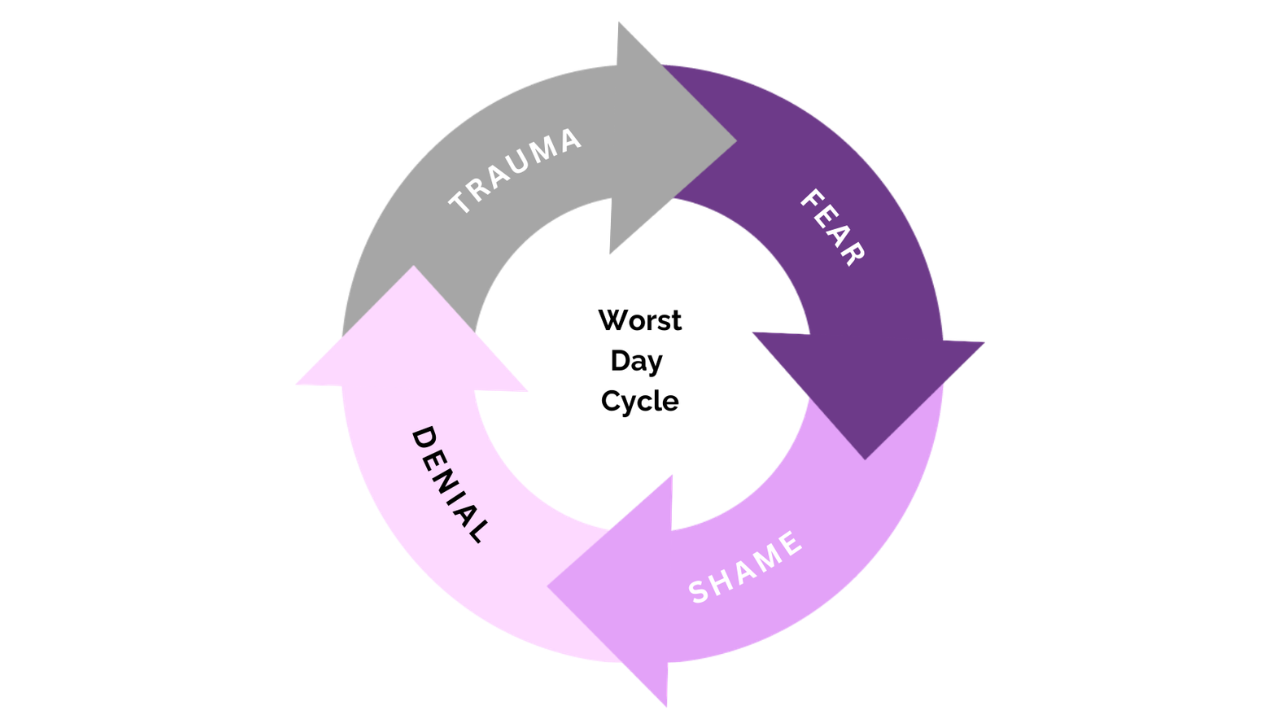
Therefore, you cannot wait until you are in the middle of a screaming match with your spouse to try to build a new neural pathway. That is like trying to learn how to fly a plane while the engines are on fire.
That’s you… trying to use your coping skills in the middle of a screaming match and wondering why they worked in the therapist’s office but not in your kitchen.
If you want metacognition to become your automatic response, you have to practice it in low-stress environments. You have to lay down the myelin when you are not triggered, so that when the catastrophe hits, your brain defaults to the Authentic Self instead of the Survival Persona.
Dr. Lisa Feldman Barrett’s neuroscience research confirms this: your brain is a prediction machine that conserves energy by defaulting to the most heavily myelinated pathways. It doesn’t choose the best response — it chooses the fastest one. Until you build enough myelin on the metacognitive pathway to make it faster than the survival persona pathway, your brain will keep choosing the old pattern.
What Does the Emotional Grocery Store Reveal About Your Childhood Blueprint?
To give you a visual of what living in metacognition actually looks like, I want you to imagine walking into a massive grocery store.
Right now, your emotional grocery shelves are fully stocked, but you did not pick any of the items. You spent your entire childhood in your mother’s grocery store or your father’s grocery store. Your cart is full of their unhealed trauma, their shame, their fear of conflict, and their conditional love. When you get triggered, you reach onto the shelf, grab your mother’s anxiety or your father’s anger, and you consume it. You are living from their emotional blueprint.
That’s you… going through your entire day running on your mother’s anxiety or your father’s rage without even knowing those items are in your cart.
Metacognition is the moment you walk into the grocery store, look at the shelves, and realize, “Wait a minute. I do not even like this. I did not put this here.”
Through metacognitive regulation, you empty the shelves. You clear out the inherited definitions of worthlessness and inadequacy. And then, you slowly begin to stock your own shelves. You decide what your morals, values, needs, wants, negotiables, and non-negotiables are. You become an observer of your own life. You pick up a boundary and say, “Yes, I want this on my shelf.” You pick up emotional transparency and say, “I will put this in my cart today.”
You stop reacting to the store you were placed in, and you become the owner of the store you are building.
That’s you… finally realizing you’ve been shopping in someone else’s grocery store for your entire adult life.
How Does the 5-Step Emotional Authenticity Method™ Build New Myelin and Rewire Your Brain?
How do we actually build the myelin, empty the shelves, and access metacognition daily? We use the Emotional Authenticity Method™.
I suggest setting an alarm on your phone to vibrate every 60 minutes. It does not matter if you are working, driving, or relaxing. When that alarm goes off, you are going to practice laying down the myelin of your Authentic Self.
Step 1: Somatic Down-Regulation for Nervous System Access (15 Seconds)
Stop what you are doing and just listen. What can you hear right now? The hum of the air conditioner? Traffic outside? Try to hear as many things as possible for 15 seconds. If you can go longer, do it. The longer the better. This instantly down-regulates your nervous system and pulls you out of your cognitive brain and into metacognition.
Step 2: Name the Core Emotion Using a Feelings Wheel
Look at a feelings wheel. The goal here is to increase your emotional language so that it becomes more granular and specific. Do not just say “stressed.” Are you feeling inadequate? Invisible? Abandoned? Rejected? Try to identify as many feelings as possible, then pick the strongest one.
That’s you… never having been taught the difference between “angry” and “invisible” — and realizing that naming the right feeling changes everything.
Step 3: Locate the Feeling in Your Body to Access Your Emotional Blueprint
Scan your body. Is it a knot in your stomach? Tightness in your throat? You have to connect somatically to the feeling because your body stores the trauma that is filling your grocery store shelves. Dr. Bessel van der Kolk’s research in The Body Keeps the Score proves that trauma lives in the body, not the mind — which is why you must get out of your head and into your somatic truth.
Step 4: Trace the Feeling to Your Earliest Childhood Memory
Follow the feeling back in time. Go right back to your childhood. You will discover that the anxiety you feel at work today is the exact same feeling you had when you were seven years old, trying to perform to get your parents’ attention. This separates the past from the present, and you can see how your perfectly imperfect parents stocked your shelves with their unhealed pain.
That’s you… tracing the anxiety you feel before every meeting back to the exact feeling you had when your father ignored you at the dinner table.
Step 5: Reconnect With Your Authentic Self Through Feelization
Ask, “Who would I be if I never had this thought or feeling again?” If this feeling of anxiety were completely wiped from the face of the earth, what would be left over? Who would you be? Can you see it and feel it? With your grocery store shelves cleared of your parents’ pain, you would feel lighter. You would feel peaceful, strong, and confident.
That’s you… feeling lighter, freer, and more grounded than you’ve felt in decades — because for the first time, you’re standing in your own grocery store.
That feeling right there? That is your Authentic Self. You are now in your own grocery store, ready to stock your shelves free from past pain, and lay down your new emotional blueprint. By doing this every hour, you are wrapping that new emotional blueprint neural pathway in myelin. You are becoming an expert in metacognition.
What Does the Absence of Metacognition Look Like Across Your Entire Life?
If you’re still wondering whether metacognition applies to you, let me show you what life without it looks like across every domain — because your childhood emotional blueprint doesn’t stay in one area. It stocks the shelves of every grocery store you walk into.
Family: You go home for the holidays and within thirty minutes, the Child Voice or the Shame Voice grabs the microphone. Your sibling makes a comment, your parent gives you that look, and suddenly you are shopping in your childhood grocery store again — grabbing defensiveness, people-pleasing, or silent withdrawal off the shelves your parents stocked decades ago. Without metacognition, you have no ability to see that the items in your cart aren’t yours.
That’s you… dreading the holidays because you know within thirty minutes you’ll be twelve years old again, buying items off your parents’ emotional shelves.
Romantic Relationships: Your partner says something dismissive and your Survival Persona hijacks the conversation. The Falsely Empowered type attacks or withdraws as punishment. The Disempowered type apologizes and over-explains. The Adapted Wounded Child does both in the same argument. Without metacognition, you cannot see that the argument isn’t about the dishes — it’s about the enmeshment pattern your childhood blueprint installed.
That’s you… knowing exactly what a healthy relationship looks like on paper and being unable to sustain one because your childhood grocery store keeps restocking itself.
Friendships: You either over-give until you burn out or keep everyone at arm’s length because vulnerability feels like handing someone a weapon. Your childhood emotional blueprint taught you that closeness equals danger, so your survival persona manages friendships like business transactions — useful, controlled, and never deep enough to threaten the shelves.
Work and Career: One critical email and the Shame Voice takes over. You either rage, overcompensate, or spiral into secret self-loathing. Your self-esteem was never built on authentic self-worth — it was built on performance, which means one piece of feedback can collapse the entire structure. Without metacognition, you cannot separate “this is constructive feedback” from “I am not good enough.”
That’s you… being the most competent person in the room but feeling like a fraud because your childhood Shame Voice is louder than any performance review.
Body and Health: Your body is the grocery store receipt — it records every item you’ve consumed from your parents’ shelves. Chronic jaw tension, gut issues, insomnia, and unexplained pain are your nervous system running childhood predictions 24/7. Dr. Gabor Maté’s research in When the Body Says No shows that this pattern of emotional suppression manifests as chronic illness and autoimmune disorders.
That’s you… your body running a childhood alarm system 24/7 while you try to override it with meditation apps and supplements.
What Is Your Next Step to Start Rewiring Your Brain?
It was not your fault or your parents’ fault, and you cannot control what happens to you in life, but through metacognition, you can choose to completely rewrite how your brain processes and responds to it. You can stop living as the wounded child or the shame-based survival persona, rewrite your emotional blueprint, stock your emotional grocery store shelves, and step fully into your adult, authentic self.
That’s you… ready to stop rearranging the items on your childhood grocery shelves and start building your own store from scratch.
If you are sitting there right now, feeling overwhelmed and needing immediate guidance, I have something that will really help you. Go to KennyWeiss.net and talk to my brand-new AI clone. I have uploaded my entire brain — every book, every framework, and every solution you need directly into this AI. It is completely free to use, and it is literally like having a one-on-one conversation with me. You can ask it about your triggers, your relationship struggles, or your Worst Day Cycle™, and it will give you the exact, root-cause feedback I would give you. Go test it out and get the help you need right now.
While you are there, you can also take the completely free Childhood Assessment to help you identify the exact emotional origins of your Worst Day Cycle™. For those of you who are ready to map out your specific triggers and stop this loop for good, check out the books, classes, emotional freedom assessments, and private coaching, and pick the one that fits where you are in your emotional blueprint remapping journey.
Whatever choice you make, just know that when you are ready, you now have a root-level solution, not a symptom-based topical band-aid approach, that will provide you with the root-level emotional regulation you are looking for.
And do not forget: You are not to blame, and you are not broken. You were just programmed, and programs can be rewritten. You did the best you could with the information you had at the time. But now that you know more, you can equip yourself with the tools to do more.
That’s you… finally understanding that metacognition isn’t another technique to add to your toolkit — it’s the operating system upgrade that makes every other technique unnecessary.
If This Article Hit Home, the Book Goes Deeper
Everything I write about on this site — the Worst Day Cycle™, your childhood emotional blueprint, why you keep repeating the same patterns no matter how hard you try — it all started with my first book, Your Journey To Success: How to Accept the Answers You Discover Along the Way.
This is the book readers call “the first time I found a roadmap I could actually understand and that seemed attainable.” It is the book that walks you through WHY your life hasn’t changed despite all the work you’ve done — and shows you, step by step, exactly how to break free. No fluff. No motivational hype. Just the truth about what was done to you, why it stuck, and what to do about it.
If you’ve read this far, you already know something needs to change. This book is where that change starts.
Ready to Stop Understanding the Problem and Start Rewiring It?
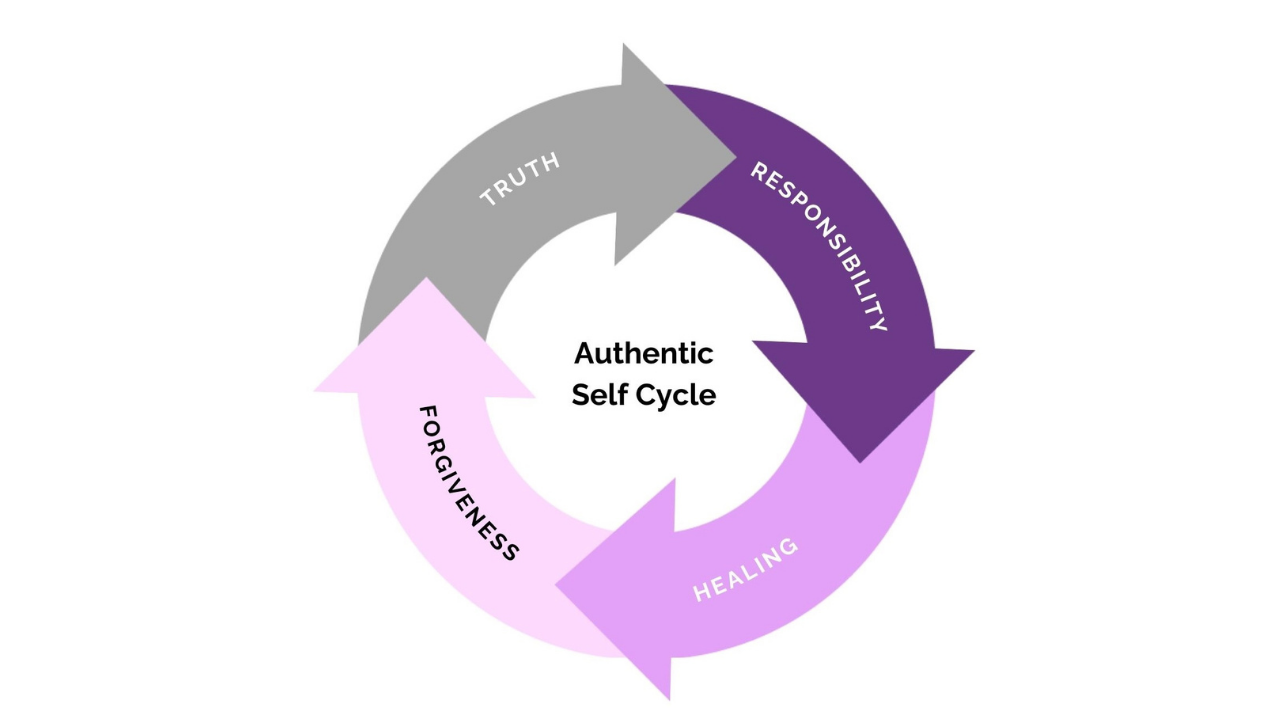
The article you just read scratches the surface. My new book, Your Journey To Being Yourself: How to Overcome the Worst Day Cycle & Reclaim Your Authentic Self with Emotional Authenticity, gives you the complete system — the Worst Day Cycle™, the Authentic Self Cycle™, and the full Emotional Authenticity Method™ — all in one place, with the neuroscience behind every step.
This is the book readers call “a genius piece of art in mastering emotion and the art of healing.” It speaks directly to the person who feels stuck, overwhelmed, and confused by the same repeating patterns — the same arguments, the same relationship breakdowns, the same shame — and is done accepting surface-level answers. Every chapter combines powerful stories, clear steps, and practical tools that show you how to rewire your emotional patterns from the inside out.
You are not broken. You were programmed. And this book shows you exactly how to rewrite the program.
Frequently Asked Questions
What is metacognitive emotional regulation and how is it different from Emotional Intelligence?
Metacognitive emotional regulation is the ability to observe your own emotional patterns in real time — to think about your own thinking — by activating the anterior prefrontal cortex. Emotional Intelligence teaches you to manage emotions using logic and cognitive strategies, but Dr. Lisa Feldman Barrett’s neuroscience proves that emotions drive thoughts, not the other way around. Metacognition sits between intellect and emotion, making it the only approach that can interrupt the Worst Day Cycle™ at the source.
What is myelin and why does it make changing emotional patterns so difficult?
Myelin is the biological insulation that wraps around neural pathways when you repeat a thought, feeling, or behavior. The more you practice a pattern — including panic, people-pleasing, or shutting down — the thicker the myelin becomes and the faster the signal travels. This is why your survival persona reactions are instant and automatic. The Emotional Authenticity Method™ builds new myelin on metacognitive pathways through hourly practice, gradually making the Authentic Self response faster than the survival persona response.
Why can’t I think my way out of an emotional trigger?
Because your triggers originate from your childhood emotional blueprint — a set of neural pathways that were formed before you had language or logic. Your brain predicts danger based on past emotional experiences, and by the time you have a conscious thought about the trigger, the cortisol and adrenaline have already flooded your system. The survival persona pathway is heavily myelinated from decades of repetition. No amount of cognitive reframing can override a neural superhighway. You need metacognition to build an entirely new pathway.
What is the Emotional Grocery Store and how does it relate to childhood trauma?
The Emotional Grocery Store is Kenny Weiss’s metaphor for your emotional blueprint. Your shelves were stocked in childhood with your parents’ unhealed pain — their anxiety, their anger, their shame, their conditional love. Every time you get triggered, you reach onto those shelves and consume their emotional products. Metacognition is the moment you look at the shelves and realize, “I didn’t put this here.” The Emotional Authenticity Method™ helps you empty the inherited items and restock with your own morals, values, and authentic emotional responses.
How long does it take to build new myelin and rewire emotional patterns?
Meaningful change begins within 2-4 weeks of practicing the Emotional Authenticity Method™ every 60 minutes. Each practice session lays down a thin layer of myelin on the new metacognitive pathway. Over 3-6 months of consistent practice, the new pathway becomes thick enough to compete with the old survival persona pathway. Eventually, metacognition becomes your automatic response — not because you forced it, but because you myelinated it. The Worst Day Cycle™ doesn’t disappear overnight, but it weakens every time the new pathway fires.
What are the Three Voices and how do they relate to the survival persona?
The Three Voices are the Child Voice (fear, helplessness, neediness), the Shame Voice (self-attack, absolutes, identity-level criticism), and the Adult Voice (calm, grounded, metacognitive awareness). The Child Voice and Shame Voice combine to create the Survival Persona — which takes one of three forms: the Falsely Empowered type (control, rage, dominance), the Disempowered type (collapse, people-pleasing, self-abandonment), or the Adapted Wounded Child (oscillating between both). Metacognition is the process of handing the microphone back to the Adult Voice — your Authentic Self.
The Bottom Line
You have been trying to change your life using the same brain wiring that created the problem. Every cognitive reframe, every positive affirmation, every “just breathe” technique was running on the survival persona’s heavily myelinated superhighway — which is exactly why it felt like pushing a boulder uphill.
The fact that you’ve read this far tells me something important about you. It tells me you’re not looking for another technique to add to the shelf. Something in you recognized that the grocery store you’ve been shopping in was never yours — and you want your own. That recognition is metacognition. That recognition is your Adult Voice breaking through the noise of the Child and the Shame.
Here’s what becomes possible when you build enough myelin on the metacognitive pathway: You stop reacting and start observing. You stop consuming your parents’ emotional products and start stocking your own shelves. You stop letting the survival persona grab the microphone and start speaking from the calm, grounded truth of your Authentic Self. Not because you tried harder — but because you built new brain wiring that makes authenticity automatic.
You are not broken. You are not “too emotional” or “too reactive.” You were wired by a childhood blueprint that did the best it could — and wiring can be rewired. When you’re ready, the Emotional Authenticity Method™ will meet you exactly where you are.
Recommended Reading
These books deepen the neuroscience of metacognition, myelin, and why traditional approaches cannot reach the childhood emotional blueprint:
Lisa Feldman Barrett — How Emotions Are Made
The foundational neuroscience proving that emotions are predictions that drive thoughts — essential for understanding why Emotional Intelligence operates on a fundamental flaw.
Bessel van der Kolk — The Body Keeps the Score
How trauma is stored somatically and why metacognition must include body awareness to access the emotional blueprint where triggers originate.
Gabor Maté — When the Body Says No
The physical cost of living without metacognition — how suppressed childhood emotions manifest as chronic illness and autoimmune disorders.
Pete Walker — Complex PTSD: From Surviving to Thriving
Understanding the survival responses that childhood programming creates — the voices that metacognition helps you observe and ultimately transcend.
Take Your Next Step With Kenny Weiss
If this article resonated with you and you’re ready to build new myelin on the metacognitive pathway and rewire your childhood emotional blueprint, explore these resources:
Start Here:
• Emotional Blueprint Starter Course — Individual ($79) — Your individual roadmap for identifying your Worst Day Cycle™ patterns, your survival persona type, and the grocery store shelves you inherited
• Relationship Starter Course — Couples ($79) — Map how both partners’ childhood emotional blueprints collide in relationship conflict
Go Deeper:
• Why We Can’t Stop Hurting Each Other ($479) — Understand the Worst Day Cycle™ collision between two survival personas
• Why High Achievers Fail at Love ($479) — For the Falsely Empowered survival persona who intellectualizes instead of feeling
• The Shutdown Avoidant Partner ($479) — Root-cause work for avoidant attachment patterns and emotional withdrawal
Full Transformation:
• Tier 1: Mapping the Blueprint ($1,379) — The comprehensive program for building metacognition and rewiring your childhood emotional blueprint
Download Kenny’s free Feelings Wheel to begin building emotional granularity — the foundation of Step 2 of the Emotional Authenticity Method™.
Explore Kenny’s articles on signs of enmeshment, insecurity in relationships, signs of high self-esteem, and 10 do’s and don’ts for a great relationship for more on how your childhood emotional blueprint shapes every area of your life.