

You sit across from your partner, furious. They did it again — the thing you’ve told them a hundred times bothers you. You want to scream. You want to leave. But something in you freezes. You swallow it. You tell yourself it’s not a big deal. And later that night, you feel a familiar emptiness you can’t explain.
That’s you — abandoning yourself to keep the peace. Again.
That’s not compromise. That’s self-abandonment. And it’s happening because you’ve never clearly defined the difference between what’s negotiable and what’s non-negotiable in your life.
Codependence recovery starts with knowing your morals and values — and then using them to determine your negotiables and non-negotiables. Without this foundation, you end up in relationships with people who violate your core beliefs, and then you blame them for behavior that was there from the beginning. The negotiables/non-negotiables exercise is one of the most powerful tools for reclaiming yourself from codependent patterns and building relationships that actually honor who you are.
In this article, I’ll walk you through exactly what negotiables and non-negotiables are, why most people have never done this work, how codependence keeps you stuck in relationships that violate your values, and the step-by-step process to change it.
TL;DR: Codependence recovery requires knowing your morals, values, negotiables, and non-negotiables. Most people skip this foundational work and end up in relationships with partners who violate their core beliefs — then blame the partner instead of taking ownership. The process starts with two lists and honest self-examination, but lasting change requires healing the emotional blueprint that made you abandon yourself in the first place.

Why Do You Need to Know Your Negotiables and Non-Negotiables?
Before you can determine what’s negotiable and what’s not, you must know your morals and values. This is the prerequisite that most people skip — and it’s the reason their relationships keep falling apart.
If you don’t have a North Star — if you don’t know what you value — how do you know if something is negotiable in your life or not? You can’t. You’re making decisions from your emotional blueprint instead of from your Authentic Adult. And your blueprint’s primary goal isn’t to honor your values. It’s to avoid abandonment at any cost — even the cost of yourself.
That’s you — saying yes when your whole body is screaming no. Agreeing to things you don’t want. Tolerating behavior that makes your stomach turn. Telling yourself “it’s fine” while your nervous system is on fire.
That’s your survival persona running your relationship, not your Authentic Adult. And until you understand the difference, your negotiables and non-negotiables don’t stand a chance.

What Is a Negotiable?
A negotiable is something you’re willing to compromise on. While you may have a strong opinion, another person’s beliefs or preferences can move you. It may not be perfect, but it doesn’t go against your morals and values. It doesn’t violate your belief system. It lives in the gray area — the space where healthy flexibility exists.
Examples of negotiables in a relationship: how clean your partner keeps the house, how often someone has a drink, food preferences, table manners, hobbies, activities. There’s an amount you’re willing to accept because it doesn’t cross a core line.
That’s you — the part of you that knows the difference between preference and principle. Between “I’d rather not” and “I absolutely cannot.”
This framework applies to every area of your life — relationships, career, friendships, parenting. Knowing what’s negotiable gives you the flexibility to connect with imperfect humans (which is all of us) without losing yourself.
What Is a Non-Negotiable?
A non-negotiable is something that flat-out goes against your values or your belief system. You won’t sacrifice your beliefs on this — period. It’s not up for discussion, and it shouldn’t be.
An example for me: I’m a recovering alcoholic. Someone wanting a drink once a week? That’s negotiable for me. Beyond that? Non-negotiable. Any drugs? Non-negotiable. I want someone who is fully present.
And here’s what matters: this doesn’t make me right. It’s just mine. You get to have yours. Yours could be the complete opposite — and that’s exactly what I want you to look at so you can honor it.
If we allow a non-negotiable behavior into our life and then get upset about it, we are actually angry at ourselves — not the other person. Going against our non-negotiables is what destroys people in relationships. It’s the deepest form of self-betrayal.
That’s you — the rage you feel at your partner that’s actually rage at yourself for tolerating what you swore you never would.
Watch the full video: Codependence does not feel like “codependence” from the inside — it feels like love, loyalty, or being a good person. My video The Brutal Reality of Being Codependent unpacks the daily experience most people never name out loud.
How Does Codependence Keep You From Honoring Your Non-Negotiables?
Here’s where it gets real. Most people have never sat down and looked at their morals, values, negotiables, and non-negotiables. As a result, they end up in relationships with people they shouldn’t be with — and then blame the other person when things fall apart.
Because of codependence, we blame our partner when they engage in non-negotiable behaviors. But most of the time, those behaviors were there from the outset. We saw the signs early on but refused to own it. That’s codependence.
We get caught up in an immature, blueprint-driven way of selecting people. We end up married to someone with five non-negotiable things — and that’s not their fault. It’s ours. Many say, “Well, I didn’t know!” But most people don’t sit down and discuss their morals and values with their partner. And we need to.
That’s you — choosing the same person in a different body, over and over, because your blueprint keeps selecting for familiarity instead of health.

The Three Survival Personas That Sabotage Your Non-Negotiables
Your survival persona — the protective identity you built in childhood to stay safe — shows up in one of three forms, and each one destroys your non-negotiables differently:
The Falsely Empowered survival persona puts up walls instead of boundaries. They control, dominate, and demand — not because they’re honoring their values, but because they’re terrified of being vulnerable. Their “non-negotiables” are often power plays disguised as principles.
That’s you — if you’ve ever confused controlling your partner with protecting yourself.
The Disempowered survival persona has no boundaries at all. They give everything away — their time, their body, their values — hoping that if they sacrifice enough, they’ll finally be loved. They don’t even know what their non-negotiables are because they’ve never been allowed to have any.
That’s you — if you’ve ever said “I don’t care, whatever you want” when you actually cared deeply.
The Adapted Wounded Child survival persona swings between both. Sometimes they rage and control. Sometimes they collapse and comply. Neither version is their Authentic Adult — and neither version can hold a non-negotiable.
That’s you — if you’ve ever exploded at your partner one day and then apologized and gave in the next, hating yourself both times.
The Worst Day Cycle™: Why You Keep Violating Your Own Values
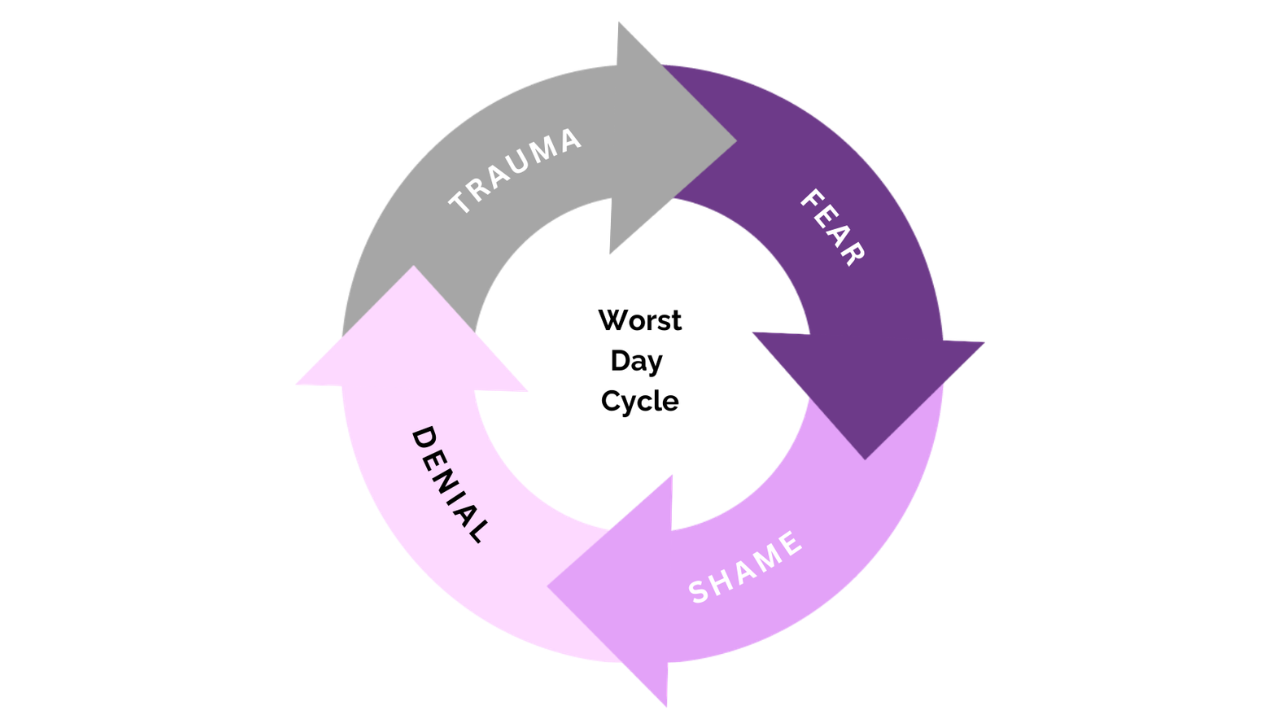
This is the Worst Day Cycle™ in action — and it’s the engine that keeps codependence running:
The trauma of childhood emotional abandonment creates fear of being alone. That fear creates shame about having needs — because in your family, having needs meant being too much, being a burden, being rejected. That shame creates denial about what you’re actually tolerating. And denial keeps you in relationships that violate your core self — blaming everyone but yourself for the pain.
Fear → Shame → Denial. Round and round. Every relationship. Every time.
That’s you — the knot in your stomach that you’ve learned to ignore. The voice that whispers “something is wrong here” that you’ve trained yourself to silence.
 childhood trauma creates fear of abandonment, shame about needs, and denial of boundary violations in codependent relationships" title="Worst Day Cycle™ — Kenny Weiss" loading="lazy" width="600" />
Codependent people almost always allow people, places, and things into their lives that go against what they believe. They are responsible for that, yet they project the blame onto others. Recovery begins when you take ownership of this pattern.

Watch the full video: Every time you swallow a truth to keep someone close, you are reinforcing the original childhood wound. I explain exactly how that loop formed in The Shocking Truth About Abandonment Trauma.
Signs You’re Violating Your Non-Negotiables (By Life Area)
In Your Family
You tolerate behavior from parents or siblings that you would never accept from a stranger. You attend family events that leave you emotionally destroyed. You let family members cross lines you set years ago because “they’re family.” You feel guilty for even thinking about setting a boundary with your mother or father.
That’s you — if the holidays feel more like a hostage situation than a celebration.
In Your Romantic Relationship
You stay with someone who does things that go against your core beliefs. You’ve told them it bothers you dozens of times, but nothing changes — and you stay anyway. You’ve stopped bringing up the things that matter most because it always turns into a fight. You feel more alone in the relationship than you did when you were single.
That’s you — if you’ve ever looked at your partner and thought, “How did I end up here?” The answer is: your blueprint chose them, not your Authentic Adult.
In Your Friendships
You have friends who drain you. You say yes to plans you don’t want to attend. You listen to gossip that violates your values. You keep people in your life because you’ve known them forever — not because they honor who you are today.
That’s you — if “being a good friend” has become code for abandoning yourself.
At Work
You tolerate a boss or colleague who treats you in ways that violate your values. You stay in a job that makes you sick because you’re afraid of the unknown. You don’t speak up in meetings because you learned early that your voice doesn’t matter. You over-perform and under-ask because asking for what you need feels dangerous.
That’s you — if your career has become another relationship where you abandon yourself to belong.
In Your Body and Health
Your body keeps the score of every non-negotiable you’ve violated. The chronic tension in your shoulders. The stomach problems. The insomnia. The exhaustion that sleep doesn’t fix. The autoimmune flare-ups that spike every time you swallow another truth.
As Dr. Gabor Maté writes in When the Body Says No, the body speaks what the mouth cannot. When you consistently override your values to maintain a relationship, your nervous system pays the price. The headaches, the jaw clenching, the gut issues — those aren’t random. They’re your body’s way of saying what your survival persona won’t let you say out loud.
That’s you — if your body has been trying to tell you something for years that you keep refusing to hear.
How Do You Determine Your Negotiables and Non-Negotiables? (Step-by-Step Process)
Here’s the exercise — and it will change your life if you actually do it:
Step 1: Make two columns. On one side, write “Negotiable.” On the other, “Non-Negotiable.”
Step 2: List every area of your life. What are your morals and values around: drugs and alcohol, politics, religion, relationships, intimacy, communication styles, parenting approaches, career values, friendships, hobbies, financial habits, family involvement, personal growth, health and wellness? Put every area of life on the list.
Step 3: For each area, decide — is this negotiable or non-negotiable? Be honest. Not what you think you should say. Not what your partner would want you to say. What is actually true for you? Where does your Authentic Adult draw the line?
Step 4: Review your current relationships against the list. Are there non-negotiables being violated right now? Are there patterns of self-betrayal you’ve been denying? This is where truth meets reality — and it can be uncomfortable. That discomfort is the beginning of healing.
That’s you — the moment you realize the problem isn’t that your partner won’t change. It’s that you keep choosing to stay in a dynamic that requires you to betray yourself.
By employing this process, we begin healing codependence, having the relationships we actually want, and achieving our life goals. Conversely, if we skip this process, we have no shot.
The Deeper Work: Why Your Emotional Blueprint Keeps Overriding Your Non-Negotiables
You might do the exercise above and know exactly what your non-negotiables are — and still violate them in your next relationship. That’s not a willpower problem. It’s a blueprint problem.
Your emotional blueprint was programmed in childhood to prioritize connection over truth, safety over integrity, belonging over self-respect. When your nervous system is terrified of abandonment, it will override your conscious values every single time. You’ll find yourself saying “it’s fine” when it’s not, tolerating behavior that violates everything you believe, and then hating yourself for it.
That’s you — knowing exactly what you should do and doing the opposite, every single time, and hating yourself for it.

This is where the Emotional Authenticity Method™ becomes essential. The 5-step process interrupts the blueprint in real time — when you’re about to abandon yourself for the sake of keeping someone close:

Step 1: Somatic Down-Regulation. When you feel the pull to say “yes” when you mean “no” — pause. Focus on what you can hear for 15–30 seconds. Let your nervous system settle before your survival persona takes over.
Step 2: What am I feeling right now? Not “what do they want me to feel” — what is actually true? Use the Feelings Wheel to find precision. Most of us can only name three or four feelings. Your Authentic Adult needs more vocabulary than that.
Step 3: Where in my body do I feel it? The tightness, the nausea, the collapse — your body knows before your mind does. This is where Gabor Maté’s work becomes real: the body is always telling the truth, even when the survival persona is lying.
Step 4: What is my earliest memory of this exact feeling? The urge to abandon yourself to keep someone? You’ve done it before. Usually with a parent. That’s the original wound — the moment your blueprint learned that your values don’t matter as much as someone else’s comfort.
Step 5: Who would I be if I never had this feeling again? This connects you to your Authentic Adult — the one who can hold the non-negotiable even when the adapted wounded child is terrified of being abandoned for it.
Watch the full video: Feeling rejected whenever someone has a need of their own is a telltale sign you are running a codependent blueprint, not an adult one. My video Feeling Rejected? Then You Are a Codependent breaks down the exact internal experience.
What Does Codependence Recovery Actually Look Like?
Before: Your partner does something that crosses your non-negotiable line. Your body tightens. Your survival persona whispers: “Don’t make a big deal out of it. They’ll leave if you say something.” You swallow it. You smile. And something inside you dies a little more.
After: Your partner does the same thing. Your body tightens. You notice it. You pause. You use the Emotional Authenticity Method™. You trace the feeling back to childhood — to the moment you learned that speaking your truth meant losing love. And then your Authentic Adult speaks: “This is a non-negotiable for me.” Calmly. Without rage. Without apology. And whatever happens next, you know you honored yourself.
That’s the difference between managing codependence and healing it.
This is the Authentic Self Cycle™ in action — Truth → Responsibility → Healing → Forgiveness. You told the truth about what you need. You took responsibility for honoring it. The healing begins. And eventually, you forgive yourself for all the years you didn’t.

 How to Heal from Codependency — The Authentic Self Cycle with Kenny Weiss
Recommended Reading for Codependence Recovery
The negotiables/non-negotiables exercise is the beginning, not the end. These books go deeper into the patterns that keep you abandoning yourself:
Facing Codependence by Pia Mellody — The definitive guide to understanding how childhood trauma creates codependent patterns. Mellody’s work on the “carried feelings” of shame and the boundary distortions of codependence is foundational to everything I teach.
When the Body Says No by Dr. Gabor Maté — The science behind why your body breaks down when you consistently override your values. If you’ve ever wondered why you’re always sick, tired, or in pain despite “doing everything right” — this book explains the connection between self-abandonment and physical illness.
Codependent No More by Melody Beattie — The classic that brought codependence into mainstream awareness. Beattie’s practical guidance on detachment and self-care remains essential for anyone in early codependence recovery.
The Gifts of Imperfection by Brené Brown — Brown’s research on shame, vulnerability, and worthiness connects directly to why we abandon our non-negotiables. When shame tells us we’re not enough, we’ll tolerate anything to avoid being alone.
The Bottom Line
No one gets into your life unless you allow it. No one violates your non-negotiables unless you let them. And no one can heal the pattern of self-abandonment except you.
That’s not blame. That’s power. Because if you created this pattern — unconsciously, from a blueprint you didn’t choose — then you can also change it. Consciously. One non-negotiable at a time.
The person inside you who knows exactly what they value — who knows where the line is — has been waiting their whole life to be heard. They’ve been buried under years of survival, under a childhood that taught them their truth was dangerous, under relationships that confirmed it.
But they’re still there. And they’re ready.
That’s you — the version of you that’s been waiting to finally say “no more” and mean it.
Frequently Asked Questions About Negotiables, Non-Negotiables, and Codependence Recovery
What if my partner disagrees with my non-negotiables?
That’s their right — and it’s important information. A non-negotiable isn’t a demand you impose on someone else. It’s a boundary you hold for yourself. If your partner’s behavior consistently violates your non-negotiable, the question isn’t how to change them. It’s why you’re staying in a dynamic that requires you to abandon yourself. This is codependence recovery work at its core — choosing yourself even when your survival persona is terrified of losing the relationship.
How do I know if something is truly a non-negotiable or if I’m being controlling?
A genuine non-negotiable protects your morals and values. Controlling behavior tries to manage another person’s choices to reduce your anxiety. The test: Does this boundary exist because it honors who you are at your core? Or does it exist because you’re afraid of what might happen if you don’t control the situation? One comes from your Authentic Adult. The other comes from your survival persona — usually the falsely empowered type that confuses walls with boundaries.
Can non-negotiables change over time?
Yes — as you do deeper recovery work and your emotional blueprint heals, some things that felt non-negotiable may soften because they were driven by fear rather than values. And some things you thought were negotiable may become non-negotiable as you gain more self-respect. The lists should be revisited regularly as part of ongoing codependence recovery. Growth means your relationship with your own values evolves.
What is the first step in codependence recovery?
The first step is getting into reality — which means acknowledging that you have been allowing people, places, and things into your life that go against your core beliefs, and that you are responsible for that pattern. This is the Truth step of the Authentic Self Cycle™. From there, you do the negotiables/non-negotiables exercise, and you begin the deeper emotional blueprint work that makes it possible to actually honor what you discover.
What’s the difference between a boundary and a non-negotiable?
A boundary is the action you take to protect a non-negotiable. Your non-negotiable is the value — “I will not be in a relationship with someone who uses drugs.” The boundary is what you do when that value is violated — you leave, you speak up, you follow through. Most codependent people know their non-negotiables but have never been taught how to hold a boundary. The survival persona either builds walls (falsely empowered) or has no boundaries at all (disempowered). The Emotional Authenticity Method™ Method™ teaches you how to hold boundaries from your Authentic Adult.
Why do I keep ending up with the same type of person?
Because your emotional blueprint selects for familiarity, not health. Your nervous system is wired to seek out the emotional dynamics of your childhood — even when those dynamics are painful. The Worst Day Cycle™ explains this: fear of abandonment drives you toward anyone who triggers the familiar dance of pursuit and withdrawal, over-giving and under-receiving. Until you heal the blueprint, you’ll keep choosing the same person in a different body. The negotiables/non-negotiables exercise gives you a conscious checklist to override the unconscious pull.
Your Next Step: Do the Exercise
Once we own that no one gets into our life unless we allow it — fully, without blame — everything changes.
Free resources to start right now:
Download the Feelings Wheel — the foundation for identifying what you’re actually feeling when you’re about to abandon your non-negotiables. And take the Codependence Blueprint Questionnaire to see exactly how deep your codependent patterns run across every area of your life.
Go deeper with structured courses at The Greatness U:
Emotional Blueprint Starter Course — Individual ($79) — Your personal roadmap to identifying your morals, values, and emotional blueprint. This is where the negotiables/non-negotiables exercise becomes a living practice instead of a one-time list.
Emotional Blueprint Starter Course — Couples ($79) — Work through negotiables and non-negotiables together as a couple with a structured framework. Discover where your values align, where they conflict, and how to navigate the differences without self-abandonment.
Why We Can’t Stop Hurting Each Other ($479) — A deep-dive into the codependent dynamics that keep you violating your own values. Understand the Worst Day Cycle™ that drives the pattern and learn how to interrupt it.
Tier 1: Mapping Your Blueprint ($1,379) — The comprehensive program for full codependence recovery and emotional blueprint healing. This is where you don’t just identify your non-negotiables — you develop the capacity to hold them.
You’re not broken. You’re trauma-trained. And the person inside you who knows exactly what they value — who knows where the line is — is waiting to be heard.