

Every self-help book has lied to you about self-sabotage. It is not a willpower problem. It is not a discipline problem. It is not a mindset problem. Childhood shame self-sabotage is the most loyal thing you have ever done for yourself — you have just been doing it for the wrong person since you were three years old.
You know the moment. The promotion is six weeks in and suddenly you are showing up late. The relationship is finally healthy and you pick the fight you swore you would never pick again. The body feels good for the first time in years and you reach for the bottle, the bag, the phone, the person you already know is wrong for you. You watch yourself do it. You hear the voice saying do not send this text, do not skip this workout, do not blow this up — and you do it anyway.
That’s you, isn’t it. Take a slow breath in. Notice your shoulders. Notice your jaw. Notice the place you have been holding this for a long time. You are not crazy and you are not broken. You are running an emotional program that was installed in your nervous system before you ever had language — and no one has ever named it for you correctly.
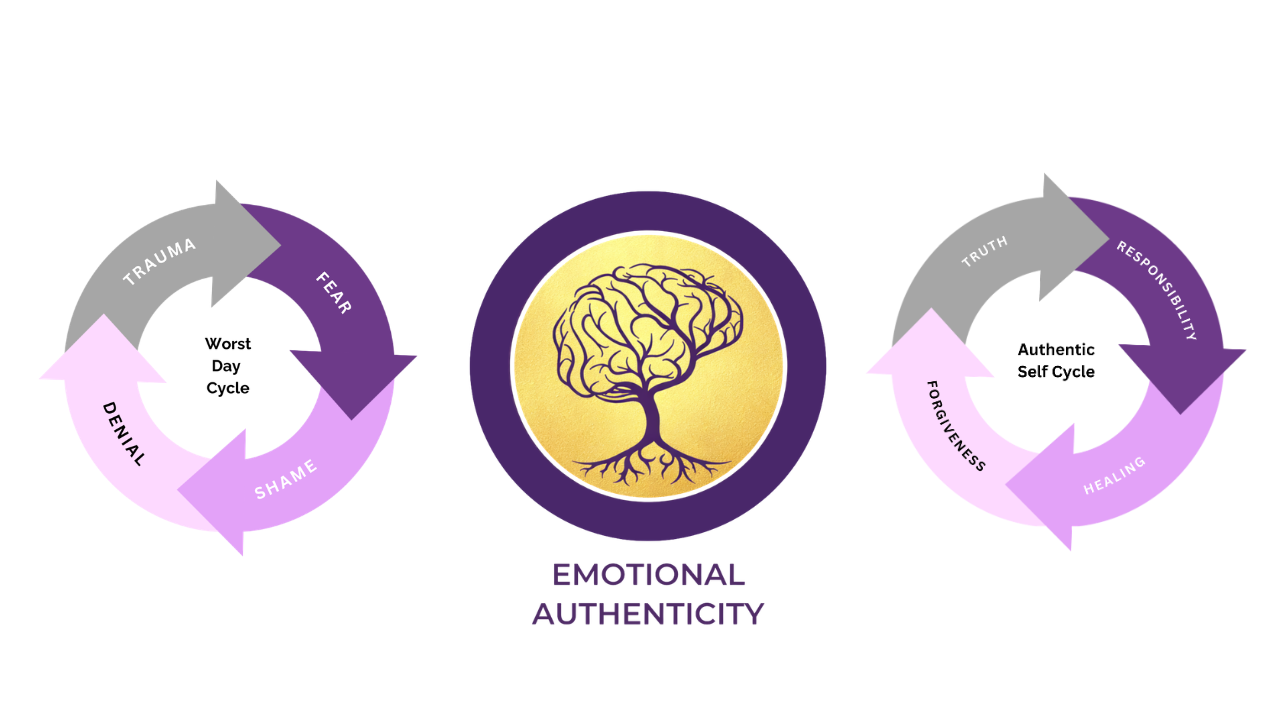 Emotional Authenticity Method™ Method, Authentic Self Cycle frameworks combined" width="600" />
The Pattern: What Childhood Shame Self-Sabotage Actually Looks Like
Self-sabotage rarely announces itself. It dresses up as a thousand small choices that look reasonable in the moment and only reveal themselves in the rearview mirror.
It is the email you do not send the day before the meeting that would change your career. It is the deep breath you take before saying the thing that ruins the dinner. It is the gym bag you packed last night that you walk past in the morning. It is the second drink you swore you would not order. It is the one-night-stand text to the person you finally got out of your life. It is the silence in the marriage when you know exactly what your partner needs you to say.
That’s you watching yourself do it.
And here is the part nobody names correctly: the destruction is most violent right after something good happens. Six weeks into the promotion. Three months into the sober streak. Two weeks after the partner finally said the thing you had been waiting your whole life to hear. The body that has been calibrated to chaos cannot tolerate stable goodness. It reads warmth as a setup. It reads peace as the prelude to abandonment. The nervous system goes looking for something familiar to anchor to — and the only thing familiar is pain.
So you reach for it. Not because you want to fail. Because you have to get back to known territory, and known territory is the original wound.
What’s Really Going On: The Childhood Shame Engine
As a child, you had absolutely no power. You could not argue with your parents. You could not regulate the emotional climate of your house. You could not decide whether love showed up that day or got withheld. You could not protect yourself from a tone, a silence, a slammed door, a parent’s depression, a sibling’s cruelty, or the feeling of being invisible at the dinner table.
That powerlessness was not a thought. It was a chemical event. It got recorded into your nervous system as a defining emotional reality — your emotional blueprint — and your brain became chemically addicted to the feeling of not liking yourself.
You did not consent to this. You could not have stopped it. Anytime you have a negative emotional experience in childhood — and there are millions of them — it creates a small spark inside the nervous system. Stack enough sparks and you have a fire. The fire is the Worst Day Cycle™. The fire is what we now call the childhood shame engine — the chemical machinery that takes a moment of powerlessness and turns it into a permanent identity.
And here is the brutal mechanism. Your brain consumes roughly 25% of every calorie you eat. That is an enormous metabolic cost. So your brain developed a survival rule: repeat what is already known. Novel experiences cost energy. Familiar patterns are cheap. Your brain does not care if a pattern is good for you — it only cares whether it is known. So when you encounter something new — a healthy partner, a calm home, a stable income, an honest conversation — your brain flags it as expensive and unfamiliar, and steers you back toward the cheaper, hotter, more chaotic program it has run since childhood. Your brain is not sabotaging you. It is budgeting. And the budget always favors the familiar over the healthy.
That’s you, in your relationships, in your career, in your body — running a 30-year-old program because your nervous system has not been told the threat is over.
The Worst Day Cycle™ — Trauma, Fear, Shame, Denial
The childhood shame engine runs on a four-stage loop. I call it the Worst Day Cycle™ because it is the cycle you secretly relive on the worst day of your life — and the cycle most people are still running on the average Tuesday afternoon without realizing it.
Stage 1 — Trauma. The original imprint. I cannot make my own decisions. I cannot stand up for myself. My needs do not matter. I am too much. I am not enough. The trauma installs the alarm system.
Stage 2 — Fear. Hypervigilance. Mood-scanning. Giving yourself away to read the room. Becoming whatever the household needed you to be in order to remain attached. That’s you scanning your partner’s face for micro-expressions, re-reading the text, asking the same question three different ways.
Stage 3 — Shame. Powerlessness becomes identity. Not I did something bad — but I am bad. The shame voice tells you that you are defective for feeling this way. Shame is the only emotion that attacks the self.
Stage 4 — Denial. The whisper that keeps the cycle running. It was just bad luck. I’ll do better next time. It is not actually my past running my present. Denial is what guarantees the next loop.
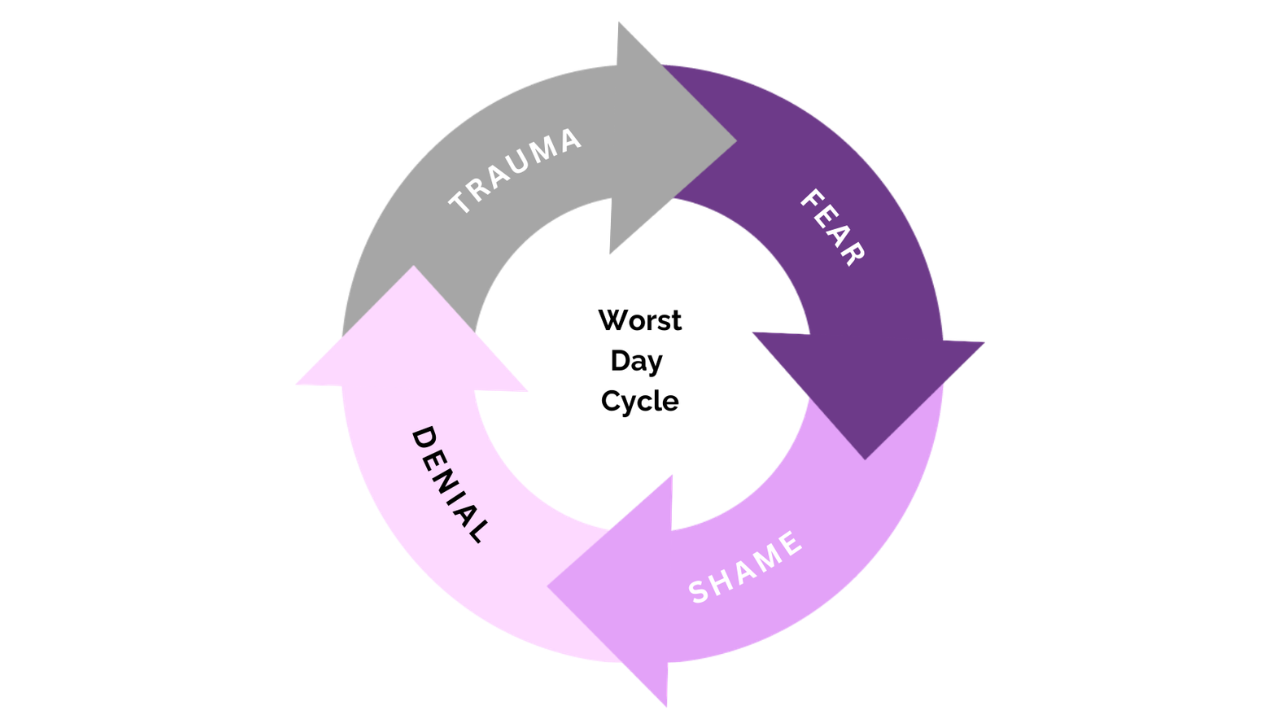
That’s you waking up every morning at the bottom of a cycle you did not start, blaming yourself for not being able to outrun a wheel that is bigger than you.
You’re Not Afraid of Failure — You’re Afraid of Success
This is the line that breaks people, so I am going to say it twice. Nobody on this planet has ever been afraid to fail. The proof is in the mirror. Every time you choose not to do the thing you know you need and want to do — the call you do not place, the workout you skip, the boundary you do not hold, the truth you do not speak — you are choosing failure. You are perfectly comfortable with it.
So if we are choosing failure, what are we actually afraid of? Success.
Because if you actually do the thing, you will get what you say you want. You will achieve it. You will be loved. You will be seen. You will be free. And here is the cruel part — your brain and body cannot tell the difference between fear and excitement. There is no chemical signature difference. The same surge that fires when a tiger appears at the edge of the cave fires when your authentic life appears at the edge of becoming real.
That is why athletes win the championship and blow up their lives. That is why entrepreneurs build the empire and burn it down. That is why people meet the partner they actually deserve and start a fight on the third date. The success surge gets read by an unrewired nervous system as identical to the original childhood threat. So the system pulls the emergency brake — and the emergency brake is the original blueprint. I cannot have my needs. I cannot speak my truth. I cannot live my life. I am powerless.
Now answer one question. Now that you are an adult, what is the fastest way for a formerly powerless child to get power back? Choose things that do not work. Pick the bad partner. Take the dead-end job. Pick the binge. Pick the blowup. Because at least this time, I chose it.
That is not weakness. That is not stupidity. That is the only form of agency a formerly powerless child ever found. It is brilliant. And it is destroying your life.

The Three Survival Personas Driving the Sabotage
The childhood shame engine does not run in a vacuum. It runs through a survival persona — the version of you that you built as a child to stay attached to your caregivers when staying authentic was not safe. There are three.
1. The Falsely Empowered Survival Persona
This is the one who controls, dominates, rages, intimidates, performs perfection, and weaponizes competence to avoid feeling vulnerable. This is the version that destroys success by becoming impossible to be in a relationship with — by exploding at the partner, by alienating the team, by creating crises that justify the rage. That’s you when the storm is in your hands and you are scaring the people you love. This persona is one of the two types of codependents Kenny Weiss writes about — the falsely empowered codependent who looks strong on the outside while a terrified child runs the operation underneath.
2. The Disempowered Survival Persona
This is the one who collapses, people-pleases, over-functions, apologizes for existing, and becomes whatever the room needs in order to belong. This is the version that destroys success by giving it away — by under-charging, by over-helping, by saying yes when every cell in the body is screaming no, by dimming light to keep the partner comfortable. That’s you bracing on the inside while smiling on the outside, exhausted from carrying a relationship that has never carried you.
3. The Adapted Wounded Child
This is the one that swings between the other two depending on who is in the room. Falsely empowered with the kids, disempowered with the spouse. Falsely empowered at work, disempowered at home. Falsely empowered when angry, disempowered when scared. The Adapted Wounded Child is what most people actually live as — a moving target of survival strategies, all of them ancient, none of them the real you. That’s you wondering why you feel like a different person in every relationship.

The survival persona is brilliant. It kept you alive in a household where authenticity was punished. It earned the only love available. It is not the enemy. It is a child’s strategy still running the adult’s life — a finger-painting set being asked to paint a mural. The skills do not match the requirements. And yet, when success starts to show up, the survival persona panics. It panics for two reasons most people will never name — and naming them is the doorway out.
Why the Survival Persona Panics at Success (The Two Hidden Mechanisms)
This is the part of the teaching that takes the longest for people to feel in their body. So read it slowly.
Mechanism 1: If You Succeed, You Lose Connection to Mom and Dad
The survival persona was not built for nothing. It was built to fit the family system. It learned the exact shape of love that was on offer — the chaos, the silence, the rage, the depression, the absence — and it became whatever was required to receive even a fraction of it. It is the only key that ever fit the lock of your childhood.
If you actually become your authentic self — if you stop performing, stop collapsing, stop managing, stop disappearing — the lock no longer accepts the key. The thread that connected you to the family of origin goes slack. Even if your parents are dead. Even if the family was abusive. Even if the connection was barely a connection at all. That thread is the only attachment your nervous system has ever known. Cutting it does not feel like freedom in the body. It feels like death.
So the survival persona makes a decision your conscious mind is not invited to. It chooses the original attachment over the new life. Every time. That’s you setting the relationship on fire two weeks after you finally felt safe in it.
Mechanism 2: If You Succeed, You Have to Admit Decades of Mis-Living
Here is the second blade. If you actually claim your authentic self and let success in, that means the survival persona was wrong all along. Which means every relationship, every career move, every shame loop, every apology, every collapse — every minute you spent operating from that persona was a minute you did not spend living as yourself.
Who on this planet wants to admit that? Twenty years. Forty years. Sixty years. Eighty years. I have never lived a single day as me.
That admission feels like dying. It feels like fraud, failure, stupidity, and a humiliation so total the body refuses to consent. So the survival persona pushes the success back down — not because it hates you, but because the alternative is a grief it does not yet know how to survive. The sabotage is not malice. The sabotage is loyalty to the brilliant little child who built that persona to keep you alive in the only room you had.
That’s you, on the verge of having the life you wanted, suddenly furious or numb for reasons you cannot explain.
Why Limiting Beliefs, Inner Critic Worksheets, and Mindset Resets Fail
You have probably already tried to fix this. Therapy. Books. Mindset coaching. Limiting belief frameworks. Affirmations. CBT thought records. Inner critic dialogue worksheets. The 5 a.m. routine. The cold plunge. The journal prompts. Maybe even ayahuasca, ketamine, EMDR, IFS parts work — and yet, here you are, still running the loop.
You are not broken. You are using tools that were not designed for the depth of the problem. Limiting belief work argues with the survival persona’s shame voice as if it were a thought. It is not a thought. It is an emotional chemical addiction installed before language existed. You cannot argue a child out of a wound while the child is still inside the wound.
Emotional intelligence gives you the border of the puzzle — the words for emotions, the regulation skills, the polite frame for conversations. But emotional authenticity is the picture inside the border — the raw, somatic truth of what is actually happening in your body. That’s you, fluent in the vocabulary of feelings, still unable to feel safe in your own life.
And here is the research punchline most people never hear. Studies have found that telling a depressed person to repeat positive affirmations actually increases their depression. The brain rejects the affirmation as a lie. The shame engine wins the argument. Limiting belief frameworks fail at self-sabotage for the same reason — they reason with a system that does not run on reason.
The childhood shame engine is not located in your thoughts. It is located in the chemistry of your nervous system, in the somatic memory of your body, and in the emotional definitions installed before you had words. To rewire it, you have to feel it, trace it, and remap it. Insight is necessary. Insight alone is useless.
The Authentic Self Cycle™ — The Antidote
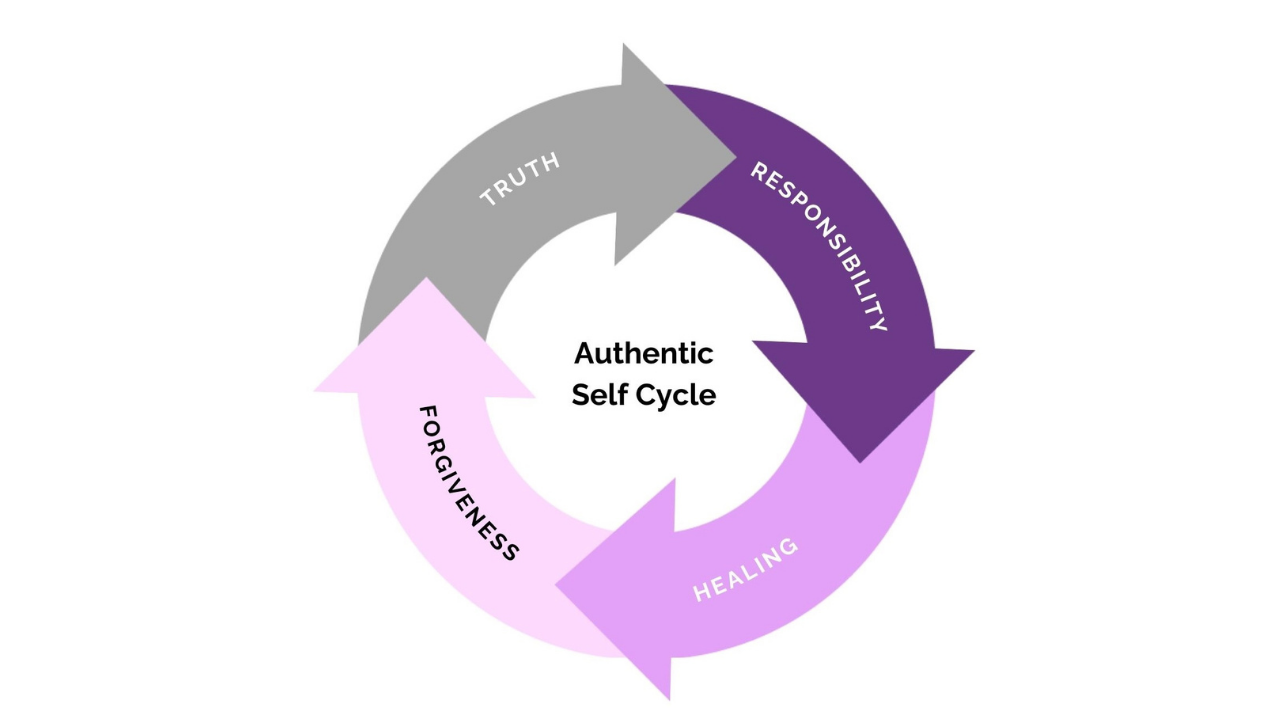
The Authentic Self Cycle™ is the inverse of the Worst Day Cycle™. Where the Worst Day Cycle runs on Trauma → Fear → Shame → Denial, the Authentic Self Cycle runs on Truth → Responsibility → Healing → Forgiveness.
Truth. You are not to blame for your childhood shame engine. Your brain and body were too young to do anything other than what they did. You were not stupid. You were not weak. You were a brilliant little kid who picked the only key that fit the family lock. And you are now an adult. The architect of today’s self-sabotage is no longer your parents. It is the program still running. The truth is both — not to blame, and the architect.
Responsibility. Now that you can see the program, you choose to stop running it. Not by force. By accountability. The adult takes the wheel and says to the wounded child driving the car, I see you, I love you, back seat — I’m driving now.
Healing. Grieving the decades the cycle has cost you. Grieving the original wound of powerlessness. Letting the body finally feel what it could not feel at five years old, at twelve, at twenty-five. This is where most people quit, because the grief is real and the body resists it. Stay. The grief is the medicine.
Forgiveness. Forgiving yourself for not knowing this earlier. Forgiving the brilliant little kid who built the survival persona. And, when ready, forgiving your parents — not because they were right, but because most parenting is what Bob Ross would have called happy little accidents. They were uneducated, not malicious. The accidents did not feel happy to the child. They were not happy. And staying angry at people who did not know any better will not free the child still trapped inside you. Forgiveness releases the hostage. The hostage is you.

The Emotional Authenticity Method™ — The 6-Step Rewire
The Authentic Self Cycle™ is the path. The Emotional Authenticity Method™ is how you walk it. Six steps. Run them once an hour for one day and your life will not look the same on the other side. That’s a promise that lands as a threat to anyone whose survival persona is reading this — which is exactly the proof that this is the work.
Step 1 — Somatic Down-Regulation
Spend 15 to 30 seconds focusing on what you can hear in the room around you. The hum of the refrigerator. A car outside. Your own breath. Your brain literally cannot think and listen at the same time. Listening opens the gate between cognition and emotion called metacognition. If you are highly dysregulated, titrate down — five seconds, ten seconds, build up. This is the gate. Without it, every step that follows is theater.
Step 2 — What Am I Feeling Right Now?
Not bad. Not anxious. Not fine. Get specific. Granular. Use a real Feelings Wheel exercise if you need a vocabulary. Is it abandoned? Humiliated? Rageful? Powerless? Disgusted? Helpless? Invisible? The vague label is the survival persona’s most effective tool — vagueness keeps you safe from the truth.
Step 3 — Where in My Body Do I Feel It?
Throat. Chest. Gut. Hips. Jaw. The body holds the original wound. The brain only narrates it. If you cannot locate the feeling somatically, you are still in the head. Drop down.
Step 4 — What Is My Earliest Memory of This Exact Feeling?
And this is where you find out the feeling is much older than today. The promotion did not create this. The relationship did not create this. The text did not create this. The childhood shame engine was already lit. Today’s event is just the match. Find the original room. The original face. The original silence. That’s the install point.
Step 5 — Who Would I Be If I Never Had This Thought or Feeling Again?
Imagine the feeling has been wiped off the face of the earth and is no longer possible. Who is left? Light. Confidence. Safety. Empowered, not powerless. You will know exactly what you would think, feel, do, and believe. You will see it without the clutter. That is your Authentic Self. It was always there, underneath the engine. The shame engine did not erase you — it just buried you.
Step 6 — Feelization
This is the step nobody else teaches and the step that actually rewires the blueprint. Feel the Authentic Self. Pull up the situation that triggered the sabotage and ask, from this place, how would I respond? What would I say? What would I do? Visualize and FEEL yourself operating from the Authentic Self. Stay in that felt experience as long as you can throughout the day. You are creating a new emotional chemical addiction to replace the old one. The brain does not change because you thought about change. The brain changes because you felt the new state, repeatedly, until the nervous system learns that this is the new home frequency.

I had to do this myself the morning of recording the video that became this article. I woke up powerless. I did not want to shoot. The survival persona was running. So I took one step toward the Authentic Self — getting up and turning toward the shower. That is it. The old emotional weight started to drop. The new state started to come up. The negativity broke. The video got made.
That’s the entire mechanism. One step toward the Authentic Self collapses the shame engine, because the engine cannot run on a body that is moving toward truth.
Real Life Signs of Childhood Shame Self-Sabotage
The childhood shame engine does not stay in one room of your life. It runs everywhere. Here is what it looks like in each.
Family
You shrink at the holiday dinner. You become the family therapist instead of a son or daughter. You explode at your mother and apologize for an hour. You ghost a sibling for a year. You parent your children from a place that feels familiar but does not feel like you. You catch yourself saying the exact sentences your mother said — and you swore you never would.
Romantic
You pick partners who confirm the shame story. You quit on the relationship that finally feels safe. You cheat the third time you feel emotionally exposed. You start a fight when intimacy gets close. You disappear in your phone when your partner reaches for you. You read the calm partner as boring and the chaotic partner as electric. That’s chemistry as wound recognition, not love.
Friendships
You over-give to keep the friendship. You ghost when you cannot give anymore. You collect people who never truly know you. You feel lonely in a room of people who would say they love you. You compare and resent. You celebrate other people’s wins on the surface and grieve them in private.
Work
You quit two miles before the finish line. You blow up the company you built. You under-charge. You over-deliver. You sabotage the promotion the day after you got it. You stay in a job that makes you sick because leaving feels more dangerous than dying inside. That’s you running a marathon, not because you got bored, but because the shame identity cannot tolerate finishing.
Body and Health
You binge after the streak. You skip the appointment. You work out twice a day for a month and disappear for six. You numb with food, with screens, with substances, with sex, with work. You feel the most disconnected from your body in the moments your life looks the best on the outside. The body is not betraying you. The body is keeping the score.
Your Next Small Step
Do not try to dismantle the shame engine in one sitting. The engine has been running for thirty, fifty, eighty years. One conversation will not undo it. And one step toward the Authentic Self will bend the curve.
Your next small step is this. The next time you catch yourself self-sabotaging — the bottle, the text, the silence, the explosion, the skip — do not argue with the shame voice. Do not try to mindset your way out. Do this instead.
- Stop. Listen for 15 seconds to whatever you can hear.
- Ask: what am I feeling right now, with one specific word.
- Ask: where in my body do I feel it.
- Ask: what is my earliest memory of this exact feeling.
- Ask: who would I be if this feeling never existed again — and let that version of you take the next action, even if the action is microscopic.
One step toward the Authentic Self. The engine cannot run when the body is moving toward truth. That’s the door. It is small on purpose. Small is what the nervous system can survive.
FAQ
What is childhood shame self-sabotage?
Childhood shame self-sabotage is the unconscious adult pattern of destroying your own success, relationships, and well-being to keep your nervous system inside the emotional chemical state it was calibrated to in childhood. It is not weakness or willpower failure. It is a brilliant survival adaptation — a child’s strategy for reclaiming power in a powerless household — running long after the original threat is gone.
Why do I sabotage myself when things are going well?
Because your nervous system cannot tell the difference between fear and excitement — they share the same chemical signature. When success arrives, the surge that floods your body reads identical to the original childhood threat. Your survival persona pulls the emergency brake to return you to known territory, which is the original wound. You are not sabotaging on purpose. You are returning to the only chemical state your nervous system has ever called normal.
Is self-sabotage a symptom of childhood trauma?
Yes. Self-sabotage is one of the most reliable downstream symptoms of unprocessed childhood emotional experiences. Repeated negative emotional moments in childhood install the Worst Day Cycle™ — Trauma → Fear → Shame → Denial — which becomes the emotional blueprint the adult body keeps reproducing through self-defeating choices, even when the conscious mind wants something different.
Why doesn’t therapy stop my self-sabotage?
Most therapy targets thoughts and behaviors, while childhood shame self-sabotage is installed in the body and nervous system before language. Limiting belief work, CBT thought records, and inner critic worksheets reason with the survival persona, but the survival persona does not run on reason. It runs on emotional chemistry. The rewire requires somatic, blueprint-level work like the Emotional Authenticity Method™ — feeling, tracing, and remapping the original install point, not arguing with the symptom.
What is the difference between fear of failure and fear of success?
Fear of failure is largely a cultural myth. The proof is that you choose failure constantly — every time you decline to do the thing you know you want to do, you are already comfortable with failure. The actual fear is success, because success requires the survival persona to die, the original family attachment to loosen, and the admission that you have spent decades not living as yourself. Those three are what the shame engine is protecting you from.
How do I stop self-sabotaging without spiritual bypassing or toxic positivity?
You stop self-sabotaging by feeling, not by reframing. The Emotional Authenticity Method™ runs six steps: somatic down-regulation, naming the feeling with granularity, locating it in the body, finding the earliest memory, imagining who you would be without the feeling, and Feelization — sitting in the felt experience of the Authentic Self until the nervous system rewires. No affirmations. No bypassing. No telling yourself you are fine when you are not. You are remapping a chemical addiction by installing a different chemical state through repetition.
The Bottom Line
You were not born broken. You were programmed by experiences your tiny nervous system was never built to metabolize, and you became brilliant at surviving a room you should have never had to survive. The childhood shame engine is the cost of that brilliance. It runs the same Worst Day Cycle™ on a Tuesday afternoon at thirty-eight that it ran on a Tuesday night at six. It chooses what does not work because the only power a powerless child ever found was the power to choose the pain. At least this time you chose it.
Self-sabotage is not your enemy. It is the most loyal thing you ever did for the wrong person. The little kid who built that engine deserves love, not contempt. And you are an adult now. Programs can be rewritten. The Authentic Self underneath the engine never went anywhere. It has been waiting under the wreckage the whole time, breathing slowly, ready for you to come home.
One step toward the Authentic Self. That is all the engine cannot survive.
Recommended Reading
- The Body Keeps the Score — Bessel van der Kolk. The clinical foundation for understanding why the body is where the original wound lives, why insight alone cannot reach it, and why somatic, repetition-based work is the path out.
- Complex PTSD: From Surviving to Thriving — Pete Walker. The clearest description of how repeating childhood emotional trauma installs adult survival strategies, including the four trauma responses that map onto Kenny’s three survival personas.
- Facing Codependence — Pia Mellody. The architecture of how childhood shame becomes adult codependent self-sabotage, especially helpful for the falsely empowered codependent and the disempowered codependent.
- I Thought It Was Just Me (But It Isn’t) — Brené Brown. A grounded, research-rooted explanation of the difference between guilt and shame, and why shame as identity is the engine underneath most adult sabotage.
Where to Go From Here
If you are ready to actually rewire the childhood shame engine instead of just understanding it, here are the next steps in increasing depth. Start where you are.
- Free — Feelings Wheel exercise: The fastest way to start practicing Step 2 of the Emotional Authenticity Method™. Build the granularity you need to actually feel what you feel. kennyweiss.net/life-changing-exercise
- Emotional Blueprint Starter Course — Individual ($79): The on-ramp to the entire system. Map your blueprint. See your survival persona. Learn the Worst Day Cycle™ in your own life. kennyweiss.net/individual-starter-course
- Relationship Starter Course — Couples ($79): If the sabotage is showing up most violently in your relationship, start here with your partner. kennyweiss.net/relationship-starter-course
- Why High Achievers Fail at Love ($479): If you are the version of self-sabotage that builds the empire and burns down the relationship, this is the deep dive. kennyweiss.net/why-high-achievers-fail-love
- Why We Can’t Stop Hurting Each Other ($479): The deep dive into how two survival personas collide and produce the cycle you keep blaming each other for. kennyweiss.net/why-we-cant-stop-hurting-each-other
- The Shutdown Avoidant Partner ($479): If your sabotage shows up as numbing, withdrawing, and disappearing inside the relationship. kennyweiss.net/shutdown-avoidant-partner
- Tier 1: Mapping the Blueprint ($1,379): The full deep work — the system Kenny uses with his private clients to rewire the childhood shame engine at the install point. kennyweiss.net/mapping-the-blueprint-tier-1
You were programmed. Programs can be rewritten. That’s you, finally getting to choose.