
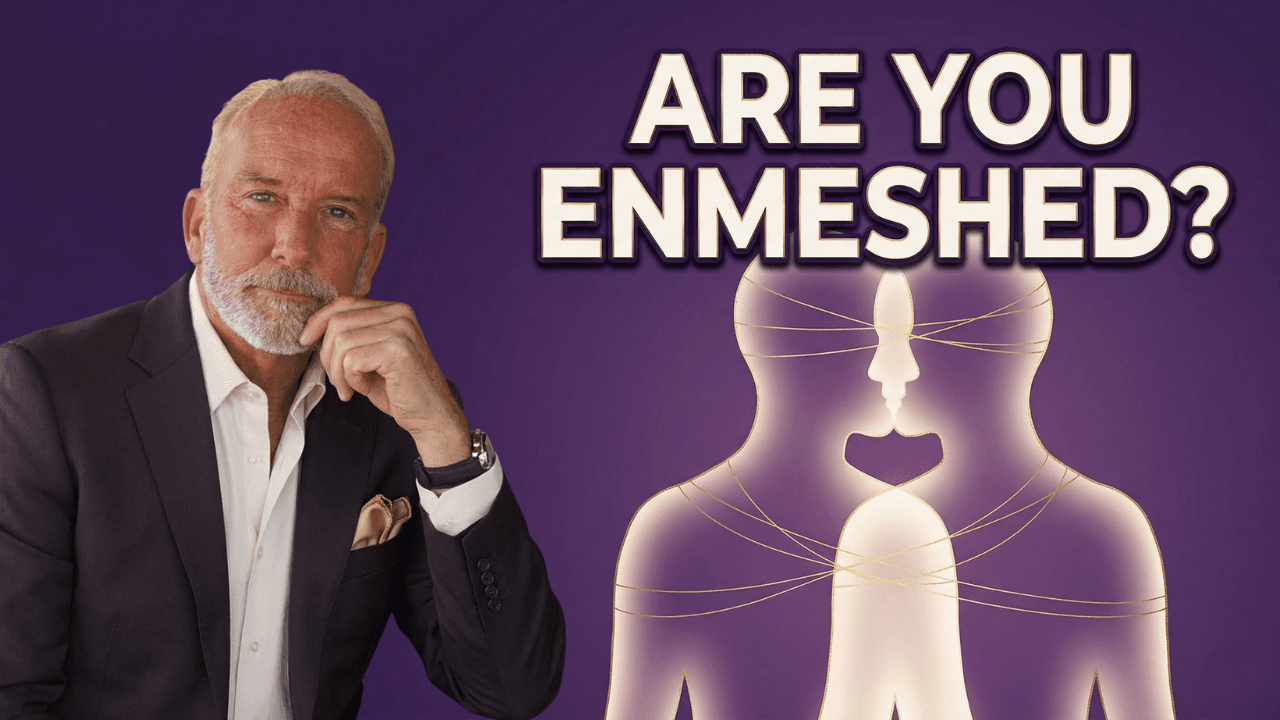
The Moment You Realize You’re Not Actually Free
You’re sitting across from someone you care about. They’re upset. You haven’t even finished your sentence, but your chest tightens. Your voice gets smaller. You shift into problem-solving mode — not because they asked you to, but because their discomfort has become your emergency.
This happens so fast you don’t even notice it anymore. By the time you realize what’s happened, you’ve agreed to something you didn’t want, canceled plans that mattered to you, or stayed late listening to a problem that isn’t yours to solve. And the worst part? You feel guilty for even noticing the resentment building inside you.
This is enmeshment.
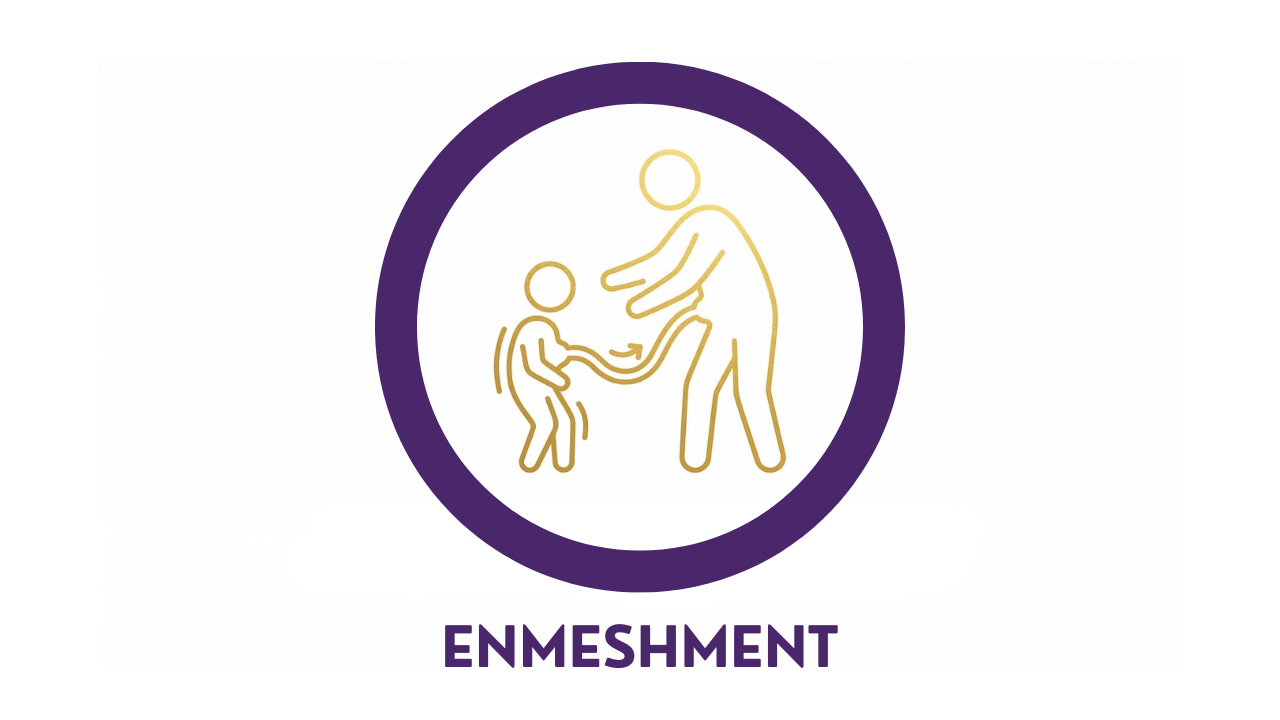
Enmeshment is what happens when your developing nervous system learned that your survival depended on monitoring and managing another person’s emotional state — usually a parent. Your job wasn’t to develop your own sense of self. Your job was to be the emotional thermostat for someone else’s dysregulation. And you got very good at it.
As an adult, this shows up as an almost involuntary responsiveness to others’ emotions. You read micro-expressions. You anticipate needs before they’re stated. You feel responsible for how other people feel. And you’ve probably been told — by therapists, books, well-meaning friends — that you just need to “set boundaries” or “communicate better.”
That hasn’t worked, has it?
That’s because enmeshment isn’t a boundary problem. It’s a nervous system problem. And your nervous system doesn’t care about your good intentions or your intellectual understanding. It cares about survival.
—
- What Is Enmeshment, Really?
- The Emotional Umbilical Cord That Was Never Cut
- Why “Just Set Boundaries” Has Already Failed You
- Enmeshment vs. Codependency: They’re Not the Same Thing
- The Signs of Enmeshment: Recognizing Your Own Pattern
- Why Your Body Is Paying the Price
- The Worst Day Cycle™ in Enmeshed Patterns
- What Healing Actually Requires: The Emotional Authenticity Shift
- The Authentic Self Cycle™: What Emerges on the Other Side
- Why Your “Empath” Identity Might Be Keeping You Stuck
- Enmeshment and Relationship Insecurity
- Recommended Reading
- Frequently Asked Questions About Enmeshment
- Your Next Step
- The Bottom Line
Watch the full video: Most people miss that enmeshment is a form of childhood abuse — one that is rarely named and almost never treated. See the reality you were not allowed to see in Enmeshment: The Childhood Abuse Nobody Talks About.
What Is Enmeshment, Really?
Enmeshment is a relational pattern where emotional and psychological boundaries between two people — typically parent and child — become blurred or completely absent. In an enmeshed family, a child’s emotional needs become secondary to managing or regulating the parent’s emotional state.
Here’s what that actually looks like in your body:
As a child, your nervous system didn’t have the luxury of developing normally. Instead of learning to self-regulate, you learned to co-regulate by constantly watching your parent’s face, voice, and body for signals of danger. If your parent was depressed, you became the emotional support. If your parent was volatile, you became the peacekeeper. If your parent was overwhelmed, you became the problem-solver.
Your nervous system learned one thing: your safety depends on their stability.
Enmeshment is a developmental nervous system pattern — not a personality flaw — where a child’s brain learns that survival depends on monitoring and managing a parent’s emotional state, creating an adult who unconsciously abandons their own needs to regulate others’ emotions.
This created a permanent wiring: other people’s emotions = your responsibility. Other people’s comfort = your job. Your own needs = a luxury you can’t afford.
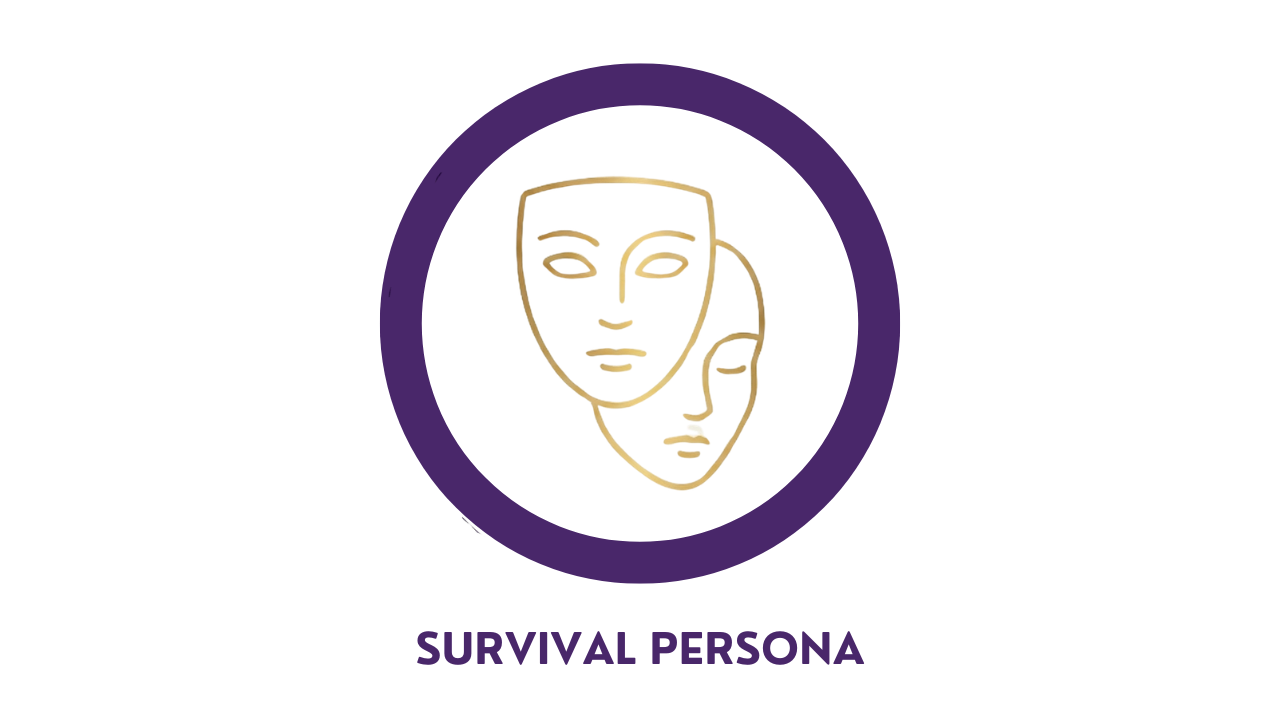
In childhood, this strategy kept you alive. A child can’t leave. A child can’t say, “This isn’t my job.” So your nervous system adapted. It created a survival persona — a version of you calibrated entirely around managing someone else’s emotional weather. That survival persona takes one of three forms: the falsely empowered type who controls, dominates, and rages to stay safe; the disempowered type who collapses, people-pleases, and makes themselves invisible; or the adapted wounded child who oscillates between both — controlling in some relationships and collapsing in others.
The problem? You’re not a child anymore, but your nervous system still thinks you are.
The Emotional Umbilical Cord That Was Never Cut
Think of a healthy birth. The umbilical cord connects mother and child — it’s how the child gets everything it needs to survive. Then the child is born, the cord is cut, and the child begins developing as a separate being with its own system, its own needs, its own emotional reality.
In enmeshment, that emotional cord was never cut. The parent — often unconsciously — kept it attached. But here’s the part no one talks about: the flow reversed.
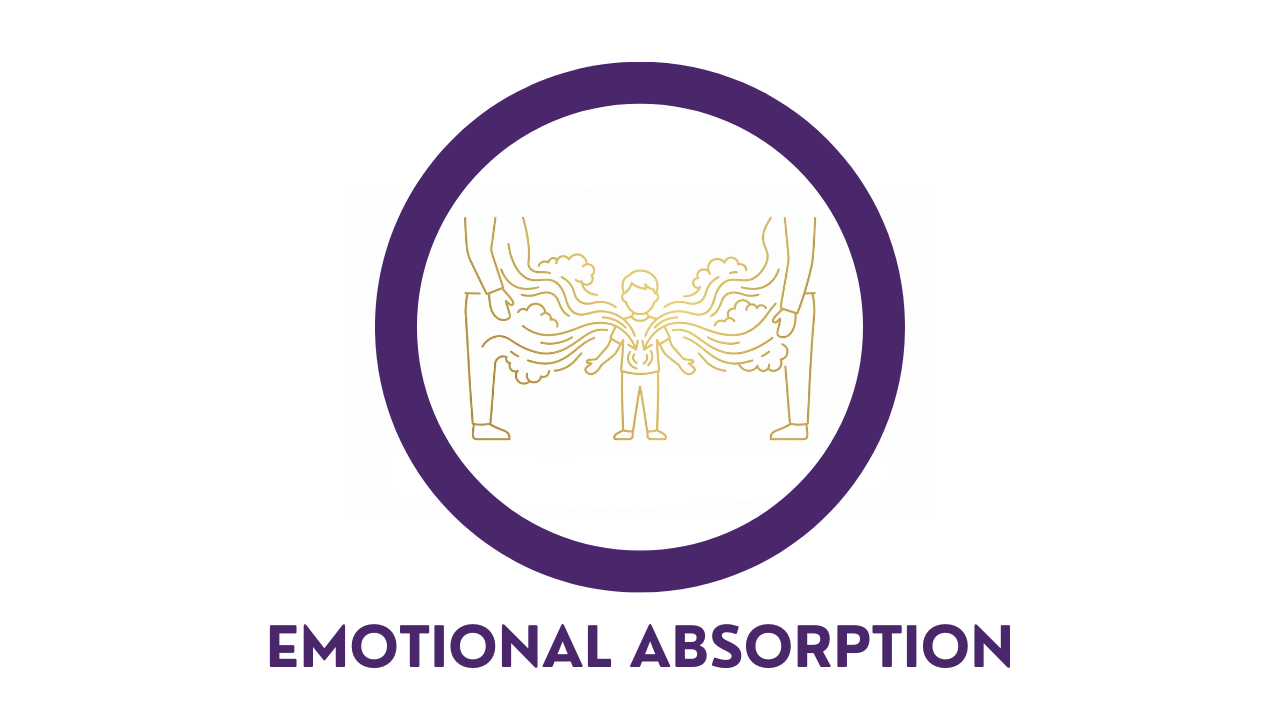
Instead of the parent providing emotional nourishment to the child, the parent began sucking the emotional life from the child. The child became the parent’s emotional supply — their regulator, their confidant, their reason for stability. The cord stayed attached, but now the child was the one being drained.
That’s you at ten years old, listening to your mother talk about her marriage. That’s you at eight, being the “easy” child because your parent couldn’t handle one more hard thing. That’s you learning to read the room before you learned to read a book.
And now, as an adult, you walk around with invisible emotional cords attached to everyone you’re close to. Your partner, your boss, your friends, your kids. Each one draining you a little more. Each one connected to that original pattern: my job is to keep them regulated, no matter what it costs me.
Why “Just Set Boundaries” Has Already Failed You
You’ve read the books. You know intellectually that you’re allowed to have needs. You’ve listened to podcasts about boundary-setting. Maybe you’ve even tried — said no, walked away, protected your time.
And then what happened?
Guilt. Anxiety. A voice in your head telling you how selfish you are. Or maybe you did hold the boundary, but it felt wrong — not just inconvenient, but wrong at a cellular level, like you were violating something sacred.
This is where most therapy and self-help gets stuck. It treats enmeshment as a conscious choice, something you can un-choose with willpower and verbal skills. But your nervous system didn’t learn enmeshment through logic. It learned it through thousands of micro-moments of survival.
Traditional boundary-setting fails for enmeshment because it targets conscious behavior while the pattern is encoded in the autonomic nervous system — the part of your brain that operates below awareness and cannot be changed through willpower or verbal skills alone.
When you try to set a boundary from your thinking brain while your nervous system is still running “other people’s emotions are my responsibility,” you’re trying to drive a car with the emergency brake on. It doesn’t matter how hard you press the accelerator. The system is fighting itself.
What you need isn’t another book about communication. You need to rewire the survival program at the nervous system level.
Enmeshment vs. Codependency: They’re Not the Same Thing
This distinction matters because it changes how you heal.
Codependency is a set of relational behaviors — obsessing over someone else’s happiness, losing yourself in relationships, sacrificing your needs for others. You can develop codependency at any age, from a partner, a friendship, a work dynamic.
Enmeshment is earlier. It’s the developmental root of codependency. It’s your nervous system’s foundational operating system, encoded in childhood, that says: my job is to manage your emotional state in order to survive.
If you’re enmeshed, you will almost certainly display codependent behaviors. But enmeshment is the architecture underneath. Codependency is what you do. Enmeshment is what you became.
Codependency is a set of relational behaviors you can develop at any age. Enmeshment is a childhood developmental wound encoded in your nervous system — the foundational architecture underneath codependency that cannot be resolved through behavioral changes alone.
You can’t think your way out of the architecture. You have to go back to the nervous system level and help it recognize that you’re safe now — that you don’t need to manage anyone else’s emotions to survive.
Watch the full video: Before you can name your own pattern, you have to see how it was installed in childhood. See the exact signs a parent is enmeshed with a child in Is Your Parent Enmeshed With You.
The Signs of Enmeshment: Recognizing Your Own Pattern
Enmeshment shows up across every relationship in your life, but it always has the same core: your boundaries blur, your sense of self becomes conditional on managing others, and you’re operating from a state of chronic anxious alertness.
In Your Family
You still defer to your parent’s opinions even when they contradict your own values. You feel responsible for their happiness, their problems, their aging. You can’t hold a different view without guilt. They know details about your life that burden you, or you know details about theirs that aren’t yours to carry. That’s you still running the childhood program: my parent’s comfort is my job.
In Your Romantic Relationships
You read your partner’s mood the moment they walk in the door. You adjust yourself to keep things calm. You have trouble articulating what you want because you’re too busy managing what they feel. You make yourself smaller and smaller — editing, dimming, adjusting — until you don’t recognize who you’ve become. That’s you still running the program: keep them stable and you stay safe.
In Friendships
You’re the one who always listens but rarely gets listened to. You show up for others’ crises while your own go unaddressed. You can’t tell someone no without over-explaining or feeling guilty for days. That’s you still running the program: your needs don’t matter if someone else is struggling.
In Work
You over-function. You manage your boss’s moods, your colleagues’ problems, your company’s dysfunction. You can’t leave on time even when your work is done. You read rooms for tension and automatically try to smooth it. That’s you still running the program: manage the emotional environment and you’ll be safe.
In Your Body
You feel anxious when alone. You’re exhausted by an invisible weight that never lifts. You catch yourself abandoning your own needs mid-conversation without even realizing it. You have constant health problems — headaches, autoimmune issues, chronic pain — because your body has been absorbing everyone else’s emotional toxicity for decades. That’s your nervous system still believing: your needs aren’t real.
If several of these ring true, you’re not broken. You’re enmeshed. Your survival system did exactly what it was designed to do. The problem is it’s still running when you no longer need it to.
Why Your Body Is Paying the Price
Enmeshed people are chronically sick. Headaches, autoimmune disease, arthritis, digestive problems — the list goes on. This isn’t coincidence. When you spend your entire life absorbing other people’s emotional toxicity while suppressing your own needs, your body eventually says what your mouth can’t.
Dr. Gabor Maté’s When the Body Says No lays out the science: your genes require a specific environment to activate. The emotional turmoil of enmeshment is that environment. You weren’t born with these conditions. Your body manufactured them because it had no other way to express the pain you couldn’t speak.
That’s you getting sick every time you visit your parents. That’s the headache that appears when your partner is upset. That’s your body screaming what your survival persona won’t let you say.
The The Worst Day Cycle™™ in Enmeshed Patterns
The Worst Day Cycle™ explains what happens when enmeshment meets a relational trigger:
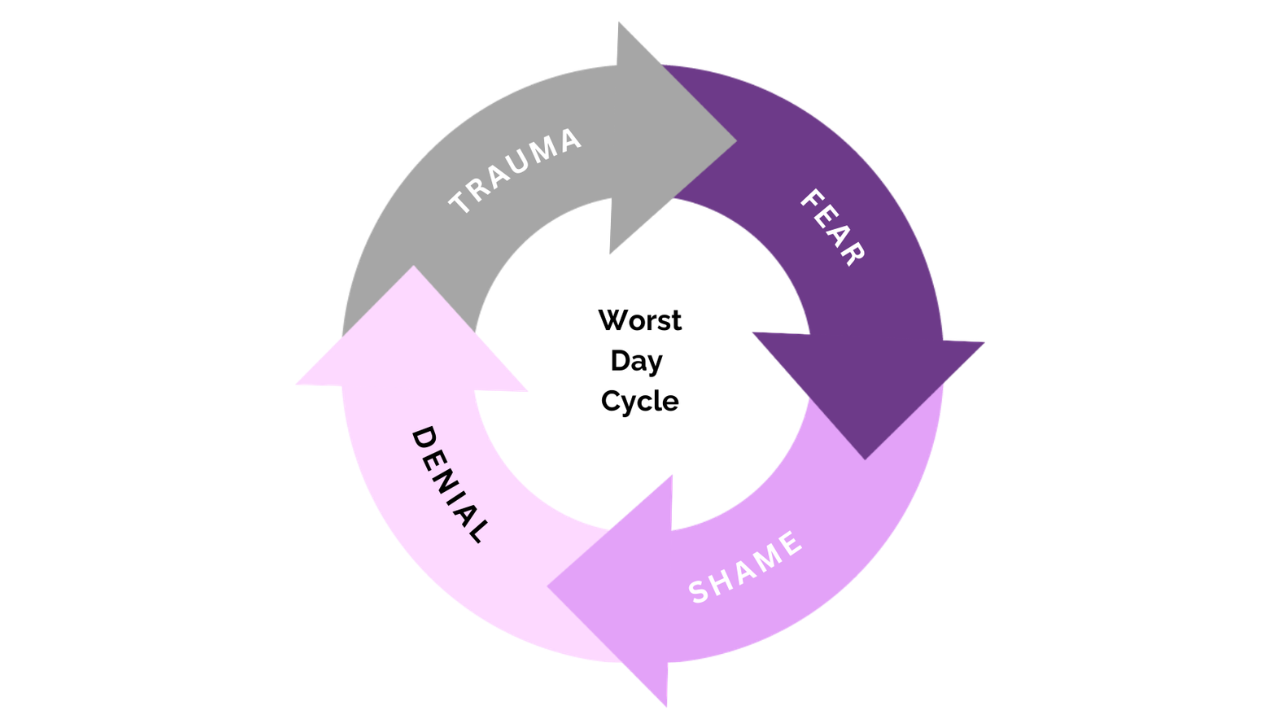
Trauma (Event) — Something happens. Someone’s upset with you, or you sense disapproval. This is just data. But your enmeshed nervous system interprets it as threat.
Fear — Your body floods with cortisol. You go into hypervigilance. What did I do wrong? What do they need? How do I fix this? The fear isn’t about the actual event — it’s about the survival response: if I don’t manage this, I’m in danger.
Shame — You don’t just feel scared — you feel fundamentally wrong for having needs, for taking space, for not being enough. The fear becomes: I am the problem. I am failing at the one job I was born to do.
Denial — So you disconnect. It’s not that bad. I’m overreacting. They’re fine. I’m fine. You abandon your own nervous system and go back to managing theirs.
The cycle repeats. And each time, your nervous system learns the pattern more deeply: my feelings don’t matter. Other people’s emotions are real. My job is to fix this.
The Worst Day Cycle™ is a four-stage neurochemical loop — Trauma → Fear → Shame → Denial — where the brain’s hypothalamus generates addictive chemical cocktails (cortisol, adrenaline, dopamine misfires) that keep you repeating the same painful patterns because your brain can’t tell right from wrong, only known from unknown.
Watch the full video: The enmeshed family system has consequences that ripple through generations. See the hidden cost before the healing work in The Danger of Enmeshed Families.
What Healing Actually Requires: The Emotional Authenticity Method™ Shift
This is where most recovery plateaus. You’ve done the inner work. You understand where it came from. But you still feel the pull. You still feel guilty. You still find yourself managing other people’s emotions before you even realize what’s happening.
That’s not failure. That’s the signal you need to go deeper — not into your story, but into your nervous system.
The Emotional Authenticity Method™ is designed precisely for this. It’s a five-step somatic process that rewires your nervous system’s relationship to your own emotional reality:
 emotional blueprint" title="The Emotional Authenticity Method™ by Kenny Weiss" loading="lazy" width="600" style="max-width:100%;height:auto;" />
1. Somatic Down-Regulation — Get your nervous system out of emergency mode. Focus on what you can hear around you for 15-30 seconds. This isn’t meditation. It’s actual nervous system regulation. You can’t rewire from panic.
2. What am I feeling right now? — Not what should you feel. Not what are they feeling. What is actually alive in your body right now? For enmeshed people, this is shockingly hard. You’ve spent your whole life feeling what others feel. Accessing your own feeling is like finding a muscle you’ve never used. Use the Feelings Wheel to help you name what you’re actually experiencing.
3. Where in my body do I feel it? — The tightness in your chest, the heaviness in your belly, the dissociation in your head — that’s where the real information lives. This step anchors you back into your own body as the source of truth.
4. What is my earliest memory of having this exact feeling? — This isn’t about blame. It’s about recognizing the pattern. Your body has been trying to tell you something since childhood. This step helps you see the thread that connects your adult pain to the original wound.
5. Who would I be if I never had this thought or feeling again? — This isn’t about positivity. It’s about possibility. What becomes available when this particular nervous system pattern isn’t running your life?
The EAM works because it addresses the actual problem: your nervous system has lost track of the difference between your feelings and other people’s feelings. It teaches your body that you can feel your own feelings, acknowledge others’ feelings, and let those be separate things.
The Authentic Self Cycle™: What Emerges on the Other Side
The Authentic Self Cycle™ is what becomes possible when you start healing:
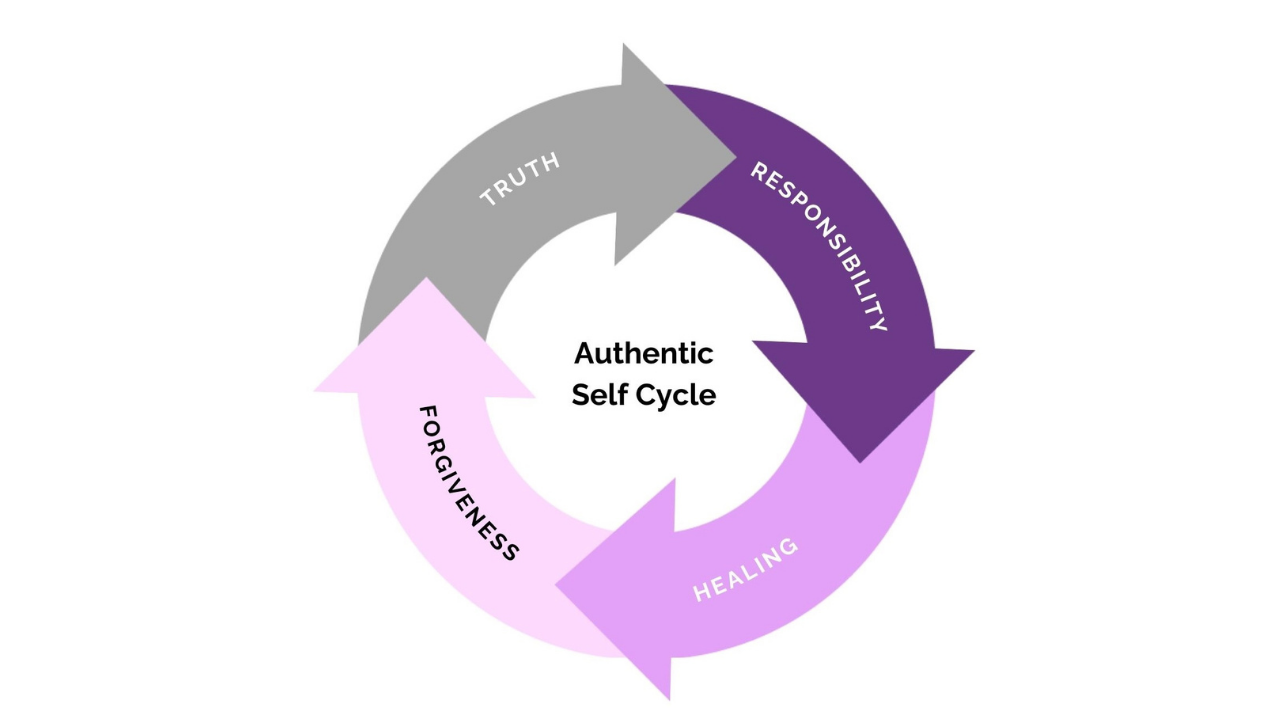
Truth — You feel something — sadness, anger, desire, a boundary — and instead of immediately managing it, you let yourself know it. This is what’s true for me right now.
Responsibility — You take ownership of your own emotional reality. Not blame toward others, not shame about yourself. This is my feeling. It’s valid. It tells me something about what I need.
Healing — You address what your feeling is pointing you toward. Maybe it’s a boundary. Maybe it’s self-care. Maybe it’s a conversation. But you move toward your own wholeness instead of away from it.
Forgiveness — Not forgiving others for enmeshing you. Forgiving yourself for surviving the way you had to. For being the person you needed to be to make it through. You did the best you could with what you understood at the time.
The ASC doesn’t mean you stop caring about others. It means you care from a place of choice, not compulsion. From wholeness, not survival. That’s you loving people without losing yourself. That’s real connection.
Why Your “Empath” Identity Might Be Keeping You Stuck
If you’ve identified as an empath, read this carefully: the “empath” label can actually lock you deeper into enmeshment. It romanticizes what is actually a dysregulated nervous system. It tells you that your hyperawareness of others’ emotions is a gift instead of a survival adaptation that’s now harming you.
You’re not inherently more sensitive than other people. Your nervous system is running a different program — one that was necessary when you were small and dependent, but is now draining your life. You can develop actual empathy (understanding others’ emotions while maintaining your own boundaries) on the other side of healing. But first, you have to recognize that your current “empathy” is enmeshment dressed up as sensitivity.
Enmeshment and Relationship Insecurity
Enmeshed people almost always experience chronic relationship insecurity. You’re constantly scanning for signs that you’re failing, that the other person is upset, that the relationship is at risk. Not because they’re giving you actual reasons to doubt, but because your nervous system is programmed to believe that someone else’s emotional comfort is your job.
That’s you waking up at 3 AM wondering if you said something wrong three days ago. That’s you over-functioning to prevent a conflict that hasn’t even happened. That’s you never feeling secure no matter how much reassurance you get.
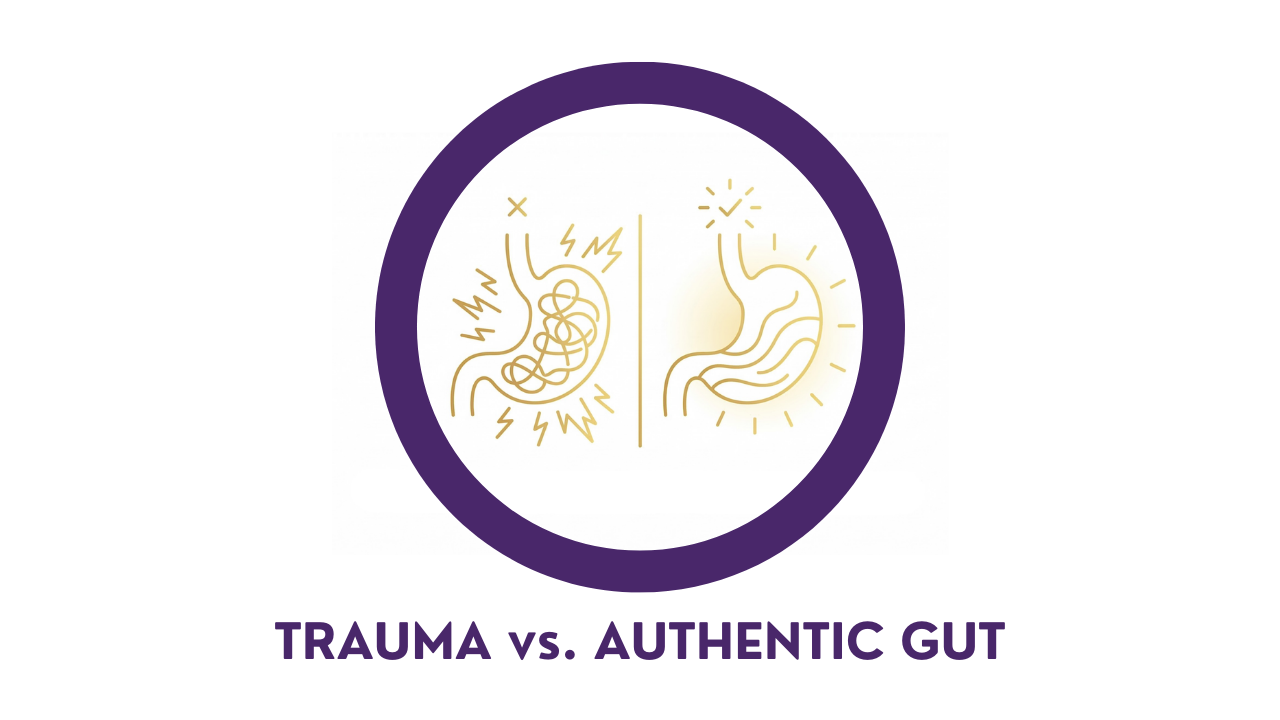
The security you’re looking for isn’t going to come from another person finally doing it right. It’s going to come from rewiring your nervous system so that your safety doesn’t depend on managing someone else.
Recommended Reading
When the Body Says No: Exploring the Stress-Disease Connection by Dr. Gabor Maté explains how chronic emotional suppression becomes physical illness. You’ll recognize yourself on every page.
The Emotional Incest Syndrome: What to Do When a Parent’s Emotional Needs Overstep Boundaries by Dr. Patricia Love directly addresses the enmeshment wound and how it shows up across your relational patterns.
Facing Codependence: What It Is, Where It Comes From, How It Sabotages Our Lives by Pia Mellody maps the developmental roots of codependency and the childhood experiences that create it — essential reading for understanding the bridge between enmeshment and adult relational patterns.
Codependent No More: How to Stop Controlling Others and Start Caring for Yourself by Melody Beattie provides practical tools for recognizing and interrupting codependent patterns that grow from enmeshment.
The Gifts of Imperfection: Let Go of Who You Think You’re Supposed to Be and Embrace Who You Are by Brené Brown explores how shame drives the survival persona and how vulnerability becomes the pathway back to your authentic self.
These aren’t self-help books with simple fixes. They’re maps of the actual problem. That’s you finally reading something that validates that this was real, that it mattered, that you weren’t overreacting.
Frequently Asked Questions About Enmeshment
Is enmeshment the same as codependency?
No. Codependency is a set of relational patterns you can develop at any age. Enmeshment is a developmental wound from childhood that creates the foundation for codependency. You can be codependent without being enmeshed, but if you’re enmeshed, codependency is almost inevitable.
Can you heal from enmeshment without therapy?
You need something beyond intellectual understanding. Whether that’s therapy, coaching, somatic work, or a structured program depends on you. The key is that you need support that goes beyond reading about it into actual nervous system rewiring.
Does healing mean cutting off my family?
Not necessarily. You might need to step back for a while to rewire. But the goal isn’t punishment or abandonment — it’s developing the ability to be in relationship without abandoning yourself. That might look different than before, but it doesn’t have to be all-or-nothing.
Why do I still feel guilty after setting a boundary, even when I know it’s healthy?
Because your nervous system interprets the boundary as danger. You’ve been wired since childhood to believe that managing others’ emotions is your job. A boundary feels like you’re failing at the most fundamental task of your existence. The guilt isn’t a sign the boundary was wrong. It’s a sign your nervous system is grieving the loss of a survival strategy. That’s exactly what the Emotional Authenticity Method™ addresses.
What if the person I’m enmeshed with refuses to see the problem?
Their awareness doesn’t determine your healing. You are the only one who can rewire your nervous system’s response. You can’t control whether they change, but you can stop running their survival program.
What does enmeshment mean?
Enmeshment means a relational dynamic where the emotional boundaries between parent and child were never properly established, creating an adult who unconsciously abandons their own needs to manage others’ emotional states. It’s a nervous system pattern, not a personality flaw.
Your Next Step
If you’ve read this far and recognized yourself, you’re already in the first stage of healing. You’re seeing the pattern.
The next stage is nervous system work. Kenny’s programs at The Greatness U are designed specifically for people like you — high-functioning, intelligent, emotionally exhausted — who have tried traditional therapy and hit a wall. The courses combine the Worst Day Cycle™, Authentic Self Cycle™, and Emotional Authenticity Method™ with actual somatic practices your nervous system needs to rewire.
Start where you are:
- Emotional Blueprint Starter Course — Individual ($79) — Your personal roadmap for understanding your survival persona and emotional blueprint
- Relationship Starter Course — Couples ($79) — Map your relational patterns together and see where enmeshment is running the show
- Why We Can’t Stop Hurting Each Other ($479) — Deep dive into the Worst Day Cycle™ and how it destroys relationships
- Why High Achievers Fail at Love ($479) — For the falsely empowered survival persona who succeeds everywhere except intimacy
- The Shutdown Avoidant Partner ($479) — Understanding the enmeshment wound behind avoidant attachment
- Tier 1: Mapping the Blueprint ($1,379) — The complete nervous system rewiring program using the Emotional Authenticity Method™
This isn’t another program that tells you to think differently. It’s work that helps your body learn that you’re safe to exist separately from others. That’s the real healing.
The Bottom Line
You’ve spent your entire adult life managing other people’s emotions while your own needs went unmet. Your nervous system learned this survival strategy so well that it feels automatic, invisible, like just who you are.
But it’s not who you are. It’s who you became to survive.
And you can become someone different. Not by trying harder. Not by reading more books. Not by forcing yourself to set firmer boundaries. But by going back to the nervous system level and teaching it what it never learned: your feelings matter. Your needs are valid. You can survive without managing someone else’s emotional state.
That’s not selfish. That’s the beginning of actually being present — for yourself and for the people you love.