
The Neuroscience Behind the Emotional Authenticity Method™
Your Brain Is Still Protecting a Child Who Doesn’t Exist Anymore
Something happened to you as a child.
Maybe it was obvious — a parent who raged, who disappeared, who made you feel like the problem in every room. Or maybe it was quieter than that. Maybe it was the way your mother’s face fell when you needed something. Maybe it was the silence after you cried. Maybe it was the feeling — wordless, enormous, impossible to name — that your emotions were too much for the people who were supposed to hold them.
Whatever it was, your body registered it. Not as a story. Not as a memory you could put words to. As a feeling. A chemical flood. A full-body conclusion that said: Something is wrong with me.
That conclusion didn’t arrive through logic. You were too young for logic. It arrived through your nervous system — through the only language a child’s body knows — and it wrote itself into every cell. I call this your emotional blueprint: the collection of all the emotional definitions and meanings your brain and body absorbed before you could even speak. You learned those definitions by watching your caregivers and society by absorbing their stress, their fear, their disappointment, their emotional chaos. You learned what love looked like by watching how it was modeled. You learned what you were worth by how people responded when you had needs.

And here’s the part that changes everything once you understand it: you were not born with those emotions. Not a single one. Every emotion you have ever felt as an adult — every flash of anger, every wave of shame, every moment of shutting down in the middle of a conversation that shouldn’t be this hard — is a learned construct. You learned it in childhood. You are reliving it now.
This is not a metaphor. This is how the brain works. Modern neuroscience has confirmed what most people spend their whole lives never realizing: emotions come before thoughts. Every thought you have and every action you ever take starts with an emotion, a feeling. Your amygdala detects a signal — a tone of voice, a facial expression, a moment of distance from someone you love — and it fires before your thinking brain even gets the message. The emotion arrives first. Then your brain scrambles to make sense of it. Then you think you’re having a rational response to what just happened. But you’re not. You’re having a childhood response to what just happened. You are, in that moment, the exact age you were when that emotional blueprint was first written.
That’s why you can be successful, intelligent, accomplished in every visible area of your life — and still fall apart in the one place where the blueprint matters most: emotional intimacy. Because your survival persona can run a business, win an argument, charm a room. But your survival persona is a child’s strategy operating in an adult world. It is a finger painting pretending to be a mural. And it is running your relationships, your self-worth, and your nervous system on a loop that was designed for a five-year-old.

This is the Worst Day Cycle™.
The Worst Day Cycle™ — How Your Childhood Keeps Replaying

The Worst Day Cycle has four stages, and every human being who experienced childhood trauma is living inside them right now.
Stage 1: Trauma. Trauma, as I define it, is any negative or overwhelming emotional event in childhood. It doesn’t require abuse. It doesn’t require a dramatic origin story. It requires only this: that something happened that was too big for your nervous system to process, and no one helped you feel your way through it. So your body stored it. Not as a story — as a feeling. A chemical imprint that wrote itself into your emotional blueprint and has been running your life ever since.
Stage 2: Fear. That stored trauma creates fear. Not the healthy fear that warns you a car is about to hit you. This is the fear that fires when your partner raises their voice. The fear that grips your chest when someone you love goes quiet. The fear that says: Something terrible is about to happen. Your amygdala cannot tell the difference between the danger you faced at five years old and the disagreement you’re having at forty-five. It fires the same alarm, releases the same chemicals, floods your body with the same terror. And because the fear is running on a childhood emotional blueprint program, it is always bigger than the moment calls for — always more intense, more consuming, more paralyzing than the adult situation warrants. This is the fear that makes you overreact, shut down, lash out, or disappear. It is not a personality flaw. It is a five-year-old’s emergency system running inside an adult body.
Stage 3: Shame. Fear that goes unprocessed turns into shame. Shame tells you: I am the problem. I’m not enough. I’m too much. My needs hurt people. If I were different, this wouldn’t have happened. Shame doesn’t say you made a mistake — it says you are the mistake. It is the most corrosive emotion a human being can carry, because it attacks your identity at the root. And it was placed into you by the people who were supposed to protect you from it. Every child who grows up in an environment where their emotions are too much, where their needs are a burden, where love is conditional — that child absorbs shame like a sponge absorbs water. It becomes the lens through which they see themselves for the rest of their lives.
Stage 4: Denial. Shame is unbearable, so the brain builds a final layer of protection: denial. Denial tells you: Everything is fine. I don’t need help. I’m over it. It wasn’t that bad. Denial is not lying. It is surviving. It is the survival persona’s most powerful tool — the ability to convince you that the cycle doesn’t exist even while it is running your entire life. Denial is why you can read a description of the Worst Day Cycle and think, That’s not me. Denial is why you can have the same fight with your partner for the fifteenth time and still believe the problem is what they said, not the five-year-old inside you who heard something completely different.
Together, trauma, fear, shame, and denial form the four-stage operating system of your survival persona. And that operating system runs your life — your relationships, your decisions, your self-talk, your nervous system — on a loop. The same painful patterns. The same reactions. The same collapses. Over and over.
You know the moment it takes over.
Your partner says something — maybe it’s nothing, maybe it’s a legitimate concern — and something inside you shifts. Your chest tightens. Your throat closes. Your heart rate spikes. Words vanish. The adult version of you — the one who is capable, articulate, grounded — disappears. And a child steps forward. That child takes over the conversation. That child holds the microphone. And the child only knows one thing: I have to protect myself the way I learned to protect myself when I was small.
Think of it like an emotional thermostat. If you’re regulating well, your emotional baseline sits around 98 degrees. Something triggers you, you spike to 102, and you cool back down. But if you’re carrying decades of unprocessed negative or overwhelming childhood emotional events, you’re already running at 105 before anything even happens. Your nervous system is already flooded. Now your partner brings up something sensitive, and the temperature hits 112. You’re in a full emotional coma. You’re not overreacting — the math was already against you.

This cycle shows up in one of three ways. You become the disempowered pursuer — flooding the zone, demanding reassurance, terrified of abandonment, pursuing connection so hard you become the thing that pushes people away. Or you become the falsely empowered distancer — shutting down, building walls, going silent, protecting yourself by disappearing because your nervous system learned that people are unpredictable and closeness is dangerous. Or — and this is what most people don’t realize — you bounce between both. Because codependence is a spectrum, not two fixed poles. Most people carry elements of both patterns and shift between them depending on the partner, the trigger, the emotional stakes. You might be the disempowered pursuer in your marriage and the falsely empowered distancer with your best friend. You might switch roles within a single argument. This is not dysfunction. This is a nervous system doing what it learned to do to survive.

And the reason none of the things you’ve tried have broken this cycle — the therapy, the self-help books, the meditation apps, the positive affirmations — is not because you’re not trying hard enough. It’s because nervous system dysregulation cannot be solved with thoughts. You cannot think your way out of a nervous system response. Your body fires before your mind even knows what’s happening. The emotion creates the thought. Not the other way around. And until you address the emotional blueprint at the level where it actually lives — in your body, in your nervous system, in the emotional blueprint that was written before you had language — the cycle will keep running.
This is where neuroscience becomes your roadmap out.
What Trauma Actually Does to Your Brain — How Trauma Affects the Brain at the Neurological Level
Two specific parts of your brain were fundamentally changed by childhood trauma, and understanding them is the key to understanding why you’re stuck — and how healing childhood trauma actually becomes possible.
Your Insula — Your Awareness Center — Literally Shrank

Buried deep inside your brain is a small region called the insula. Neuroscientist Bud Craig, in his landmark research published in Nature Reviews Neuroscience, called the insula the seat of what he termed the “sentient self” — the part of you that experiences your own existence moment by moment. The insula is where your body’s raw signals become conscious feelings. When you feel your heartbeat quicken, notice tension gathering in your chest, sense butterflies in your stomach — that’s your insula translating physical sensation into emotional awareness. Without it, you would be a biological organism running on reflex, with no conscious connection to your own inner world.
When you experienced negative childhood emotional events, your nervous system learned that feeling your own body was dangerous. If you had felt everything fully — the rage, the abandonment, the betrayal, the overwhelming loneliness — it would have been annihilating. A child’s nervous system cannot survive that. So your brain did something brilliant: it turned the volume down. Your insula adapted. Gray matter volume decreased. The region that was supposed to connect you to your feelings learned instead to disconnect you from them.
A 2020 meta-analysis confirmed that childhood maltreatment is associated with reduced insular cortex volume across multiple studies. A 2023 study in Borderline Personality Disorder and Emotion Dysregulation explicitly examined what researchers called “Disregarding One’s Own Body” — the way traumatic childhood experiences cause people to lose awareness of their own physical and emotional signals. Hugo Critchley’s research, published in Nature Neuroscience, showed something remarkable: people with healthy insula function can literally feel their own heartbeat. They are consciously connected to the data their body sends them. People with damaged insula function cannot. They are strangers to their own interior.
This is why you can be in the middle of a relationship meltdown and not even realize your body is flooding with stress chemicals until you’re already gone — already in survival mode, already saying things you don’t mean, already shut down behind a wall you didn’t consciously build. Your awareness center — the part of your brain that was supposed to warn you, to give you a moment of choice between trigger and reaction — was shrunk by the very experiences it was trying to protect you from.
And here’s what makes this even more complex: trauma doesn’t create just one insula problem. It creates two opposite ones, depending on how your nervous system adapted. Some people develop hyperinteroception — an overactive insula that amplifies every signal, every sensation, every micro-shift in a partner’s tone. They feel too much. They are the pursuers, the ones who feel everything at a ten, the ones whose bodies are constantly scanning for danger because their insula never stops sending alarm signals. Other people develop hypointeroception — an underactive insula that suppresses sensation, that makes emotions feel distant or irrelevant, that creates a kind of numbness that looks like strength but is actually disconnection. They are the distancers. Both patterns come from the same wound: an insula that learned your own feelings were dangerous.
Your Vagus Nerve — Your Body’s Communication Highway — Stopped Working Properly

The vagus nerve is the longest nerve in your body. It runs from your brainstem all the way down through your chest and into your gut, touching your heart, your lungs, your digestive organs along the way. And here is the detail that changes everything about how you understand healing: eighty percent of the vagus nerve is afferent — meaning it carries signals from your body up to your brain. Your body is constantly reporting. Constantly sending data about whether you are safe or in danger. Your brain is constantly listening.
When your childhood taught your nervous system that the world was dangerous, that listening stopped. Your vagal tone — the strength of your vagus nerve’s signaling capacity — dropped. And your nervous system got stuck.
Stephen Porges’ Polyvagal Theory, published across multiple landmark papers and comprehensively reviewed in 2022 in Frontiers in Integrative Neuroscience, explains exactly where it got stuck. Your autonomic nervous system has three states. The ventral vagal state is where safety and genuine connection live — your heart rate is steady, blood flows to your prefrontal cortex, you can think clearly, feel your feelings, and be present with another person. The sympathetic state is fight or flight — your heart rate spikes, adrenaline floods your system, your thinking brain goes offline, and your body prepares for danger. The dorsal vagal state is the deepest shutdown — freeze, collapse, dissociation. Your body’s last resort when it decides that fighting and running are both impossible.
Trauma survivors spend most of their lives oscillating between the sympathetic and dorsal vagal states. Fight or shut down. Pursue or disappear. The ventral vagal state — the place where you can actually feel, connect, love, and be present — becomes almost unreachable. And something else happens that most people never realize: calm starts to feel dangerous. Because in your childhood, calm was often when something bad was about to happen. Calm was the silence before the explosion. Your nervous system learned that stillness means a blindside is coming. So it stays vigilant. Always scanning. Always braced. Never at rest.
Sylvain Laborde’s “vagal tank” theory, published in Frontiers in Neuroscience, offers a way to understand this. Imagine your capacity to regulate your nervous system as a tank of resource. When you’re born, that tank is full. But chronic stress — especially negative childhood emotional events — drains it. By adulthood, the tank is nearly empty. Your nervous system is running on fumes. It can’t regulate. It can’t recover. It can’t feel safe. This is nervous system dysregulation at its deepest level — not a character flaw, not a choice, but a depleted tank. And every new trigger drains it further.
And this disrupted vagal signaling creates something that ruins people’s lives without them ever knowing it: a false gut feeling. You’ve heard the advice a thousand times — “trust your gut.” But what no one tells you is that your gut is sending signals up that vagus nerve based on the emotional blueprint that was written in childhood. If your childhood taught your nervous system that closeness is dangerous, your gut will scream danger every time someone gets close to you. If your childhood taught you that you have to earn love by performing, your gut will flood you with panic every time you stop performing. That feeling in your stomach — the one that says something is wrong, get out, this person can’t be trusted, you’re about to be hurt — that is not your authentic gut feeling. That is what I call your trauma gut. That is your Worst Day Cycle firing through your vagus nerve, sending the same childhood alarm signals to your brain, and your brain interpreting them as present-tense truth.

This is why you keep choosing the same partners. This is why the “nice” person feels boring and the emotionally unavailable person feels like chemistry. This is why you leave relationships that are safe and stay in relationships that are destroying you. Your trauma gut is running the show, and it is telling you that the familiar pain of your childhood is “home.” It feels right because it matches the blueprint — not because it is right.
The Emotional Authenticity Method™ and the Authentic Self Cycle™ clear this disruption. As your vagal tone rebuilds and your insula reconnects, something remarkable happens: you stop reliving your trauma gut. The false signals quiet down. And your authentic gut feeling — the one that was there before the trauma rewired everything — comes back online. You start sensing the difference between a childhood alarm and a genuine present-moment signal. You start trusting yourself again, not because someone told you to, but because your nervous system has healed enough to send you accurate information.
But here is the part that matters most: the tank can be refilled.
The Emotional Authenticity Method™ — What Healing Actually Looks Like

The Emotional Authenticity Method™ is not another thinking exercise. It is not about reframing your thoughts, reciting affirmations, or intellectually understanding your childhood. It is a multidimensional process with far too many layers and dimensions to fit into a single article — but its first six steps are foundational, can be practiced immediately, and will have a massive, immediate impact on your nervous system and begin rewiring your unhealed emotional blueprint. These six steps work directly with your body — at the level where the trauma actually lives — to move you out of your Worst Day Cycle and into your Authentic Self Cycle™.
And it works on four distinct neurological mechanisms simultaneously. Each one is validated by peer-reviewed research.
It REGULATES — activating the vagal brake to immediately calm your flooded nervous system.
It REMAPS — sending interoceptive signals up the vagal highway to your insula, rebuilding the awareness center that trauma shrank.
It REWIRES — opening a neuroplasticity window through emotional processing, allowing your brain to build new neural pathways.
It DOWN-REGULATES — building cumulative vagal tone over time, shifting your nervous system’s baseline from chronic hypervigilance toward genuine, durable safety.
No other approach addresses all four levels at once. Most address one or two. This is why the EAM produces transformations that other methods cannot.
Here is how it works, step by step — and what happens inside your brain and body at each stage.
Step 1: Somatic Down-Regulation
You’re triggered. Your nervous system is flooding. Your emotional temperature just hit 112 and you’re in a coma — no words, no clarity, no access to the adult version of yourself.
The first thing you do is something counterintuitive: you turn your attention outward. For fifteen to thirty seconds, you focus on what you can hear. Not what you’re feeling — what you can hear. The hum of the refrigerator. A car passing outside. Birdsong. The sound of your own breathing. Then what you can touch — the fabric of your shirt against your skin, the pressure of your feet on the floor. Then what you can see.
This single act does something neurologically precise. It puts you into metacognition — the space between intellect and emotion. You are not suppressing the emotion. You are not pretending you’re fine. You are creating just enough room for your prefrontal cortex — your thinking brain — to come back online. You are telling your vagus nerve: The immediate danger has passed. You can stand down.

The mechanism behind this is not psychological. It is physiological — and it starts with listening. Porges’ research on the Social Engagement System shows that auditory attention is directly linked to the ventral vagal complex. When you focus on what you can hear — when you orient your attention toward environmental sounds — you activate the neural circuits that govern safety and social connection. Your middle ear muscles, which are innervated by cranial nerves tied to the ventral vagal system, engage. Your brain shifts from threat detection to environmental processing. A 2025 randomized controlled trial published in Psychophysiology by Kumpulainen and colleagues confirmed that focused auditory attention to environmental sounds produced significant increases in heart rate variability, reduced heart and respiratory rates, and measurably increased parasympathetic nervous system activity — all markers of vagal brake activation. The researchers found that auditory attention decreased anxiety and increased feelings of comfort and safety. This is exactly what the listening exercise does: it activates what Porges calls the vagal brake — an actual neurological mechanism that shifts your nervous system out of sympathetic activation and toward the ventral vagal state of safety.
If you’re highly flooded, you use titration. Thirty seconds grounding in the environment. Thirty seconds allowing the trigger back — feeling the full intensity. Thirty seconds grounding again. You repeat this three to five times. Each cycle, the emotional charge diminishes. You are titrating the dose so your nervous system can process it without being overwhelmed. This is the principle behind somatic experiencing — and the research backs it. Two randomized controlled trials published in 2017, one in the European Journal of Psychotraumatology and another in the Journal of Traumatic Stress, showed that somatic experiencing produces significant PTSD symptom reduction.
But down-regulation is just the beginning. It creates the conditions for healing. What comes next is where the real work begins.
Step 2: What Am I Feeling?
Now that your prefrontal cortex is back online — now that you have enough capacity to be curious instead of just reactive — you ask yourself a deceptively simple question: What am I actually feeling right now?
Most people answer this question the same way: “I feel bad.” Or “I feel upset.” Or “I feel triggered.” And that answer, while honest, is not specific enough to heal anything. There is a world of difference between feeling ashamed and feeling powerless. Between feeling invisible and feeling betrayed. Between feeling abandoned and feeling smothered. Your body knows the difference, even if your mind hasn’t learned to name it yet.
This is where the research of Dr. Lisa Feldman Barrett becomes essential. Barrett’s work on emotional granularity — the ability to make fine-grained distinctions between emotional states — has shown that people who can precisely name what they’re feeling experience better mental health, better coping, better emotional regulation, and even better physical health outcomes. People who experience their emotions with less granularity — who feel “bad” without further distinction — remain stuck in undifferentiated distress. Specificity is not a luxury. It is a neurological tool.
When you sit with the question — What am I feeling? — and push past “bad” to arrive at “ashamed” or “invisible” or “powerless” or “unlovable,” something shifts. You have just taken the first step toward giving your nervous system new information. You are no longer a child who is overwhelmed by a feeling too big to name. You are an adult who can identify what is happening inside you. And in doing so, you are teaching your nervous system something it has never learned: that you can survive this feeling. That the feeling itself is not lethal. That you can be in the presence of your own pain without being destroyed by it.
This is not a small thing. For someone who has spent decades running from their emotions — decades building a survival persona specifically designed to never feel this feeling — the act of sitting still and naming the shame is an act of enormous courage. And it is the beginning of a neurological revolution. Because every time you allow yourself to experience a painful feeling and you see that your greatest fear — that it will be too big, too scary, and it will annihilate you — isn’t actually true. Here you are, perfectly able to survive it, and your brain is learning something it has always needed to know: I am ok. These feelings are not too big or too scary, and they won’t annihilate me. I can feel this. I am strong, and I can reclaim my peace and my safety. I can be free.
Step 3: Where in My Body Do I Feel It?
Now you take your somatic reconnection one step deeper. You ask:
Where in my body do I feel this?
You put your hand on the place. Your chest. Your throat. Your stomach. Your legs. Wherever the sensation lives — wherever your body has been storing this emotion, possibly for decades — you locate it. You make contact with it. You acknowledge it.
This is interoception — the ability to sense what is happening inside your own body. And it is the neurological key to everything that follows.
When you bring conscious attention to a body sensation, you are sending interoceptive signals up the vagus nerve’s afferent pathway — the body-to-brain highway. Those signals travel from your gut, your chest, your throat, up through the brainstem, and directly to your anterior insular cortex — the very region that the negative emotional events shrank. You are literally sending data to the part of your brain that was trained to ignore it. You are rebuilding the connection between your body and your awareness center.
A 2024 study in Translational Psychiatry proved that interoceptive training directly impacts the neural circuit of the anterior insula cortex. A 2005 Harvard study by Sara Lazar and colleagues found that meditative and interoceptive practice increases cortical thickness in the insula — literally rebuilding the gray matter that trauma had reduced. A 2020 study in Frontiers in Psychology established that there is a direct, systematic relationship between interoception, vagal tone, and emotional regulation — they are neurologically linked. When you improve one, you improve them all.
This step expands your somatic reconnection. It takes you deeper into the truth that your body has been trying to tell you, possibly for your entire adult life. And it adds another layer to the lesson your nervous system is learning: I can feel this pain in my body. I can put my hand on it. I can stay present with it. And I am still here. I am still safe. Each time you do this, you are proving to the part of you that learned to run from sensation that running is no longer necessary. You are, for perhaps the first time, teaching your body that it is safe to come home to itself.
And something else begins to happen here — something most people don’t expect. As you rebuild the connection between your body and your awareness center, as your vagus nerve begins to repair its signaling, your authentic gut feeling starts coming back online. Remember the trauma gut — the false signals that have been running your decisions, your relationships, your entire life? This step is where that starts to change. Each time you locate a feeling in your body and stay present with it instead of running, you are teaching your vagus nerve to send accurate signals again. You are clearing the static. And as the static clears, you begin to sense the difference between a childhood alarm firing and a genuine present-moment signal from your body. Your gut starts telling you the truth again.
Step 4: What Is My Earliest Memory of This Exact Feeling?
Now you trace the feeling back. And here is how you do it.
Most people, when they first ask themselves When have I felt this exact feeling before? — don’t immediately remember something from childhood. They go to something recent. Last week. Last month. A fight with their partner. A moment at work. That’s normal. That’s where your mind goes first. Write it down.
Then you ask again: When was the time before that? When was the time before I felt this exact same feeling?
Another memory surfaces. Maybe six months ago. Maybe a year. Write it down.
You keep going. And before that? Write it down. And before that? Write it down.
What starts to happen is extraordinary. The memories get older. They move backward through your life — from last month to last year to five years ago to your twenties, your teens, your early adolescence — and then, if you stay with it, they land somewhere in childhood. A moment when someone — a parent, a teacher, a sibling, a caregiver — said or did something, or failed to say or do something, that planted this exact feeling in your body. Maybe it was a direct wound: criticism, rage, humiliation. Maybe it was an absence: the parent who never showed up emotionally, the comfort that never came. Maybe it was something you couldn’t have named as a child, but your body understood perfectly — the moment you realized your feelings were a burden to the person who was supposed to carry them with you.
And now you look at that list. All those moments written down. All those memories stretching from last week all the way back to childhood. And I ask you: Do you see what you just did?
You just proved it to yourself. Not because I told you. Not because you read it in a book. You traced it with your own memories, your own felt experience, and you saw the thread with your own eyes. Every single one of those moments — from the fight with your partner last Tuesday all the way back to the kitchen where your mother made you feel invisible — is the same feeling. The same emotional blueprint. The same program running on repeat.
You just proved to yourself that all emotions are learned in childhood. And yes — you and everyone else are living your lives stuck in the Worst Day Cycle. Which means you are not bad. You are not broken. You are not uniquely damaged or fundamentally flawed. You are just like everyone else: human, limited, and perfectly imperfect. Running a program that was installed before you could even spell your own name.
This is where the Worst Day Cycle reveals itself. This is where a person finally sees the thread connecting their adult pain to its childhood origin — and the revelation can be staggering.
I want to tell you about a client I worked with several years ago, because when you read her story, you are going to feel it. You just walked through the process yourself. You traced the thread. Now you’re going to see it in someone else’s life, and it will hit you between the eyes — because you will recognize the pattern.
She came to me just after being diagnosed with cancer. She was overwhelmed with fear, but I didn’t start with the cancer. I started where I always start.
“When you think about everything happening right now — the diagnosis, all of it — what are you feeling?” I asked her.
“Frustration,” she said.
“Where do you feel that frustration in your body?”
She didn’t hesitate. Her right hand went to her chest, just above her left breast. “Right here.”
I asked her to tell me about other things in her life that frustrated her. She talked about her marriage — how she felt invisible, how she had to manage everything. She talked about her kids — how she had to repeat herself endlessly before anyone listened. She talked about her career — the constant feeling of being taken for granted.
Every time, I asked her the same question: “Where do you feel that?”
Every time, her hand went to the same spot. Over and over. Twenty-three times I asked. Twenty-three times her hand landed in the same place on her chest. I repeatedly asked these questions because, especially with a health issue, I knew she was going to need to feel an overwhelming amount of examples; otherwise, the denial from her Worst Day Cycle wouldn’t allow her to accept the truth.
Then I asked her: “Where is your cancer?”
Her eyes went wide. The tears cascaded out of her. “Right here,” she whispered, her hand still on the same spot on her chest. “Right here.”
All that frustration. All that rage she’d never expressed. All those years of feeling invisible and powerless and responsible for everyone else’s emotions. Her body had been storing it in the exact same place — and it had been eating her alive from the inside.
When we traced it back — when we went all the way to the origin — she found the childhood root. She was a little girl who had learned, very early, that her mother was emotionally fragile. That her mother couldn’t handle her daughter’s needs. That if she expressed frustration or anger or wanted anything for herself, it would overwhelm her mother — and she would lose the only connection she had. So she swallowed it. She became the caretaker. She took care of her mother’s emotions instead of her own. She learned that her job in the world was to hold everyone together, and that her own feelings were dangerous.
And then she grew up and recreated that exact dynamic — her Worst Day Cycle — in every area of her adult life. In her marriage, where she managed everything and felt invisible. At work, where she gave herself away and felt taken for granted. With her children, where she sacrificed her needs so constantly that frustration had nowhere to go except deeper into her body. The cancer lived in the same spot because the unprocessed emotion lived in the same spot. It had been there since she was a child, compounding quietly for decades.
When we started healing that wound — when she finally faced the original feeling and let herself grieve the little girl who had to be strong too early — her oncologist couldn’t explain what happened next. “What are you doing?” her doctor asked. “Your numbers are through the roof. You shouldn’t be recovering this fast. We haven’t done this much treatment.”
She was doing what the research predicts. She was healing at the level where the damage actually lived.
This is what Step 4 does. It takes the feeling you identified, locates it in your body, and then reveals the moment it was first installed in your emotional blueprint. And when you see it — when you really see the thread connecting your adult pain to a child’s wound — something breaks open. The Worst Day Cycle suddenly makes sense. Not intellectually. In your bones. You feel it: Oh my God. I’ve been reliving this my entire life. This isn’t my partner’s fault. This isn’t my fault. This is a program. And programs can be rewritten.
Step 5: Who Would I Be If I Never Had This Thought or Feeling Again?
This is the moment everything turns.
You’ve traced the pain to its origin. You’ve felt it in your body. You’ve seen the Worst Day Cycle for what it is — a childhood program running on repeat. Now you flip the question entirely.
Who would I be if I never had this thought or feeling again? If it was wiped off the face of the earth and no human could ever feel it — what would be left?
The answer arrives not as a thought, but as a feeling. And it is almost always the same: Lighter. Free. Empowered. Safe. Strong. At ease. Calm. Confident.
I have asked this question to hundreds of clients who only minutes before were in overwhelming distress, fear, sadness, powerlessness, helplessness, anxiety, depression, and all manner of emotional states.
Every single one — without exception — gives some version of that answer. Not because they’re being coached into it. Because the Authentic Self is real. It exists underneath the survival persona, underneath the shame, underneath the emotional blueprint that was written in childhood. It has been there the whole time, buried but intact, waiting.
And what that means — what that proves, every single time — is something most people have never been told and desperately need to hear: no matter what you have done, no matter what has been done to you, no pain, no tragedy, no mistake will ever disconnect you from your Authentic Self. It never leaves you. It cannot be destroyed.
It cannot be taken. No matter what you have been through, you can always — always — reclaim it.
That reassurance is the safety and acceptance the hurt child inside you never received. That child needed someone to say: You are not broken. You are not too much. You are not the problem. The real you is still here, and nothing that happened to you could ever erase it. No one said that. So the survival persona built its walls, and the child stayed hidden behind them for decades. But in this moment — when a person feels their Authentic Self for the first time and realizes it was there all along — you have laid the first step in learning how to become the parent for yourself that you always needed.

One client — a woman who had come to me carrying decades of anger — felt the shift happen in her body in real time. We had been working through the release process. Her fury started at a ten out of ten, sitting right in her chest. As we moved through the steps, the emotion changed — it traveled to her stomach, dropped to a five, and then settled into something deeper: trapped. A two out of ten. Not rage anymore. The truth underneath the rage.
“When was the first time you felt trapped?” I asked her.
She went still. “I was in a toy box,” she said quietly. “These girls put me in a toy box and sat on top of it. I couldn’t get out. I couldn’t breathe. I was screaming and nobody came.”
We stayed with that memory. We let her feel it — not the story of it, but the sensation of it. The compression in her chest. The panic. The helplessness. We didn’t rush past it. We didn’t try to reframe it or make it better. We just let her body do what it had been trying to do since she was a little girl: complete the feeling it had never been allowed to finish.
And then I asked her: “Now — who would you be if you never had that feeling again?”
The change was visible. Her entire body shifted. Her posture opened. Her face softened. When she spoke, her voice was different.
“I feel like my arms are branches,” she said. “I feel tall. I feel buoyant. I feel strong. I feel happy and light. I feel free.”
That is the Authentic Self. That is who she was before the toy box. Before the shame. Before the survival persona built its walls. That person never left. She was just buried under decades of protection.
When I reflect that back — when I tell a client, “That person you just described? That is you. That is who you are without your parents’ pain. That is your Authentic Self” — it is often the most powerful moment in the entire process. Because they are not meeting a fantasy. They are meeting themselves. Many for the first time.
And the proof that this is real — not wishful thinking, not an intellectual reframing, but a genuine neurological state — is in what happens next.
Step 6: Feelization™ — The Rewiring
This is where the neural rewiring actually happens.
You have just felt, perhaps for the first time, what it is like to exist without your childhood pain. You are sitting in the feeling of your Authentic Self — lighter, freer, safer, stronger. Feelization™ means staying there. Making it as strong as you can. Not visualizing it — feeling it. In your body. In your chest. In your nervous system.
Then you ask yourself: How would I respond to this situation from this feeling? What would I say? What would I do?
You see yourself operating from your Authentic Self in the exact situation that triggered you. Not from your wounded child. Not from your survival persona. From the person you just met — the one who was there before the pain.
Here is why this works neurologically. Your Worst Day Cycle created deep neural ruts through decades of repetition. Every time you repeated the pattern — every time shame fired and denial covered it and your survival persona took over — your brain wrapped that pathway in another layer of myelin, making it faster, more automatic, more dominant. Your Worst Day Cycle is a superhighway in your brain. It fires without your permission.
Feelization™ creates an equally deep rut in the opposite direction. When you sit in the feeling of your Authentic Self — when you deliberately fire the emotional chemicals of peace, pride, safety, self-love, lightness — you are building a new neural pathway. And every time you practice it, that pathway gets deeper. Stronger. More automatic.
A 2017 study in Translational Psychiatry, published by Nature, found that vagus nerve stimulation enhanced extinction of conditioned fear by approximately seventy percent. The mechanism: when the vagus nerve is activated while you’re processing a fear memory, the brain’s fear conditioning is literally unlearned. The amygdala’s grip on the memory weakens. The memory becomes a memory — not a present threat. The EAM activates this same mechanism through body-based awareness rather than electrical stimulation, reprocessing traumatic memories while the vagal system is in a regulated state.
A 2018 study in Scientific Reports found that mindfulness training induces structural connectome changes in insula networks. A 2024 study in Scientific Reports proved that brain mechanisms underlying emotion regulation involve heart rate variability and vagal activation — the precise mechanisms the EAM employs. A 2021 study in Autonomic Neuroscience documented that vagus nerve stimulation produces lasting brain plasticity changes.
The goal is to create what I call a new emotional chemical addiction. Your life has been about having an emotional chemical addiction based on trauma, fear, shame, and denial. Feelization™ replaces it with an emotional chemical addiction to your Authentic Self — to peace, pride, strength, and self-love. The more you practice sitting in that feeling, the deeper that new neural pathway becomes, and the weaker the old Worst Day Cycle becomes.
This is neuroplasticity in action. Not in theory. In your body, in real time, in a way that is measurable and permanent.
Why the Emotional Authenticity Method™ Works Where Everything Else Falls Short
You’ve tried other approaches. While they are all well intentioned, you already know they haven’t been enough.
Cognitive Behavioral Therapy focuses on your thoughts. But every single thought and action you ever take starts with an emotion or feeling. CBT suppresses emotions. It teaches you to manage the symptom without touching the root issue. It’s like treating an emotional fever with an ice pack — the temperature might dip momentarily, but the infection underneath stays untreated. You cannot CBT your way past an amygdala alarm. The most popular therapy in the world is a band-aid approach because it doesn’t work at the level where the problem actually lives.
Traditional Emotional Intelligence gives you a border but not the picture. You learn vocabulary. You learn to name emotions. You develop minor awareness. But awareness without healing is just pain with better language. Emotional intelligence gives you the border of a puzzle — a nice frame, some words for what you’re looking at. But it never gives you the picture inside the border. The border without the picture is not intelligent.
Talk therapy processes stories, not the nervous system. You tell your story. You gain insight. You understand how your past shaped you. This has value. But trauma isn’t stored as narrative. It’s stored as body sensation, as nervous system memory, as insula disconnection. You can talk about your childhood abandonment for twenty years and still have your nervous system react to your partner’s silence as if you’re five years old and no one is coming. Because the memory isn’t in your story. It’s in your body. Talk therapy can’t reach it there.
Dialectical Behavior Therapy teaches you how to survive your emotions — but never asks where they came from. DBT was originally designed for people in acute crisis, and it does that job well. It gives you four skill modules — distress tolerance, emotional regulation, mindfulness, and interpersonal effectiveness — that are essentially a toolbox for managing symptoms in the moment. But managing symptoms and healing the wound that creates them are two entirely different things. DBT is like building a seawall to hold back the ocean. It can protect you from the next wave. But the ocean is still there. The storm that created the waves — your childhood emotional blueprint — is still generating them. And because the standard DBT protocol explicitly avoids processing deeply negative emotional events in its early stages, the majority of people who enter DBT — eighty to ninety percent of whom have histories of childhood trauma — are given an elaborate system for tolerating their pain without ever being guided to the place where the pain originated. You learn to survive your emotions. You never learn to heal them.
Internal Family Systems gives you a map of your inner world — but doesn’t rewire the nervous system that runs it. IFS is a sophisticated model. It identifies the parts of you that are protecting you — the managers that keep you controlled, the firefighters that react impulsively, the exiles that hold the pain from childhood — and it teaches you to approach them with compassion from what IFS calls the “Self.” The insight can be profound yet lacking, because your “parts” are your survival personas, and without reconnecting to your authentic self, you have a survival persona at the boardroom table. There is another critical gap. IFS works primarily at the cognitive and relational level — you are talking to your parts, negotiating with your protectors, gaining permission to approach your exiles. What it often does not do is take you into the body, into the nervous system, into the somatic experience of the wound itself. It’s like having a brilliant architect draw the blueprint for a new house while the old one is still on fire. You understand the structure perfectly. You can see every room, every wall, every hidden passage. But understanding the blueprint doesn’t put out the fire. The fire is in your nervous system. It lives in your vagus nerve, your insula, your autonomic responses. And until you go there — until you feel the feeling in your body, trace it to its origin, and let your nervous system complete what it never got to finish — the parts will keep cycling. The recognition that traditional IFS needed a somatic dimension is exactly why practitioners developed Somatic IFS as a separate modality. The original model, on its own, doesn’t reach the level where the trauma actually lives.
The Emotional Authenticity Method™ works because it addresses all four neurological levels simultaneously — regulation, remapping, rewiring, and down-regulation. It meets the trauma where it lives: in the body, in the nervous system, in the emotional blueprint that was written before you had words. And it produces changes that are not just felt but structurally measurable in the brain.
The research is not ambiguous about this. When it comes to healing childhood trauma and negative emotional events in adults, body-based approaches that work with the nervous system produce measurable brain changes that cognitive-only approaches do not. A 2025 study in Biological Psychiatry established that emotional control depends on proper vagal interoceptive functioning — exactly what the EAM activates. A 2021 study in Biological Psychiatry: Cognitive Neuroscience and Neuroimaging showed that as people heal from PTSD through therapy, functional connectivity between the amygdala and insula normalizes. A 2022 meta-analysis of HRV biofeedback for PTSD, funded by the VA and Department of Defense, confirmed that sustained vagal tone training produces lasting improvements in nervous system flexibility and symptom reduction.
Sixty-eight peer-reviewed studies. Thirty-two journals. Three decades of neuroscience research. All pointing to the same conclusion: when you work with your nervous system — when you regulate, remap, rewire, and down-regulate — your brain heals. Not because you’re strong enough. Not because you finally think the right thoughts. Because neuroplasticity is real. Because your vagus nerve can be trained. Because your insula can rebuild. Because your nervous system can learn, at any age, that it is safe to feel again.
The Authentic Self Cycle™ — Where Healing Takes You
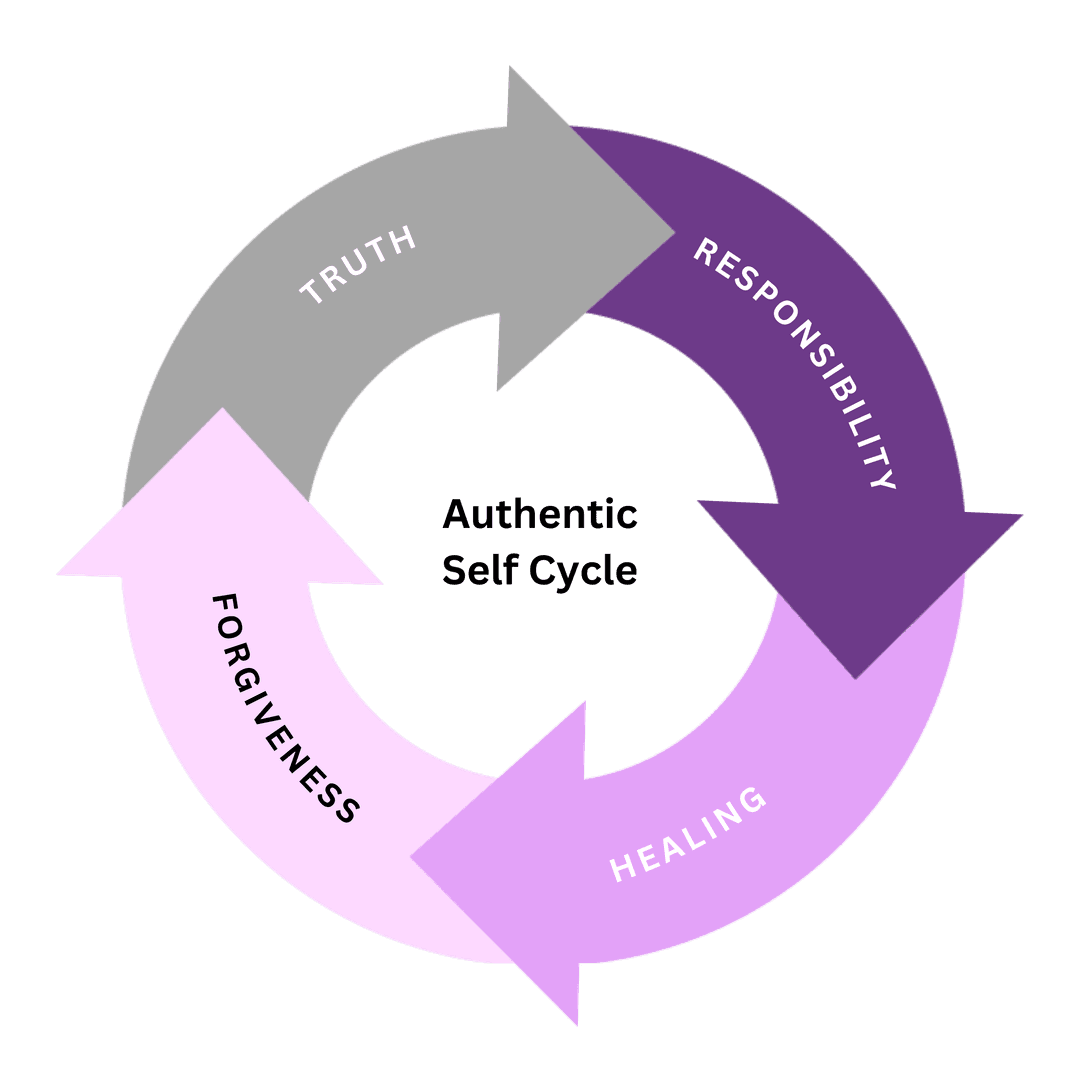
The Worst Day Cycle runs on trauma, fear, shame, and denial. The Authentic Self Cycle™ runs on something entirely different: Truth, Responsibility, Healing, and Forgiveness.
Truth means admitting that the Worst Day Cycle exists — that your adult life has been run by your unhealed childhood emotional blueprint and the survival persona it built. Not the story your survival persona tells about why things keep going wrong. The real emotional reality underneath: that you are reliving childhood emotional blueprint patterns, and that the pain driving your reactions today was placed into you before you had any say in the matter. Truth is the moment you stop pretending the cycle isn’t there and say, out loud or to yourself, This is what’s been happening to me. This is why.
Responsibility means committing to a plan of action. It means deciding that you will develop the knowledge, the skills, and the tools to heal the pain from the past and reclaim your Authentic Self — the person you were before the pain. Responsibility is not self-blame. It is not beating yourself up for having a Worst Day Cycle or blaming your perfectly imperfect caregivers. It is the opposite: it is choosing to take ownership of your healing because no one else can do it for you. It is the commitment to learn, to practice, to show up for the process even when the survival persona screams at you to stop.
Healing means returning to the original emotional moment — the childhood wound where the blueprint was written — and rewriting its meaning at the source. This is where the Emotional Authenticity Method™ lives. This is the process. This is the work of feeling what you were never allowed to feel, tracing it to its origin, and letting your nervous system finally complete what it couldn’t complete as a child.
Forgiveness is what happens naturally when you commit to the first three steps. When you live in truth, take responsibility, and do the healing work, forgiveness doesn’t have to be forced or performed. It arrives on its own. You begin to forgive yourself — for the years spent in the cycle, for the relationships that suffered, for the ways the survival persona caused harm while it was trying to protect you.
And you begin to forgive the perfectly imperfect people from your past who transferred their own unhealed pain into you. Not because what happened was acceptable. But because they were running their own Worst Day Cycle — their own unhealed childhood emotional blueprint — and they passed it forward because no one ever showed them how to heal it either.
When your vagal tank is full, when your insula is reconnected, when new neural pathways have been built through Feelization™, the Authentic Self Cycle™ becomes accessible. Not as an aspiration. As your nervous system’s default state. You can feel without being overwhelmed. You can connect without losing yourself. You can be present in your body without your body feeling like a war zone.
Stephen Porges’ research on the social engagement system explains why this matters so deeply for relationships. Your capacity for genuine connection — for truly being present with another person, hearing them, being vulnerable with them — depends on vagal tone. When trauma drains the vagal tank, the social engagement system shuts down. You can’t simply “choose” to be more connected. Your nervous system won’t allow it. But as vagal tone rebuilds through the EAM, your capacity for real intimacy returns. Not because you decided to trust. Because your nervous system learned that trust is safe.
This is the transformation clients describe again and again: “Scared to death to start, but once we did, it was like this wall just dropped. All the things we feared — the exact opposite happened. We felt relief. We felt safe. Really excited. Pure joy. But most of all, the biggest feeling was lighter. We were lighter because we weren’t carrying the pain from the past anymore.”
Ready to Start?
Your survival persona protected you brilliantly. The shame and the denial did their job. They got you through a childhood that was too much for your nervous system to bear. That was not a weakness. That was genius.
But you are not that child anymore. And the protection that saved you then is the prison that holds you now.
Your brain can change. Your insula can regrow. Your vagal tone can strengthen. Your emotional blueprint can be rewritten. Your Authentic Self — the one that was there before the pain, the one who feels lighter, freer, safer, stronger — has been waiting for you. It never left.
The research is clear. The method is proven. The neuroscience shows the way.
If you would like to begin your journey back to your authentic self, you can pick whichever path feels right for you.
Explore the Emotional Authenticity Method™ — Learn the full process and understand Feelization™ in depth.
Discover Your Worst Day Cycle™ — Take the assessment and see your pattern clearly for the first time.
Start Your Authentic Self Journey — Begin with a course, workshop, or one-on-one coaching.
Work with Kenny Directly — Personalized guidance through the process, at the level where it actually heals.
The Research — 68 Peer-Reviewed Studies
The science behind the Emotional Authenticity Method™ is not anecdotal. It is peer-reviewed, rigorous, and spans three decades of neuroscience research across 32 journals. Below are all 68 validating studies, organized by the framework they support.
Emotional Authenticity Method™ (29 Studies)
- Brain Mechanisms Underlying the Modulation of Heart Rate Variability When Accepting and Reappraising Emotions (2024) — Scientific Reports (Nature)
- The Effects of Mindfulness and Meditation on Vagally-Mediated Heart Rate Variability: A Meta-Analysis (2021) — International Journal of Environmental Research and Public Health / PMC
- From Physiology to Psychiatry: Key Role of Vagal Interoceptive Pathways in Emotional Control (2025) — Biological Psychiatry
- Brain Plasticity and Vagus Nerve Stimulation (2021) — Autonomic Neuroscience: Basic and Clinical
- Vagus Nerve Stimulation Enhances Extinction of Conditioned Fear and Reduces PTSD Symptoms in Rats (2017) — Translational Psychiatry (Nature)
- Heart Rate Variability Biofeedback as a Treatment for PTSD: A Systematic Review and Meta-Analysis (2022) — Multiple journals (VA/DoD funded)
- A Systematic Review of Associations Between Interoception, Vagal Tone, and Emotional Regulation (2020) — Frontiers in Psychology
- Breath of Life: The Respiratory Vagal Stimulation Model of Contemplative Activity (2018) — Frontiers in Human Neuroscience — Gerritsen & Band
- Effects of Voluntary Slow Breathing on Heart Rate and Heart Rate Variability: A Systematic Review and Meta-Analysis of 223 Studies (2022) — Journal of Neuroscience and Biobehavioral Reviews
- Vagus Nerve Stimulation as a Gateway to Interoception (2020) — Frontiers in Psychology
- Intrusive Experiences in PTSD: Treatment Response Induces Changes in the Effective Connectivity of the Anterior Insula (2020) — bioRxiv
- What Has Neuroimaging Taught Us on the Neurobiology of Yoga? A Review (2020) — Frontiers in Integrative Neuroscience
- Interoceptive Awareness Skills for Emotion Regulation: Theory and Approach of MABT (2018) — Frontiers in Psychology — Price & Hooven
- Meditation Experience Is Associated with Increased Cortical Thickness (2005) — NeuroReport — Lazar et al. (Harvard)
- Mindfulness Training Induces Structural Connectome Changes in Insula Networks (2018) — Scientific Reports (Nature)
- Mindfulness-Based Training Attenuates Insula Response to an Aversive Interoceptive Challenge (2016) — Social Cognitive and Affective Neuroscience
- Somatic Experiencing: Using Interoception and Proprioception as Core Elements of Trauma Therapy (2015) — Frontiers in Psychology — Payne, Levine & Crane-Godreau
- Interoceptive Training Impacts the Neural Circuit of the Anterior Insula Cortex (2024) — Translational Psychiatry
- Neural Systems Supporting Interoceptive Awareness (2004) — Nature Neuroscience — Critchley et al.
- How Do You Feel — Now? The Anterior Insula and Human Awareness (2009) — Nature Reviews Neuroscience — A.D. (Bud) Craig
- Creating Memories for False Autobiographical Events in Childhood: A Systematic Review (2017) — Applied Cognitive Psychology — Brewin & Andrews
- Consistency of Adults’ Earliest Memories Across Two Years (2018) — Memory — Ece, Demiray & Gülgöz
- The Fate of Childhood Memories (2016) — Frontiers in Psychology — Wang & Peterson
- A Randomized Controlled Trial of Brief Somatic Experiencing for Chronic Low Back Pain and Comorbid PTSD Symptoms (2017) — European Journal of Psychotraumatology — Andersen et al.
- Somatic Experiencing for Posttraumatic Stress Disorder: A Randomized Controlled Outcome Study (2017) — Journal of Traumatic Stress — Brom et al.
- Schema Therapy for Emotional Dysregulation in Personality Disorders: A Review (2018) — Current Opinion in Psychiatry — Dadomo et al.
- Longitudinal Randomized Comparison Study on the Community Resiliency Model (2026) — Discover Mental Health — Habimana et al.
- Association of Nonsexual and Sexual Traumatizations with Body Image and Psychosomatic Symptoms (2010) — General Hospital Psychiatry
- The Impact of Traumatic Childhood Experiences on Interoception: Disregarding One’s Own Body (2023) — Borderline Personality Disorder and Emotion Dysregulation — Schmitz et al.
Worst Day Cycle™ (22 Studies)
- Non-Invasive Vagal Nerve Stimulation Effects on Hyperarousal in PTSD (2017) — Psychiatry Research: Neuroimaging
- Heart Rate Variability and Trauma Exposure in a Post-Conflict Setting (2016) — BMC Psychiatry
- A Model of Neurovisceral Integration in Emotion Regulation and Dysregulation (2000) — Journal of Affective Disorders — Thayer & Lane
- A Roadmap to Understanding Interoceptive Awareness and PTSD (2024) — Frontiers in Psychiatry
- Childhood Maltreatment Is Associated With Reduced Insular Cortical Volume (2020) — Multiple journals (meta-analysis)
- Diverging Roles of the Anterior Insula in Trauma-Exposed Individuals (2019) — Scientific Reports (Nature)
- Proneness for and Aversion to Self-Conscious Emotion in Posttraumatic Stress (2021) — Psychological Trauma — Schoenleber et al.
- Prospective Relations Between Stigma, Guilt, Shame, and Prolonged Grief Symptoms (2025) — Journal of Affective Disorders — Bottomley et al.
- Experiential Avoidance as a Mediator in Shame and PTSD (2020) — Psychological Trauma — Leonard et al.
- Distinctive Cardiac Autonomic Dysfunction Following Stress Exposure (2016) — Behavioural Brain Research — Koresh et al.
- Attachment Styles and Codependency Among Individuals with Substance Use Disorders (2025) — Journal of Ethnicity in Substance Abuse — Ayhan et al.
- Adverse Childhood Experiences and Shame- and Guilt-Proneness (2019) — Child Abuse & Neglect — Wojcik et al.
- The Scare Tactic: Do Fear Appeals Predict Motivation and Exam Scores? (2014) — School Psychology Quarterly — Putwain & Remedios
- Associations Between Profiles of Self-Esteem and Achievement Goals (2019) — International Journal of Environmental Research and Public Health — Ferradás et al.
- Fear of Failure: Polynomial Regression Analysis (2020) — Anxiety, Stress, and Coping — Giel et al.
- Believing Is Achieving — Role of Treatment Expectation in Neurofeedback (2020) — Progress in Neuro-Psychopharmacology & Biological Psychiatry — Schönenberg et al.
- Psychological Treatments for Children with PTSD: Network Meta-Analysis (2020) — Journal of Child Psychology and Psychiatry — Mavranezouli et al.
- Childhood Adversity and Epigenetic Modulation of the Glucocorticoid Receptor (2012) — PLoS ONE — Tyrka et al.
- Stress, Epigenetics and Depression: A Systematic Review (2019) — Neuroscience and Biobehavioral Reviews — Park et al.
- Adult Avoidant Attachment, Attention Bias, and Emotional Regulation (2022) — Behavioral Sciences
- Dynamics of Attachment and Emotion Regulation in Daily Life (2022) — Cognition and Emotion
- Emotion Regulation Unveiled Through the Categorical Lens of Attachment (2024) — BMC Psychology
Authentic Self Cycle™ (5 Studies)
- The Evolution of Sociality and the Polyvagal Theory (2023) — Biological Psychology — Stephen W. Porges
- The Sentient Self (2010) — Brain Structure and Function — A.D. (Bud) Craig
- Schema Therapy for Borderline Personality Disorder (2006) — Journal of Clinical Psychology — Kellogg & Young
- Schema Therapy for Patients with Borderline Personality Disorder: Single Case Series (2005) — Journal of Behavior Therapy and Experimental Psychiatry — Nordahl & Nysaeter
- Better Than Sham? Double-Blind Placebo-Controlled Neurofeedback Study (2017) — Brain: A Journal of Neurology — Schabus et al.
Cross-Framework (12 Studies)
- Polyvagal Theory: Current Status, Clinical Applications, and Future Directions (2025) — PMC (comprehensive review)
- Resting Vagally-Mediated Heart Rate Variability and Momentary Affect in Daily Life (2024) — Psychophysiology — Bylsma et al.
- Vagal Tank Theory: The Three Rs of Cardiac Vagal Control (2018) — Frontiers in Neuroscience — Laborde, Mosley & Thayer
- Polyvagal Theory: A Science of Safety (2022) — Frontiers in Integrative Neuroscience — Stephen W. Porges
- Toward an Interpersonal Neurobiology of the Developing Mind (1999) — Infant Mental Health Journal — Daniel J. Siegel
- The Polyvagal Theory: New Insights into Adaptive Reactions of the Autonomic Nervous System (2009) — Cleveland Clinic Journal of Medicine — Stephen W. Porges
- Amygdala and Insula Connectivity Changes Following Psychotherapy for PTSD (2021) — Biological Psychiatry: Cognitive Neuroscience and Neuroimaging
- Prevalence of Codependence in Young Women Seeking Primary Health Care (2008) — The American Journal of Orthopsychiatry — Noriega et al.
- Double-Blind Sham-Controlled Randomized Trial of fMRI Neurofeedback in Children With ADHD (2022) — The American Journal of Psychiatry — Lam et al.
- Cost-Effectiveness of Psychological Treatments for PTSD (2020) — PLoS One — Mavranezouli et al.
- The Biology of Belief: Cell Environment Controls Gene Expression (2005) — Book + Original Stem Cell Research — Bruce H. Lipton, PhD
- Epigenetic Modifications of Gene Expression by Lifestyle and Environment (2017) — Archives of Pharmacal Research — Abdul et al.