

Self-deception is the unconscious survival mechanism created in childhood that causes you to deny, minimize, justify, and rationalize painful truths about your family, your relationships, and yourself — it is the fourth stage of the Worst Day Cycle™ and the engine that keeps every other emotional pattern locked in place. If you’ve ever said “my childhood was fine” while your body tells a different story, or stayed in a relationship you know is destroying you while insisting it will get better, or defended someone who hurt you because admitting the truth feels worse than the pain — that’s self-deception. And it’s not your fault. It’s a brilliant strategy your child self invented to survive an impossible situation.
That’s you — the one who can see everyone else’s patterns but can’t see your own. The one who knows something is off but can’t name it. The one who’s been running from a truth that your body has been screaming for decades.
Table of Contents
- What Is Self-Deception?
- Why We Self-Deceive: The Childhood Origins of Denial
- The Survival Persona: Your Childhood Solution
- How the Worst Day Cycle™ Powers Self-Deception
- The Three Types of Survival Personas That Deny Reality
- Signs of Self-Deception Across Your Life
- Why Self-Deception Is So Hard to Break
- The Authentic Self Cycle™: Your Path Out
- The Emotional Authenticity Method™ in Action
- Your Healing Journey: From Denial to Truth
- Frequently Asked Questions
- The Bottom Line
What Is Self-Deception?
Self-deception is the fourth stage of the Worst Day Cycle™—the survival mechanism your childhood self created to deny the truth of your parents’ imperfections, their emotional unavailability, their rage, their neglect, or their own unhealed trauma. It’s the voice that says, “Everything’s fine,” even when your gut knows it isn’t. It’s the internal narrative that justifies, minimizes, rationalizes, and represses what you actually experienced.
Self-deception isn’t a character flaw. It’s a brilliant childhood strategy. And that’s the problem: it was brilliant when you were small and dependent, but it’s sabotaging you now.
Self-deception operates through a survival persona—a false identity your child self created to protect yourself from the unbearable truth that your parents were imperfect, that they couldn’t meet your needs, or that their love was conditional. This denial took three forms depending on your nervous system response: falsely empowered (the controller), disempowered (the people-pleaser), or adapted wounded child (the oscillator between both).
That’s you if you’ve ever said “my childhood was fine” despite growing up with an emotionally distant parent, or defended someone who hurt you, or stayed stuck in a pattern you swore you’d never repeat.
Why We Self-Deceive: The Childhood Origins of Denial
Your child brain faced an impossible choice. Your parents—your survival, your source of food, shelter, and the earliest mirror of who you are—were imperfect. They were angry, unavailable, critical, controlling, or trapped in their own trauma. But you couldn’t acknowledge this truth because it meant three things your nervous system couldn’t tolerate:
- Attachment loss: If I face who my parent really is, I’ll lose connection. Subconsciously, your child brain made the equation: truth = abandonment.
- Existential threat: Without my parent’s approval and protection, I won’t survive.
- Identity collapse: If my parent is the problem, then I was wrong to trust them, and I’ve been betrayed by the one being I needed most.
So your child self made a deal: “I will deny what I see. I will condone, justify, repress, and suppress the truth. I will become whatever my parent needs me to become. I will make it my fault so at least the world makes sense.”
This is why most people say, “Oh, my childhood was fine”—because they’ve gone into massive denial to survive.
 childhood trauma creates denial patterns in adulthood" width="600" style="max-width:100%;height:auto;" />
That’s you if you find yourself defending a parent who hurt you, or minimizing your own experience by saying “it wasn’t that bad,” or feeling ashamed to admit your childhood was painful.
The Survival Persona: Your Childhood Solution
Your survival persona is the identity your child self created to deny reality and survive. It’s not a character defect—it’s a child’s brilliant adaptation to an impossible situation. The problem is you’re still using it.
The survival persona is the identity your brain built in childhood to earn love, maintain attachment, and survive emotional chaos — it was brilliant at age seven but is now the hidden engine behind self-deception, relationship failure, and emotional emptiness in adults.
Think of it this way: your survival persona is a child’s finger painting trying to paint an adult mural. It worked when you were small. The rules were simple. You needed to manage your parent’s moods, earn their approval, or stay small and unnoticed. Your nervous system learned these survival strategies and they became automated—they became who you think you are.
But as an adult, those same strategies that kept you safe now keep you stuck. The child who had to be perfect is now burned out. The child who had to be invisible is now lonely. The child who had to be strong is now isolated. The survival persona believes something powerful: “If I let go, I disappear. If I change, I lose everything. Healing is death—because healing is the death of the survival persona.”
That’s you if you’ve achieved success but feel empty, or if you can’t receive love even when it’s offered, or if you sabotage good things because something inside says you don’t deserve them.
How the Worst Day Cycle™ Powers Self-Deception
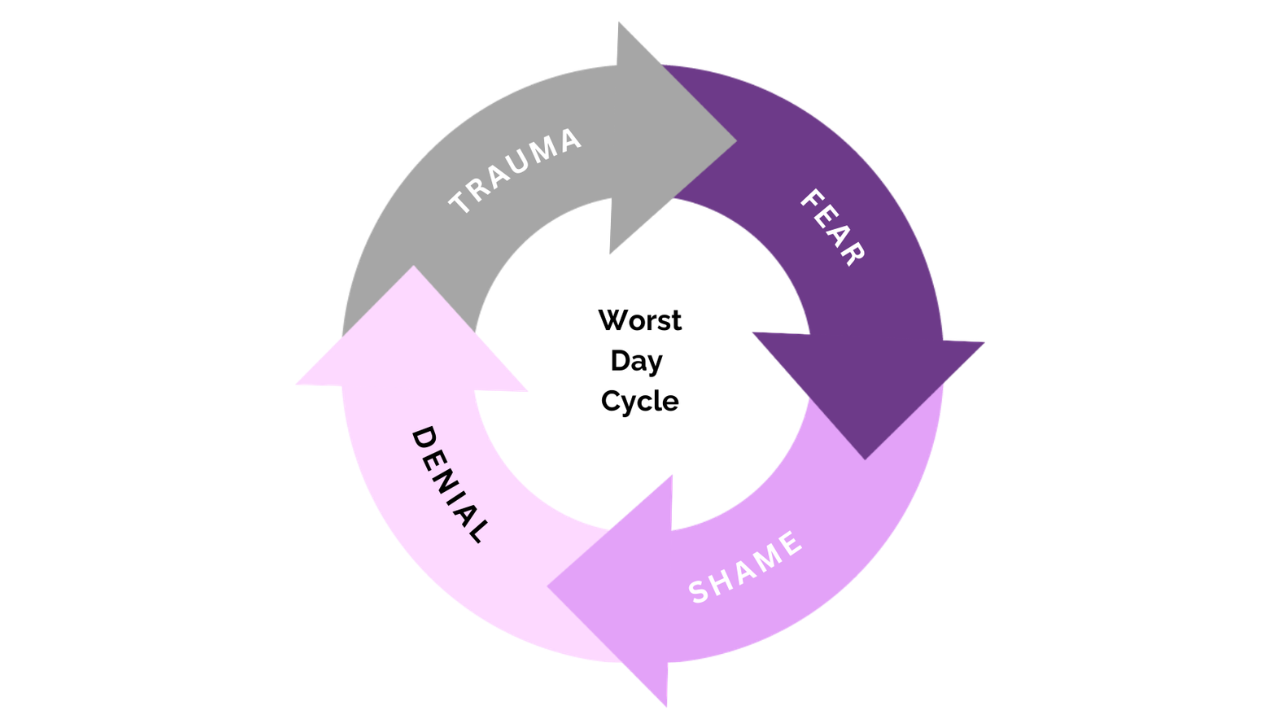
The Worst Day Cycle™ has four stages: Trauma → Fear → Shame → Denial. Self-deception is the final stage—the survival mechanism that protects you from facing the earlier three.
Trauma: Any childhood emotional experience that created painful meanings. Not necessarily abuse—it could be an emotionally distant parent, a sibling who got more attention, a parent’s unhealed trauma bleeding into the home, inconsistent love, or conditional affection. The child brain interprets these experiences and creates meaning: “I’m not enough. I’m too much. I’m invisible. I’m responsible for my parent’s feelings.”
Fear: The hypothalamus in your brainstem responds to this trauma by generating chemical cocktails—cortisol, adrenaline, dopamine, oxytocin misfires. Your nervous system becomes addicted to these patterns because they’re known, and the brain thinks known = safe. Your brain conserves energy by repeating known patterns. It can’t tell right from wrong; it only knows familiar vs. unfamiliar.
Shame: The moment you internalize the message that YOU are the problem. Not your parents’ behavior—you. Your core identity becomes “I am the problem. I am fundamentally wrong. I am unlovable.” Shame is where you lost access to your authentic self.
Denial: The survival persona steps in and creates a false narrative. “My parents did the best they could.” “I shouldn’t have been so sensitive.” “I deserved it.” “That never happened.” “It wasn’t that bad.” Denial protects you from the unbearable grief of admitting your parents were imperfect and you were hurt by people you needed to love unconditionally.
Self-deception is a neurochemical survival strategy created in childhood when the brain learned to deny painful truths about caregivers in order to maintain attachment — it automates denial so thoroughly that the adult genuinely cannot see the pattern without intervention.
This cycle is why you repeat the same relationship patterns, sabotage your success, stay in situations that hurt you, and can’t seem to change even though you desperately want to. Your nervous system is running a program it learned in childhood, and denial keeps you from seeing the pattern clearly enough to interrupt it.
That’s you if you’ve said, “I know I’m repeating my parents’ patterns, but I can’t help it,” or if you stay in situations that hurt you because admitting how much they hurt would be too much to bear.
The Three Types of Survival Personas That Deny Reality
The Falsely Empowered Persona: “I’m In Control”
This survival persona responds to childhood trauma by seizing control. If your parent was unpredictable, rageful, or emotionally unsafe, your nervous system learned to scan for threats and manage them aggressively. You became the controller—hyper-responsible, driven to dominate situations, rageful when things go wrong, unable to receive help or vulnerability.
The denial here is: “If I stay in control, I’ll never be hurt again. If I’m the strongest, the smartest, the most successful, I’ll finally be safe.” The survival persona believes that success, achievement, and dominance equal worth. Self-deception takes the form of minimizing others, staying isolated at the top, or rationalizing aggressive or controlling behavior as “just being responsible.”
That’s you if you’re a high achiever who feels lonely at the top, or if you find yourself controlling your partner or children, or if you rage when you lose.
The Disempowered Persona: “I’m Not Enough”
This survival persona responds to childhood trauma by collapsing into smallness. If your parent was critical, demanding, or made you responsible for their emotions, your nervous system learned: “If I’m small and compliant, I’ll be safe. If I disappear, they’ll stop attacking.” You became the people-pleaser, the caretaker, the one who abandons your own needs to manage everyone else’s.
The denial here is: “If I just love them harder, if I just do more, if I just become who they need me to become, they’ll finally love me.” The survival persona believes that self-abandonment equals love. Self-deception takes the form of staying in relationships that hurt, minimizing your own needs, or telling yourself that suffering means you’re good or noble.
That’s you if you attract narcissists or emotionally unavailable partners, or if you feel guilty when you set a boundary, or if you believe your own needs are selfish.
The Adapted Wounded Child: The Oscillator
This survival persona swings between falsely empowered and disempowered. One moment you’re raging and controlling; the next you’re collapsing into people-pleasing. One moment you’re confident; the next you’re certain you’re worthless. You might be the Controller at work and the People-Pleaser at home. This internal oscillation creates chaos and confusion.
The denial here is: “I’m just complicated. People are just too much. I just need to find the right balance.” The survival persona hides the fact that you’re terrified—of connection, of abandonment, of being fully seen. Self-deception takes the form of explaining away your contradictions, staying in relationships that keep you oscillating, or dismissing your own emotional needs as “too much.”
That’s you if people say you’re “hard to read,” or if you don’t know which version of yourself will show up in relationships, or if you feel like you have multiple personalities depending on the situation.
Signs of Self-Deception Across Your Life
Self-deception shows up differently depending on which area of your life we’re looking at. Here’s how to recognize it:
Family Relationships
- You defend a parent who hurt you, even to yourself
- You minimize or reframe childhood abuse as “just how they were”
- You stay enmeshed with family members who don’t respect your boundaries
- You feel responsible for your parent’s emotional wellbeing
- You believe your parent did the best they could, even with evidence they didn’t
- You’re unclear about what you actually feel versus what you think you should feel
That’s you if you’ve defended a family member to friends, then gone home and cried about how they treated you.
Romantic Relationships
- You stay with partners who are emotionally unavailable, like your opposite-gender parent
- You convince yourself that crumbs of attention mean they love you
- You believe you can change them if you just love them enough
- You ignore red flags because you’re invested in a narrative that isn’t true
- You sabotage good relationships because something feels “wrong” about being loved
- You attract partners who activate your childhood trauma, then deny the pattern
Learn more about this pattern in our post on insecurity in relationships.
That’s you if you stay with someone because “they have potential,” or if you tell yourself that a partner who hurt you “didn’t mean it,” or if you accept behavior you’d never tolerate from a friend.
Friendships
- You befriend people who consistently disrespect or use you
- You believe you’re responsible for managing friends’ emotions
- You minimize how badly you’re being treated to keep the friendship
- You don’t have friendships where you feel fully safe being yourself
- You deny that certain friendships are one-sided or draining
- You believe you’re the problem if a friendship isn’t working
That’s you if you have friends who consistently cancel on you, and you tell yourself “they’re just busy” rather than admitting they don’t prioritize you.
Work & Career
- You work in environments where you’re underpaid, overworked, or disrespected
- You deny that your boss is manipulative, and blame yourself for not meeting their demands
- You can’t receive recognition or compliments about your work
- You sabotage promotions or success opportunities
- You believe if you just work harder, finally you’ll be enough
- You’re disconnected from what you actually want, pursuing what you think you should want
Explore more about self-worth and deserving good things in our post on signs of high self-esteem.
That’s you if you’ve stayed in a job that was killing you because you believed you weren’t skilled enough to leave, or if you can’t accept a compliment about your work without immediately finding fault.
Body & Health
- You ignore symptoms because you don’t deserve to take care of yourself
- You tell yourself you’re fine when you’re actually struggling with anxiety, depression, or chronic pain
- You deny that stress is affecting your health
- You sabotage weight loss or fitness efforts because you don’t believe you deserve to feel good
- You numb physical or emotional pain through substances, food, or compulsions
- You believe your body is wrong or needs to change before you can accept yourself
That’s you if you’ve ignored a health concern for months, then been shocked when a doctor says it’s serious, or if you can’t rest even when you’re exhausted because you feel like you don’t deserve it.
Why Self-Deception Is So Hard to Break
Here’s the brutal truth: your survival persona doesn’t want to change. It believes change is death.
Your nervous system has been running the same program for decades. Every cell in your body has myelin—insulation around neural pathways—that’s been reinforced through repetition. Your survival persona is hardwired. Breaking denial requires you to:
- Face unbearable grief: The realization that your parents were imperfect, that you were hurt by the people you needed most, and that some of what happened to you was genuinely unfair.
- Release a false identity: The person you’ve believed you are—the strong one, the responsible one, the unneedy one, the perfect one—wasn’t real. It was armor.
- Admit you’ve been an imposter: You’ve lived your life as someone you’re not. That’s a profound loss to grieve.
- Face abandonment fears: Your subconscious believes that if you stop performing this identity, you’ll be abandoned or discovered as a fraud.
This is why denial is so powerful. It’s not weakness; it’s a survival strategy that made perfect sense when you needed it. The work isn’t to shame yourself for using it—it’s to recognize it’s no longer serving you and gently, with compassion, choose something different.
The Authentic Self Cycle™: Your Path Out of Denial
The Authentic Self Cycle™ is the healing counterpart to the Worst Day Cycle™. Where the WDC says Truth → Fear → Shame → Denial, the ASC rewires your system through Truth → Responsibility → Healing → Forgiveness.
Stage 1: Truth
Truth means naming your emotional blueprint—the painful meanings your child brain created about yourself, your worth, and what’s possible. It means looking at your actual childhood without the denial, the minimization, or the rationalizations. It means seeing clearly: “This actually happened. It actually hurt. I was actually a child who couldn’t protect myself.”
This isn’t about blaming your parents. It’s about separating their behavior from your worth. Their imperfection doesn’t define you. Their inability to love you the way you needed doesn’t mean you’re unlovable—it means they were limited.
That’s you when you first allow yourself to say out loud: “My parent actually hurt me,” without immediately defending them or minimizing it.
Stage 2: Responsibility
Responsibility means owning your emotional reactions without blame. It means recognizing: “I have been choosing this survival persona. I have been choosing denial. I have been staying in situations that hurt. I created the patterns that are keeping me stuck.”
This isn’t shame. Shame says “I am bad.” Responsibility says “I made choices based on incomplete information, and I can choose differently now.” You’re not responsible for what happened to you in childhood. You ARE responsible for what you do about it now.
That’s you when you stop blaming your parents or your partner or your circumstances and start asking yourself: “What am I not seeing? How am I participating in my own pain?”
Stage 3: Healing
Healing means rewiring your emotional blueprint so that conflict becomes uncomfortable but no longer dangerous. In childhood, conflict meant potential abandonment or attack. Your nervous system still believes this. Healing means creating new neural pathways where you can disagree with someone and stay emotionally safe. Where you can face hard truths and not fall apart. Where your worth isn’t dependent on being perfect.
This is where the Emotional Authenticity Method™ comes in—a six-step process to rewire your emotional responses and create a new chemical addiction to the feelings of your authentic self instead of your trauma.
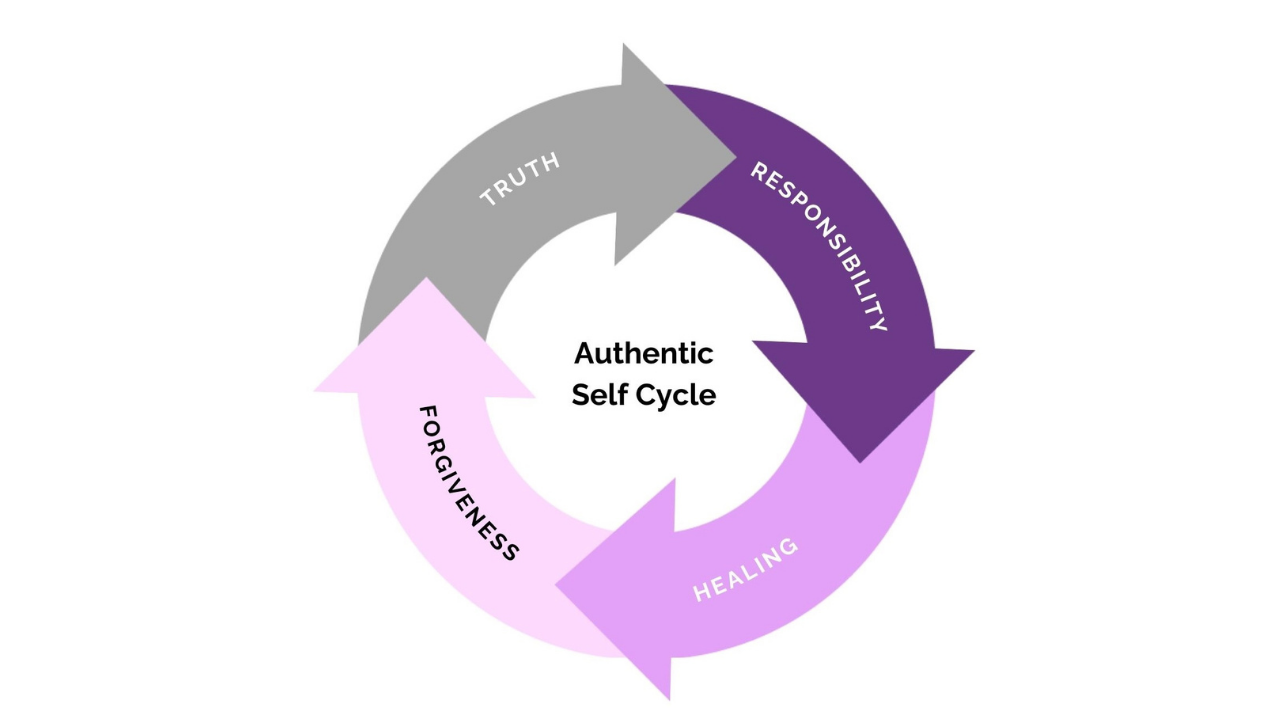
Stage 4: Forgiveness
Forgiveness means releasing the inherited emotional blueprint and reclaiming your authentic self. It means forgiving yourself for the survival strategies that made sense at the time. It means forgiving your parents not because what they did was okay, but because holding onto rage is like drinking poison and expecting them to die.
Forgiveness isn’t about reconciliation. It’s about freedom. It’s about no longer letting their imperfection or your childhood trauma run your adult life.
That’s you when you can talk about your parents’ flaws without rage, when you can acknowledge your pain without letting it define you, when you can move forward without carrying their burden.
The Emotional Authenticity Method™ Method™ in Action
The Emotional Authenticity Method™ is a six-step process to break denial and rewire your emotional blueprint. Here’s how it works:
Step 1: Somatic Down-Regulation
When you’re triggered, your nervous system is flooded. Your survival persona takes over. Before you can access truth or make new choices, you have to calm your body. Focus on what you can hear for 15-30 seconds. If you’re highly dysregulated, use titration—alternate between the trigger and something calming.
This step takes you out of fight-or-flight and into your prefrontal cortex where you can actually think clearly.
Step 2: What Am I Feeling Right Now?
Use emotional granularity. Don’t just say “bad.” Are you angry? Scared? Ashamed? Disappointed? Lonely? Use the Feelings Wheel to expand your emotional vocabulary. Precision matters because different emotions point to different childhood wounds.
Step 3: Where in My Body Do I Feel It?
Emotions aren’t just in your brain—they’re in your body. Where do you feel this feeling? Your chest? Your stomach? Your throat? Your legs? Noticing the somatic location helps you access the nervous system directly.
Step 4: What Is My Earliest Memory of Having This Exact Feeling?
This is where you connect current pain to childhood pain. Your nervous system is reacting to today’s trigger as if it’s yesterday’s trauma. By finding the original wound, you can see the pattern clearly. You can say: “Oh, this isn’t actually about my partner’s comment. This is about my parent’s critical voice. I’m a child again, desperate to be good enough.”
Step 5: Who Would I Be If I Never Had This Thought or Feeling Again?
This is the vision of your authentic self. Not the falsely empowered controller. Not the disempowered people-pleaser. The real you. What would be possible if you weren’t running this old program? How would you show up in relationships? How would you live?
Step 6: Feelization
Sit in the feeling of your authentic self and make it strong. Don’t just visualize it—FEEL it. Feel what it’s like to be grounded, worthy, seen, able to say no, able to receive love. Your nervous system is addicted to the feelings of your trauma. Feelization creates a new addiction—to the neurochemical state of your authentic self.
That’s you when you can name what you’re feeling, trace it to childhood, and then consciously choose a different response in the moment—when your behavior comes from your authentic self instead of your survival persona.
Your Healing Journey: From Denial to Truth
Breaking denial isn’t one moment. It’s a thousand small moments where you choose to see more clearly, to feel more deeply, to be more honest with yourself.
It starts small. You notice yourself defending someone who hurt you. You pause. You ask: “Why am I doing this?” You realize you’re protecting them to protect yourself—because if they’re bad, then your childhood was bad, and that’s too much pain to feel.
Then you try something different. You let yourself feel angry at someone you’ve always forgiven. It’s terrifying. But something shifts. You’re no longer a powerless child. You can hold them accountable and survive.
Then you recognize a pattern. You realize you’ve recreated your childhood in your marriage. That your boss is just like your parent. That your best friend takes and takes and never gives. And this time, instead of denying it, you name it. You get help. You set boundaries. You leave situations that hurt.
This is what happens when you move from denial to truth. Not overnight. Not without grief. But gradually, you become more authentically yourself. Less defended. More capable of real connection. More free.
That’s you in the middle of the healing journey—not fully there, but willing. Scared but honest. Grieving but also hopeful.
Three Metaphors That Illuminate Self-Deception
Sometimes the clearest understanding comes not from analysis, but from image and story. These three metaphors from the Emotional Authenticity work cut to the heart of why self-deception happens and what healing looks like.
The Child Finger Painting Trying to Paint an Adult Mural
Your survival persona is a child’s response to a child’s world. It made sense when you were small and dependent. But you’re not small anymore. The rules have changed. The skill sets have changed. Yet you’re still operating with a child’s toolkit.
A child’s finger painting is beautiful and deserves love. But ask that child to paint an adult mural and it won’t work. Not because the child is bad or wrong, but because the tool doesn’t fit the task. That’s your survival persona in your adult relationships, career, and life. It can’t do what you’re asking of it. And the denial is the voice that says, “Actually, this is fine. This is working great.”
The Pain Buffet Table
The shame you carry isn’t yours. You’re sitting at your parents’ pain buffet table, eating their emotional pain, their unmet needs, their untreated trauma. They didn’t have choices about what got served. They inherited it from their parents. But somewhere, the line stops.
Denial says: “This is my pain. I deserve this. I should carry this.” Truth says: “This is inherited. It’s not mine to carry. I can put it down.”
Healing is choosing to stop eating from that buffet table and creating your own kitchen where you serve yourself nourishment instead of poison.
The Three Voices and the Microphone
When you’re triggered, three voices operate at once. The Child Voice is panicked: “I’m going to be abandoned. I’m not safe.” The Shame Voice attacks who you are: “You’re pathetic. You don’t deserve this. You’re too much.” The Adult Voice is calm and grounded: “This is hard, and I can handle it. This is about them, not me. I’m safe.”
Denial is when the Child Voice and Shame Voice grab the microphone and convince you they’re telling the truth. Your survival persona sides with them and says, “Hide. Deny. Perform. Make it disappear.”
Healing is learning to recognize all three voices, give the microphone to your Adult Voice, and let it speak the truth that counters the lies your trauma taught you.
That’s you when you start noticing which voice is running the show, and you’re consciously choosing to let the grounded, adult part of you lead instead of the panicked, shamed child.
The Victim Position Paradox and Self-Deception
Here’s something most denial work misses: as long as you’re stuck in the Victim Position Paradox, you can’t break denial effectively.
The Victim Position Paradox is the invisible agreement you made in childhood: “If I stay in this role, if I don’t change, if I keep suffering, then I have an excuse for not pursuing my dreams. I have an explanation for my pain. I’m not responsible.”
There’s a secondary gain to staying in denial. Denial allows you to stay a victim—and victims have an excuse. Their suffering makes sense. They can’t be blamed for their circumstances because they’re too hurt, too damaged, too broken.
But at some point, you have to choose. Do you want to be right about how broken you are? Or do you want to be free?
You can’t be both. Breaking denial means moving out of the victim role and into ownership. It means saying: “I was a victim of my childhood. AND I am responsible for my adulthood. Both are true.”
This is why denial is so seductive. It lets you off the hook. It says, “You’re a victim; you can’t help it; it’s not your fault.” Healing says, “What happened to you wasn’t your fault. AND your response to what happened is now your responsibility.”
The Authentic Self Cycle™ is an identity restoration system that replaces the Worst Day Cycle™ by moving through Truth, Responsibility, Healing, and Forgiveness — creating a new neurochemical pattern that replaces fear, shame, and denial with safety, worth, and authentic connection.
That’s you when you stop asking “why did this happen to me?” and start asking “what am I going to do about this?”—when you move from victim to survivor to thriver.
Frequently Asked Questions: Your Self-Deception Questions Answered
Is self-deception the same as lying to myself?
Not exactly. Lying is conscious—you know the truth and choose to deny it. Self-deception is unconscious—your nervous system has literally repressed, suppressed, or reframed the truth so thoroughly that you genuinely don’t see it. You’re not intentionally lying. Your survival persona has automated denial to protect you from unbearable pain. That’s why it’s so hard to break—you’re not lying; you’re defending.
How do I know if I’m in denial about something?
Pay attention to three signals: First, you’re defending someone or a situation to others and to yourself. Second, your gut feels one way but your story says another. Third, you keep repeating the same pattern even though you swear you won’t. If the evidence doesn’t match your narrative, denial is running the show.
Can I heal from self-deception without therapy?
Self-awareness and the frameworks in this post can create movement. But denial is powerful, and your nervous system is expert at protecting you from what it thinks will destroy you. Working with a therapist or coach who understands trauma, attachment, and the survival persona accelerates the process significantly. You can hire professional support without it meaning you’re broken—it means you’re serious about freedom.
What if breaking my denial means losing my relationship or my family?
This is the real fear underneath denial. Your subconscious believes that if you stop performing this identity, if you speak your truth, if you set boundaries, you’ll be abandoned. Sometimes that fear is based in reality—some people will reject you for becoming authentic. But staying in denial guarantees losing yourself. And relationships built on denial aren’t real relationships; they’re transactions where you exchange your authenticity for their approval. Real intimacy requires truth. If someone leaves because you got healthier, they were never going to stay anyway.
How long does it take to stop self-deceiving?
Breaking a lifetime of denial isn’t a linear process. You’ll have breakthroughs followed by old patterns resurfacing. You’ll see something clearly one day and slip back into denial the next. But with consistent work using tools like the Emotional Authenticity Method™, most people report significant shifts in 3-6 months. Real integration takes longer—usually 1-2 years to feel like you’re operating from your authentic self most of the time. The key is consistency and self-compassion, not perfection.
Is there shame in realizing I’ve been self-deceiving my whole life?
There can be. But remember: self-deception was a brilliant survival strategy. Your child brain created it to save your life. Honor that. At the same time, recognize that as an adult, you have choice. You don’t have to keep using it. Grief is healthy here—grief for the lost years, for the patterns, for the person you could have been. But shame? That’s just your old voice trying to keep you small. Your authentic self knows better.
The Bottom Line: Your Real Self Is Waiting
Self-deception is a survival mechanism your child self created to protect you from unbearable truth. It was genius. It kept you connected to your parents. It helped you survive impossible situations. But as an adult, it’s costing you authenticity, freedom, and real connection. Your survival persona—whether falsely empowered, disempowered, or oscillating between both—isn’t who you are. It’s armor you no longer need to wear.
The path out isn’t through more denial or more shame. It’s through truth. Through recognizing that your parents’ imperfections don’t define your worth. Through owning your choices without blame. Through rewiring your nervous system so that vulnerability isn’t dangerous and conflict isn’t fatal. Through creating a new chemical addiction to the feelings of your authentic self.
This is possible for you. Not because healing is easy—it’s not. But because your authentic self is still in there, waiting. The real you. The one who doesn’t need to control or collapse or perform. The one who can feel, grieve, rage, laugh, and love from a place of truth.
Your parents couldn’t give you the perfect childhood. They couldn’t give you perfect love. But you can give yourself something more valuable than perfection: you can give yourself truth. You can stop denying. You can become who you actually are.
That’s the work. That’s the freedom waiting for you on the other side of denial.
What to Do Right Now: Your Next Steps
You’ve read this post. You see yourself in it. Here’s what to do:
- Complete the Feelings Wheel exercise. Expand your emotional granularity. Start noticing which feelings are actually running your behavior. This single practice changes everything.
- Identify your survival persona type. Are you falsely empowered, disempowered, or oscillating? Write down specific examples of how this persona shows up. Name it. See it clearly.
- Trace one pattern to childhood. Pick one situation where you’re self-deceiving. Use Step 4 of the Emotional Authenticity Method™ to find your earliest memory of this exact feeling. Write it down. This is where the pattern started.
- Consider a course or coaching. Self-awareness is the first step. But rewiring happens through structured work and often through one-on-one or group support. The courses below are designed specifically for this.
Recommended Courses for Breaking Denial and Healing
Transform Your Relationship With Truth
Self-deception doesn’t happen in isolation—it shapes every relationship and life area. These courses are designed to help you move from denial to authentic living:
Discover your emotional blueprint and begin rewiring it. Learn the foundations of the Authentic Self Cycle™ and start using the Emotional Authenticity Method™.
$79
See how denial shows up in partnerships. Learn to break the Worst Day Cycle™ with your partner and build intimacy based on truth.
$79
Deep dive into the neurobiology of attachment, trauma, and how self-deception keeps you repeating painful patterns. Understand the science behind your survival persona.
$479
For the falsely empowered survival persona: Understand why success hasn’t translated to intimacy, and how to break the control-and-distance pattern.
$479
For those attracted to emotionally unavailable partners: See the Victim Position Paradox clearly and break the pattern of seeking unavailable love.
$479
The most comprehensive program. Learn all six steps of the Emotional Authenticity Method™ in depth, with daily practices, group work, and transformation.
$1,379
Ready to move from denial to truth? Start with the Emotional Blueprint Starter Course — Individual™ or go deeper with Tier 1: Mapping the Blueprint. Each course includes video training, worksheets, and lifetime access.
Recommended Reading: Masters of the Healing Field
These authors and teachers have deeply influenced the frameworks in this post:
- Mellody Beattie — Codependent No More and The Language of Letting Go. The foundational work on self-abandonment and recovery.
- Gabor Maté — When the Body Says No and Scattered Minds. Essential neurobiology of trauma and stress.
- Bessel van der Kolk — The Body Keeps the Score. The neuroscience of how trauma lives in your nervous system and how to heal it.
- Brené Brown — Dare to Lead and The Gifts of Imperfection. Vulnerability as strength and shame resilience.
- John Bradshaw — Homecoming: Reclaiming and Championing Your Inner Child. The foundational work on reparenting your wounded child.
- Harriet Lerner — Why Won’t You Apologize?. The psychology of apology and the denial that prevents healing in relationships.
Deep work on self-deception and denial requires reading that challenges you. These books are investments in understanding yourself at the deepest level.
Related Articles: Continue Your Healing Journey
You’ll deepen your understanding with these companion posts:
- The Signs of Enmeshment: Why You Can’t Separate From Your Parents — How denial keeps you fused with family.
- Insecurity in Relationships: 7 Signs Your Survival Persona Is Running the Show — How self-deception sabotages intimacy.
- Signs of High Self-Esteem: What Real Confidence Looks Like — The opposite of denial: clarity and groundedness.
- Negotiables & Non-Negotiables in Codependence Recovery — How to know what’s acceptable and what isn’t as you break denial.
- 10 Do’s and Don’ts for a Great Relationship — How to build intimacy based on truth instead of denial.
What Others Are Saying
Loading reviews…