

Childhood trauma is any negative emotional experience that created painful, inaccurate beliefs about yourself, others, or the world. It isn’t always dramatic — it can be subtle dismissal, conditional love, perfectionism, or unspoken rules. Most of us don’t realize we carry it because we learned to survive it early. The body remembers what the mind denies.
Table of Contents
- What Is Childhood Trauma?
- Why You Don’t Recognize It
- The Worst Day Cycle™
- Your Survival Persona: Three Types
- Childhood Trauma Signs by Life Area
- Your Body Keeps Score
- Recognizing Family Patterns
- How Trauma Shows Up in Romantic Relationships
- Friendships and Boundary Issues
- Work, Perfectionism, and Achievement
- The Authentic Self Cycle™: Your Path to Healing
- The Emotional Authenticity Method™
- People Also Ask
- The Bottom Line
- Recommended Reading
- Get Started Today
What Is Childhood Trauma?
Most people think childhood trauma has to be dramatic — abuse, neglect, loss. The truth is far more subtle and far more common.
Childhood trauma is any negative emotional experience that created painful, inaccurate beliefs about yourself, others, or the world — and your nervous system learned to fear repeating that experience. It’s the parent who withheld approval. The sibling who was always preferred. The message that your feelings were “too much” or “not enough.” The demand for perfection. The withdrawal of love when you disappointed someone. The unspoken rule that your needs came last.
That’s you — the one who says “my childhood was fine” while your body tells a completely different story.
When childhood messaging is shame-based (and statistics show 70%+ of childhood messaging is), your developing brain creates neural pathways of unworthiness. The amygdala, your threat-detection center, becomes hyperactive. Your hypothalamus begins producing chemical cocktails — cortisol (stress), adrenaline (fear), dopamine misfires (addiction to pain), and oxytocin corruption (twisted bonding). By adulthood, your nervous system is addicted to these emotional states because they’re the most familiar states your brain knows.
The brain is energy-efficient. It conserves energy by repeating known patterns, whether those patterns hurt us or heal us. The brain can’t tell right from wrong — it only knows known versus unknown. When your childhood taught you that abandonment, criticism, control, or shame was “normal,” your adult brain will seek situations that feel like home, even when home was painful.
The most dangerous part? You don’t recognize it’s happening.
Why You Don’t Recognize It — The Denial Problem
Your childhood survival persona is brilliant. It protected you. It kept you safe. It helped you navigate an unpredictable, shaming, or conditional environment by becoming someone who wouldn’t trigger the pain again.
The problem is that in adulthood, your survival persona becomes your saboteur.
Denial is the final stage of the Worst Day Cycle™ — it’s the survival persona created to survive the pain. In childhood, denial worked. It let you function. It let you go to school, perform, achieve, dissociate from the pain long enough to survive each day. Many high achievers, successful professionals, and “fine on the outside” people are living in deep denial about their childhood wounding.
That’s you — the one with the perfect resume, the successful career, and the sneaking feeling that something is deeply wrong with your closest relationships.
Why don’t you see it? Because:
- Normalization: If everyone in your family did it, it felt normal.
- Minimization: “It wasn’t that bad” — a defense mechanism that keeps you trapped.
- Blame-shifting: You blame yourself for how you “turned out” instead of looking at what you survived.
- Loyalty confusion: Recognizing parental wounding feels like betrayal.
- Survival persona protection: Your survival persona is still convinced that showing your authentic self = danger.
The Worst Day Cycle™: How Trauma Perpetuates Itself
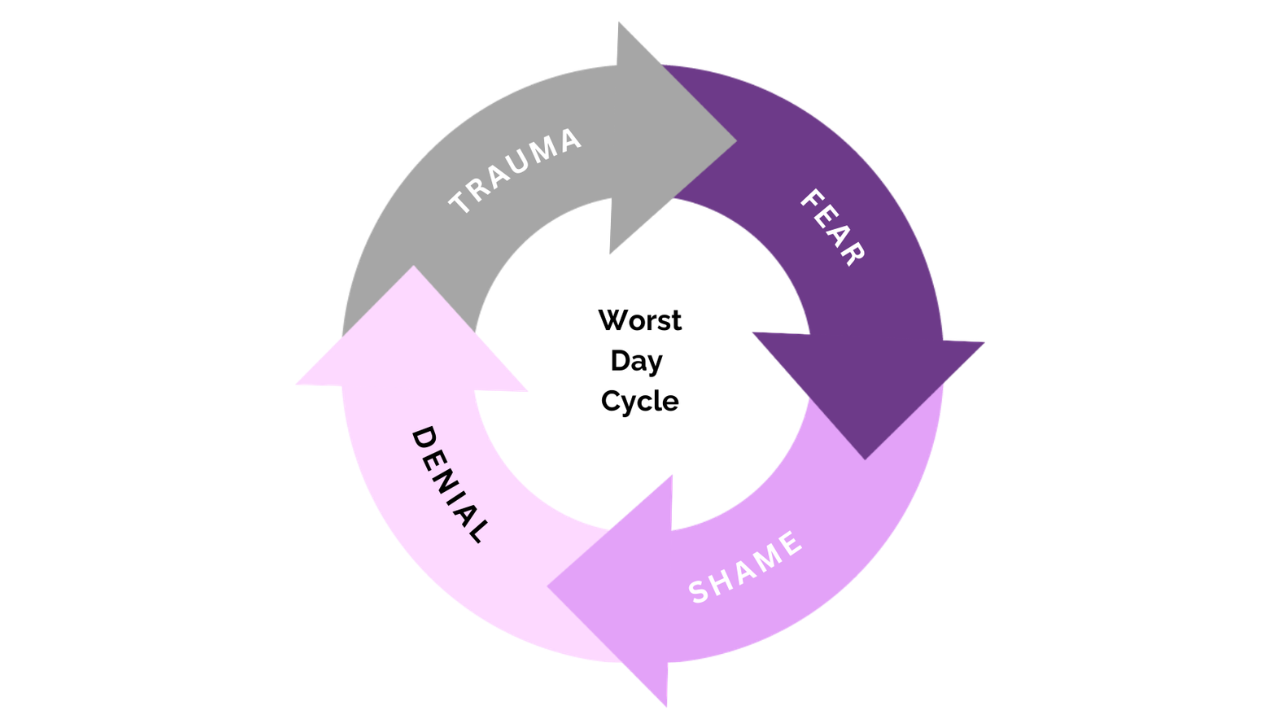
The Worst Day Cycle™ is a four-stage system that explains how childhood trauma doesn’t stay in the past — it repeats in the present through your nervous system.
Stage 1: Trauma (The Wound)
A negative emotional experience created a painful belief. Maybe it was conditional love — “I only matter if I achieve.” Maybe it was enmeshment — “I don’t have a separate identity from my parent.” Maybe it was criticism — “I’m fundamentally flawed.” Maybe it was parentification — “Your emotional needs are my responsibility.” Whatever the wound, it embedded itself in your emotional blueprint.
Stage 2: Fear (The Hypervigilance)
Your body learned to be afraid of repeating that experience. The hypothalamus stays on alert. Your nervous system scans constantly for threats that match the original wound. A partner’s distance triggers abandonment terror. A mistake at work triggers shame spirals. A friend’s honesty triggers criticism dread. Fear drives repetition because your brain thinks repetition = safety. If you can predict and control the pain, you won’t be surprised by it.
That’s you — the one who says “I just saw it coming” after another relationship ends the same way.
Stage 3: Shame (The Identity Corruption)
Shame is where you lost your inherent worth. It’s the belief that you are the problem, not what happened to you. Unlike guilt (“I did something bad”), shame says “I am bad.” Shame lives in the body as tension, numbness, contraction. It drives compulsive behaviors — over-achieving, perfectionism, people-pleasing, self-sabotage, addiction, dissociation. Shame is the breeding ground for survival personas.
Stage 4: Denial (The Survival Persona)
Denial is not ignorance. It’s a sophisticated psychological defense. It’s the protective identity you created to survive. It tells you: “This doesn’t bother me.” “I’m fine.” “I don’t need anything.” “I’m too strong for this.” The survival persona is brilliant — it worked in childhood. But in adulthood, it prevents genuine intimacy, Emotional Authenticity Method™, and real healing.
How the cycle repeats: Trauma → Fear (hypervigilance) → Shame (identity corruption) → Denial (survival persona) → Repeated trauma patterns. The cycle spins because your nervous system is addicted to the familiar chemical states of fear, shame, and the dopamine spike of denial/numbing.
Your Survival Persona: Three Types
Your survival persona is not your authentic self. It’s a protection system. Understanding which type you developed is the first step to stepping out of denial and into healing.
Type 1: The Falsely Empowered Survival Persona
You became the fixer, the achiever, the independent one. You learned early that if you could be perfect, successful, or in control, you could prevent the pain. You over-function in relationships. You’re the strong one. The one who “has it all together.” You rarely ask for help because asking = weakness in your emotional blueprint.
That’s you — the one organizing everyone else’s life while your own is secretly falling apart.
The falsely empowered persona shows up as workaholism, perfectionism, control-seeking, and the inability to be vulnerable. Relationships feel transactional to you because you’re always the giver, never truly the receiver.
Type 2: The Disempowered Survival Persona
You learned to disappear. You became small, quiet, compliant. Maybe the family rule was “don’t speak up” or “your needs don’t matter” or “peace at any cost.” You became the peacekeeper. You read the room. You absorbed everyone’s emotions. You say yes when you mean no. You apologize for existing.
The disempowered persona shows up as passive-aggression, people-pleasing, difficulty with boundaries, and chronic resentment. You blame others for taking advantage of you, but you never actually said no.
Type 3: The Adapted Wounded Child
You oscillate between the two. Sometimes you’re falsely empowered (controlling, critical, managing). Sometimes you’re disempowered (withdrawn, resentful, compliant). You swing between extremes because you never developed a stable sense of self. Your emotional blueprint taught you that relationships are unsafe and unpredictable, so you’re always scanning for danger.
That’s you — the one in the relationship where you’re sometimes the fixer and sometimes the victim, cycling through the same conflict patterns over and over.
The adapted wounded child shows up as relationship instability, emotional volatility, and the feeling that you’re acting rather than living.
Childhood Trauma Signs by Life Area: How Your Wound Shows Up
Childhood trauma doesn’t announce itself. It shows up as patterns, reactions, and behavioral loops. Here’s where to look:
Signs in Your Family of Origin Relationships
The definitive sign of childhood trauma family patterns: You’re still trying to get your childhood needs met from people who couldn’t meet them then and can’t meet them now. You’re waiting for the approval that never came. The warmth that was conditional. The love that felt safe. You’ve become skilled at managing their emotions, anticipating their needs, and taking responsibility for their feelings.
Common family patterns include:
- Chronic guilt around disappointing parents (even as an adult)
- Difficulty setting boundaries with family members
- Taking responsibility for a parent’s happiness or emotional state
- Defending the parent to others while feeling angry with them privately
- Minimizing what happened (“It wasn’t that bad”)
- Feeling obligated to stay in contact even when relationships are painful
- Repeating family patterns with your own children
- Enmeshment — not knowing where your emotions end and theirs begin
That’s you — the one who still feels like a child around your parents, apologizing for things that weren’t your fault.
Signs in Romantic Relationships
Childhood trauma in relationships looks like choosing people who echo your original wound, then being shocked when they do. If your parent was emotionally unavailable, you choose unavailable partners. If your parent was critical, you choose critical partners. Your nervous system recognizes the pattern as “familiar = home,” even though home was painful.
Common romantic patterns include:
- Choosing emotionally unavailable partners (and trying to fix them)
- Attracting partners with similar wounds (creating a dysfunction cycle)
- Inability to tolerate conflict — shutting down, numbing, or over-reacting
- Hypervigilance to partner’s moods and distance
- Using sex/intimacy as a way to manage fear of abandonment
- Difficulty asking for needs to be met (then resenting your partner for not knowing)
- Oscillating between controlling and compliant, depending on fear level
- Betrayal and infidelity patterns
- The ending being identical to the beginning: intense connection followed by gradual disconnection
That’s you — the one saying “Why do I always end up with the same person?” when you consciously chose someone completely different.
If you’re noticing these patterns, read our post on relationship insecurity signs and explore enmeshment patterns in depth.
Signs in Friendships
Childhood trauma shows up in friendships as boundary confusion, role rigidity, and relationship imbalance.
- You’re always the listener, never the one being listened to
- You take on your friend’s problems as your responsibility
- You feel guilty saying no or taking space
- You choose friends who need “fixing” (mirroring your family role)
- You abandon relationships when they require reciprocal vulnerability
- You feel resentful because “nobody is there for you” (but you never asked)
- You struggle with friends’ success because their winning feels like your losing
- Friendships often end in conflict or ghosting when boundaries get tested
That’s you — the friend who shows up for everyone else’s crisis while your own life quietly crumbles.
Signs in Work, Achievement, and Performance
Childhood trauma shows up at work as perfectionism, overfunction, and the inability to ever feel “good enough.”
- Chronic overworking or over-delivering to feel worthy
- Perfectionism that prevents you from finishing projects or taking risks
- Difficulty accepting praise or promotions (imposter syndrome)
- Choosing careers that require self-sacrifice (proving your worth through suffering)
- Shutting down during conflict with authority figures (or over-compliance)
- Difficulty delegating because “nobody does it right”
- Using work to avoid intimate relationships
- Fear of being “found out” as not actually competent
- Success followed by self-sabotage (achieving, then falling apart)
That’s you — the high achiever with the title, the salary, and the gnawing sense that you’re a fraud.
Your Body Keeps Score: Physical Signs of Childhood Trauma
The body holds what the mind denies: Childhood trauma creates measurable changes in nervous system regulation, sleep architecture, immune function, and chronic pain patterns. This is not psychosomatic. This is biology.
Physical signs of childhood trauma include:
- Chronic tension: Neck, shoulders, jaw clenching (holding the feelings you won’t feel)
- Sleep disturbance: Insomnia, night terrors, restless sleep (nervous system can’t downshift)
- Digestive issues: IBS, reflux, constipation (the gut is your second brain; trauma lives here)
- Chronic pain: Back pain, headaches, fibromyalgia (the body feels the pain the mind denies)
- Hypervigilance: Always scanning the room, exaggerated startle response, inability to relax
- Numbness or dissociation: Disconnection from your body, feeling like you’re watching yourself live
- Immune dysfunction: Frequent illness, slow recovery, autoimmune conditions
- Sexual dysfunction: Difficulty with arousal, pleasure, or feeling safe during intimacy
- Appetite dysregulation: Eating too much (numbing), too little (control), or chaotic patterns
That’s you — the one who “just has a sensitive stomach” or “has always been a light sleeper,” not realizing your nervous system is in chronic fight-or-flight.
Breaking Free: The Authentic Self Cycle™
If the Worst Day Cycle™ is how trauma perpetuates, the Authentic Self Cycle™ is how you heal.
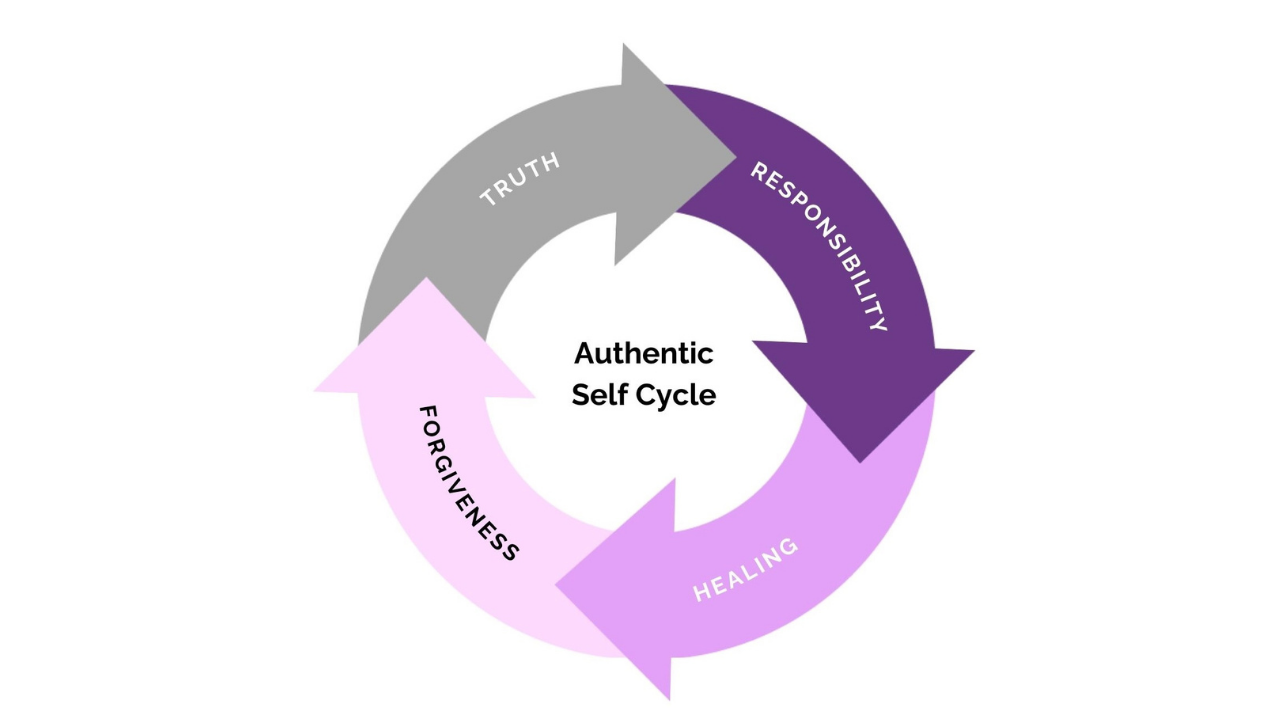
The Authentic Self Cycle™ has four stages:
Stage 1: Truth
Name the blueprint. See “this isn’t about today.” Recognize that your current reactions are rooted in childhood survival, not present danger. Your partner’s mild criticism isn’t the same as your parent’s shaming voice. Your boss’s feedback isn’t your parent’s conditional love. But until you name the blueprint, you keep reacting to the past while thinking you’re responding to the present.
Truth is uncomfortable. It requires you to acknowledge what you survived and what it cost you. It requires mourning the childhood you didn’t get. Many people stay in denial because truth hurts, but the alternative — staying trapped in the Worst Day Cycle™ — hurts more.
Stage 2: Responsibility
Own your emotional reactions without blame. This is not the same as self-blame. Responsibility means: “My nervous system is reacting to patterns from my past. I get to feel whatever I feel. And I also get to choose my response.” You’re not responsible for what happened to you. You are responsible for what you do about it now.
That’s you — finally seeing that you can grieve your childhood AND choose a different future.
Responsibility is where you stop waiting for your parents to change, your partner to fix you, or your circumstances to finally feel safe. You become the author of your own emotional story.
Stage 3: Healing
Rewire the emotional blueprint so conflict becomes uncomfortable but not dangerous. Healing is not about “getting over it.” It’s about creating new neural pathways so your nervous system stops treating the present like the past. This is where the Emotional Authenticity Method™ (EAM) comes in.
Stage 4: Forgiveness
Release the inherited emotional blueprint and reclaim your authentic self. Forgiveness isn’t about letting people off the hook or saying what happened was okay. It’s about releasing the hold the wound has on your present and future. It’s the recognition that you’re no longer a child in an unsafe environment. You’re an adult with choices, boundaries, and the capacity to protect yourself.
That’s you — not becoming someone new, but finally meeting who you always were underneath the survival persona.
The Emotional Authenticity Method™: Your Healing Practice
The Emotional Authenticity Method™ (EAM) is a five-step practice for rewiring your emotional blueprint in real time. When you feel triggered, dysregulated, or stuck in a familiar pattern, use this.
Step 1: Somatic Down-Regulation (with optional titration)
Your nervous system needs to feel safe before your brain can process anything. This means bringing your body temperature down, slowing your heart rate, and signaling safety to your amygdala. Techniques include: slow breathing (4-count in, 6-count out), cold water on your face, grounding (5-4-3-2-1 sensory awareness), progressive muscle relaxation, or movement. Optional titration means approaching the feeling in small doses rather than going all-in.
Step 2: What Am I Feeling?
Most people who grew up with emotional invalidation can’t name feelings with specificity. You say “fine” or “stressed” when you’re actually afraid, ashamed, lonely, or grieving. Use the Feelings Wheel at kennyweiss.net/life-changing-exercise to develop emotional granularity. The more specific you get (“I feel unseen and unvalued” vs. “I’m fine”), the more information you have to work with.
That’s you — finally realizing you’ve been numb instead of strong.
Step 3: Where in My Body Do I Feel It?
Emotions live in the body. Fear lives in the chest. Shame lives in the gut. Grief lives in the throat. Anger lives in the jaw and fists. When you locate the feeling somatically, you’re accessing deeper information about your nervous system. Stay with the sensation without trying to fix it immediately.
Step 4: What Is My Earliest Memory of This Feeling?
This is where you connect present to past. When did you first learn that this feeling was dangerous, shameful, or unacceptable? Who told you to be afraid of it? What happened the last time you expressed it? This is not rumination — it’s detective work. You’re building the bridge between your childhood wound and your current pattern.
Step 5: Who Would I Be If I Never Had This Feeling Again?
This is the visioning step. Not “I’ll be perfect.” But “I’d be someone who can stay present in conflict.” “Someone who asks for what I need.” “Someone who doesn’t disappear when things get hard.” You’re building a vision of your authentic self — not your survival persona, but the person beneath the protection system.

People Also Ask
Can childhood trauma be healed?
Yes. The brain is plastic (neuroplasticity) and the nervous system can be recalibrated. Healing doesn’t mean erasing the past or pretending it didn’t hurt. It means rewiring your nervous system so the past stops controlling your present. This requires consistent practice, usually professional support, and genuine willingness to feel what you’ve been denying. Most people report significant shifts within 6-12 months of committed work.
Is everyone with childhood trauma repeating it in their relationships?
Not consciously, no. But yes, unconsciously — until you do the work. The brain’s default setting is repetition (known = safe). Without awareness and active rewiring, you’ll recreate familiar patterns. This is why two people with similar wounds often attract each other and then wonder why they cycle through the same fights.
What’s the difference between shame and guilt?
Guilt is about what you did (“I made a mistake”). Shame is about who you are (“I am a mistake”). Guilt can be productive — it motivates change. Shame is paralyzing — it creates worthlessness. Childhood trauma creates pervasive shame. Learning to distinguish shame from guilt is crucial to healing.
How does the Emotional Authenticity Method™ work in relationships?
When your partner says something that triggers you, instead of reacting from your survival persona (controlling, withdrawing, numbing), you pause. You run through the EAM steps. You down-regulate. You name what you’re actually feeling (often fear underneath the anger). You find where it lives in your body. You trace it back to your childhood. And then you respond from your authentic self instead of your survival persona. This transforms conflict from reactive cycles into opportunities for intimacy.
What if my family says I’m being dramatic or selfish for addressing my trauma?
Family systems are invested in maintaining the status quo. Naming your trauma threatens the family narrative (which is usually “we were fine”). Their defensiveness says more about their own denial than about you. Setting non-negotiables around your healing is not selfish — it’s necessary.
Can I heal from childhood trauma without professional help?
Some people can with the right resources, community, and self-awareness. Most people benefit from professional support — not because they’re “broken,” but because trauma lives in the nervous system and a trained professional can help you access and rewire it more effectively. Whether that’s therapy, coaching, somatic work, or a combination depends on your history and needs.
The Bottom Line: You Don’t Have to Repeat Your Childhood
Childhood trauma isn’t a life sentence. It’s a pattern — and patterns can be broken.
The fact that you’re reading this means some part of you recognizes that something is off. That part of you — the one that knows things could be different — is your authentic self trying to break through the survival persona. Listen to it.
That’s you — standing at the threshold between the Worst Day Cycle™ and the Authentic Self Cycle™, finally ready to choose something different.
You don’t have to earn love through perfection. You don’t have to disappear to keep the peace. You don’t have to chase people who can’t stay. You don’t have to repeat what happened to you. Those were survival strategies in childhood. They’re sabotage in adulthood.
Your body remembers what your mind denies, but your body can also remember healing. Your nervous system can learn that you’re safe. Your emotional blueprint can be rewritten. Your authentic self can emerge. It takes time. It takes courage. It takes support. But it’s possible.
You deserve emotional authenticity. You deserve reciprocal relationships. You deserve to feel at home in your own body and your own life.
Recommended Reading
- Mellody Beattie — Codependent No More and The Language of Letting Go
- Gabor Maté — When the Body Says No and Scattered Minds
- Bessel van der Kolk — The Body Keeps the Score
- Brené Brown — Dare to Lead and The Gifts of Imperfection
- Pete Walker — Complex PTSD: From Surviving to Thriving
- Sue Johnson — Hold Me Tight (for relationship patterns)
Get Started Today
Recognizing childhood trauma is the first step. Healing requires action.
If you’re ready to move from survival to authenticity, we have courses designed specifically for this work:
- Emotional Blueprint Starter Course — Individual ($79) — Start here to map your emotional blueprint and understand your survival persona.
- Relationship Starter Course — Couples ($79) — If you’re in a romantic relationship and want to stop repeating cycles.
- Tier 1: Mapping the Blueprint ($1,379) — Deep dive into the EAM™, your frameworks, and real-time rewiring practices.
- Why High Achievers Fail at Love ($479) — Specifically for falsely empowered personas who are successful everywhere except intimacy.
- The Shutdown Avoidant Partner ($479) — If you find yourself attracting emotionally unavailable partners.
- Why We Can’t Stop Hurting Each Other ($479) — For couples cycling through the same conflict patterns.
You can also start with a free tool: the Feelings Wheel at kennyweiss.net/life-changing-exercise. Spend time with it this week. Develop emotional granularity. Notice where your survival persona shows up. And remember: That’s you — finally ready to write a different story.