

You are doing everything for everyone. You are exhausted, resentful, and you cannot figure out why you keep ending up here — depleted, invisible, carrying the entire emotional weight of your relationships while telling yourself it is because you are a good person. You said yes again when every cell in your body screamed no. You swallowed your opinion because someone might get upset. You gave away your time, your energy, your truth — and then you got furious at them for not noticing.
That’s you — running the same loop, wondering why nothing changes no matter how much you give.
Here is the direct answer: how to stop stress at this level has nothing to do with breathing exercises, time management, or learning to “communicate better.” The stress you feel is actually fear — specifically, the fear of powerlessness. And that fear was installed in your emotional blueprint during childhood, when you learned that your survival depended on abandoning your authentic self to maintain attachment with your caregivers. Every time you say yes when you mean no, every time you give yourself away to avoid conflict, every time you obsess over what you cannot control — you are not stressed. You are reliving a childhood pattern. This is Step 4 in the five-part How To Stop Stress series, and it addresses the most prevalent and deeply rooted fear of all.
What Is the Fear of Powerlessness and Where Does It Come From?
It comes from attachment — and this is not abstract psychology. You are the only species on this planet whose survival depends on being physically and emotionally attached to another human being. As a child, you literally could not survive without that bond. And in that bond, there were countless moments where your sense of self — what I call your authenticity — was challenged. Your parents imparted their views on you. Many of us heard things like, “If you don’t stop crying, I will give you something to really cry about!” Or, “Children are to be seen and not heard.” Comments like these made it clear: you could not express your authentic self and keep the connection. But you could not prevent these events either. And that is where you learned the fear of powerlessness for the first time.
That’s you — the child who learned that speaking up meant losing love.
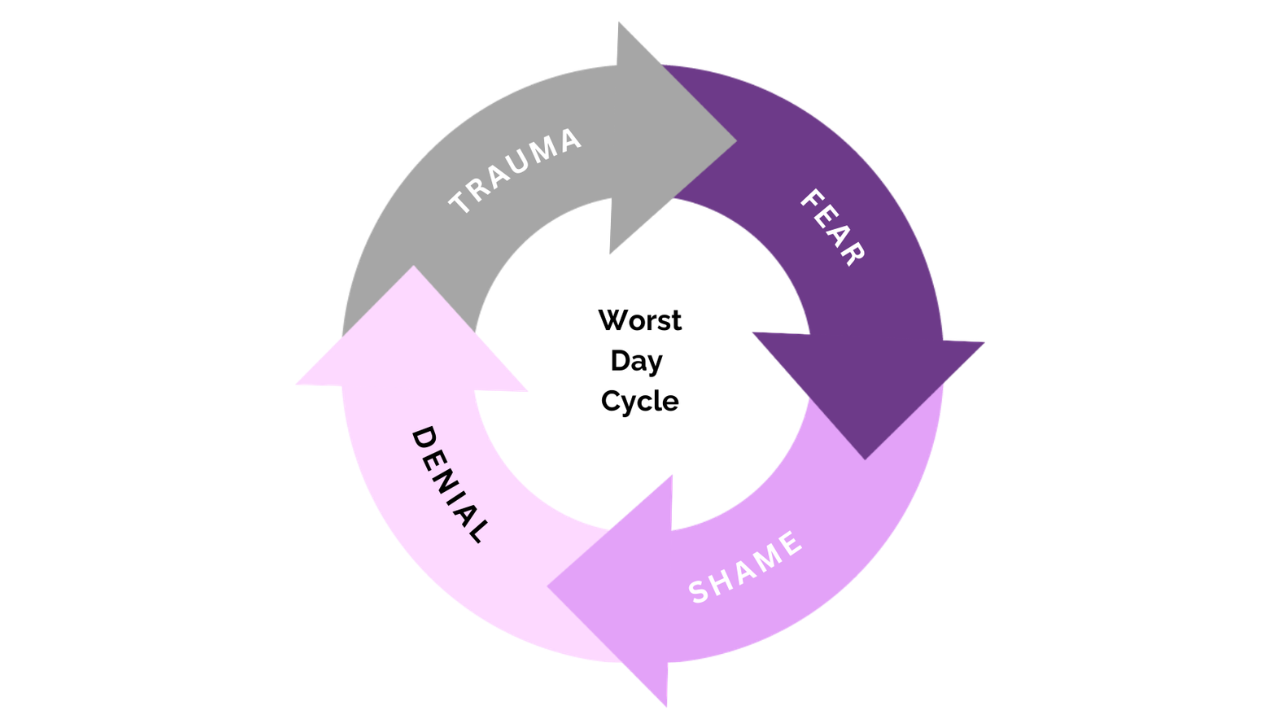
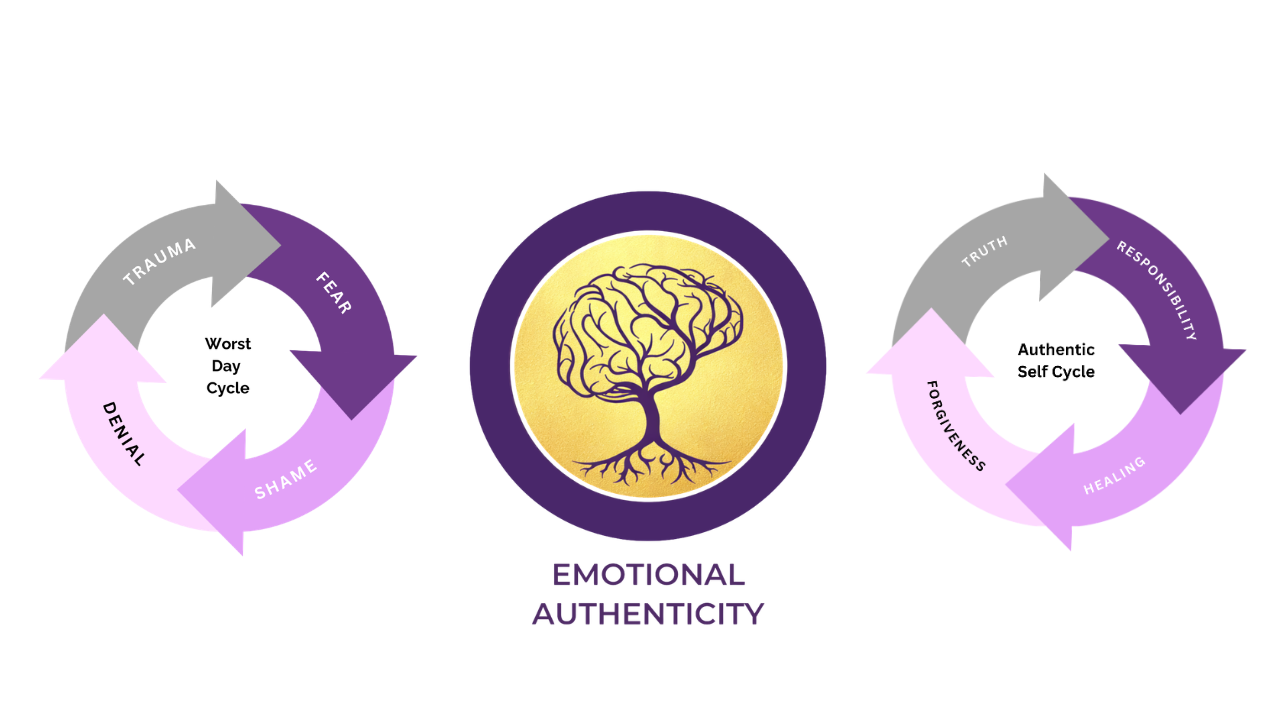
This is the core of the Worst Day Cycle™: Trauma → Fear → Shame → Denial. The trauma was not that your parents were evil — it was that they were perfectly imperfect, and your nervous system was too young and underdeveloped to process the emotional experiences that came with that. The fear of powerlessness was born in those moments. And because it came at the hands of your primary attachment figures, it carried shame with it — the deep, below-conscious belief that something is fundamentally wrong with you. Then denial sealed it shut: “That’s just how I am. I’m just a people-pleaser. I’m just too nice.”
What Does Powerlessness Actually Look Like in Your Daily Life?
Powerlessness does not announce itself. It does not feel like weakness to you — it feels like responsibility, like being a good partner, a reliable employee, a devoted parent. It feels like stress. But what you are calling stress is actually fear wearing a socially acceptable mask. Our culture glorifies stress and shames fear, so your emotional blueprint learned early to rename its truth and keep the cycle going.
That’s you — calling it stress because admitting it is fear feels like admitting you are broken.
You take on every project at work because your survival persona says you have to be perfect. You say yes to your mother’s demands because the child inside you still hears her voice and cannot bear the thought of her disapproval. You give and give in your relationship, then erupt in resentment when it is not returned — and the eruption itself becomes more evidence that something is wrong with you.
Here is what this pattern looks like across the three survival persona types:
If you are falsely empowered, your powerlessness hides behind control. You dominate conversations, micromanage outcomes, rage when things do not go your way — not because you are strong, but because underneath the control is a terrified child who learned that the only way to feel safe was to overpower everyone around them. You would rather intimidate than admit you are afraid.
If you are disempowered, your powerlessness is visible to everyone but you. You collapse in conflict, over-apologize, people-please compulsively, lose yourself in every relationship, and call it love. You absorb everyone else’s stress and moods. You feel guilty if you rest, guilty if you say no, guilty if you even think of asking for help. Underneath all of it is the childhood belief: I am only lovable when I perform.
That’s you — the one who does everything for everyone and then wonders why no one does anything for you.
If you are the adapted wounded child, you oscillate between both. You people-please until you cannot take it anymore, then you explode. You go from doormat to dictator and back again, and you cannot understand why you swing so violently between these two extremes. The answer is that both are survival strategies your child self created between the ages of 6 and 17 to navigate the dysfunction in your home — and you have been confusing them with your authentic self ever since.

What Are the Three Signs You Are Experiencing the Fear of Powerlessness?
Sign 1: Focusing on What You Can’t Control
The first sign is that all of your attention, energy, and emotional bandwidth is consumed by what you cannot control — and none of it is directed at what you can. You are having money trouble, and instead of asking, “What are my options? What can I do today?” you spend the entire day spinning: “Oh my God, I’m going to go broke. I’m going to be on the street.” You are stuck in the victim-side of the problem, reliving it exactly as you did in childhood when you had no recourse, no power, no way to feed yourself or defend yourself. You are in a powerless, childlike state — and you do not even know it.
That’s you — looping in catastrophic thinking while the actual solutions sit right in front of you, untouched.
Sign 2: Giving Yourself Away
The second sign is that you are going against your own morals, values, needs, and wants — your negotiables and non-negotiables. You are giving yourself away.
Here is a story from a real client. He is a mortgage professional who gives gifts to his clients. He found someone selling designer knives — a perfect gift. But the salesperson was a woman who kept pressuring him to buy. He started getting afraid and pulled back. What he did not see was that the pushy saleswoman was triggering memories of his mother, who controlled every feeling and every action he ever took. So he told the saleswoman, “I need to talk this over with my wife.” He went to his wife and said, “Hey, I have an idea about these designer knives. What do you think?” She immediately said, “No.” And he did not do it.
Do you see what happened? He was in a room with two women, and he gave himself away — twice. His morals and values were in line with the knives being a great gift. It was his need and want to share that gift with his clients. It was negotiable and the right thing for him. Instead of honoring himself, he repeated the exact childhood pattern: defer to the woman in his life, abandon his own truth, and never even realize he was acting like the child who could never say no to his mother.
That’s you — making decisions based on someone else’s comfort while your authentic self watches from the sideline, screaming.
Sign 3: The Inability to Say No
The final way powerlessness expresses itself is the inability to say no. Most people cannot say no because they feel it is rude, mean, or selfish. But this belief did not come from nowhere. It originated in childhood, where you could never say no to your parents. Your life depended on them. “No” meant you were a bad child. “No” meant they might withdraw love. And so you learned — in every cell of your body, not just your mind — that saying no was dangerous.
As an adult, that conditioning runs invisibly. You say yes to your boss when you are already leading three other projects. You say yes to your friend’s request when you do not have the bandwidth. You say yes to your partner’s demand when everything inside you protests. And every single yes that betrays your truth makes you more powerless.
That’s you — the one who keeps score of everything you did for them, then resents them for not returning it.
Here is the doctrine underneath this: many people in your life — parents, siblings, aunts, uncles — followed the same condition: put others first. As a child, when asked to do something you did not want to do, you had to say yes and put others before yourself. You were trained to give yourself away. Now as an adult, you are conditioned to say yes all the time. And when you feel you cannot truly make your own decision, saying yes leads you to feel powerless and rejected. What most people do not realize is what subconsciously underlies that guilt — a sense that if I say no, I am saying no to my parents, which makes me a bad person, and they will not love me. This is how codependence is transferred into all of us.
What’s Really Going On Beneath the Stress?
What is really going on is self-abandonment. Every time you people-please instead of speaking truth, every time you say yes when every cell in your body screams no, every time you abandon your own morals, values, needs, and wants to keep the peace — you do two harms simultaneously: others still do not show up the way you hoped, and you betray yourself again. You become the perpetrator of your own self-abuse.
That’s you — the one who abandoned yourself to keep everyone else comfortable, and now you are the one who is suffering.

This is the Worst Day Cycle™ in its most invisible form. The trauma of childhood created the fear of powerlessness. The fear drives you to give yourself away, to say yes, to focus on what you cannot control. The shame tells you that this is who you are — you are “too nice,” you are “just a giver,” you are “selfless.” And the denial hides the entire mechanism so you never see it. You think the problem is the other person. You think if they would just appreciate you, just reciprocate, just notice — you would be okay. But the problem was never them. The problem is the childhood blueprint that taught you to make yourself powerless in exchange for connection.
Science confirms this. Research consistently shows that poor health conditions and unresolved past painful emotions are directly linked. The inability to say no and the resulting emotional turmoil is one of the leading causes of chronic health issues. Your body keeps the score of every boundary you did not set, every truth you swallowed, every time you chose their comfort over your own existence.

Why Usual Advice Fails — And Why You Still Feel Stuck
You have read the books. You have tried therapy. You have practiced “I statements” and “active listening” and “setting boundaries.” And you are still stuck. Here is why.
Traditional therapy and self-help tools operate at the surface. They teach you what to say but never address why you cannot say it. They give you a script for setting a boundary, but the moment you try to use it, your nervous system floods with the same panic you felt at age five when your mother raised her voice. The script is useless because the child inside you is running the show — and that child knows, with absolute certainty, that setting a boundary means losing love.
That’s you — knowing exactly what to do but completely unable to do it when the moment arrives.
Communication tools, EQ training, mindset coaching, and even attachment-based therapy all fail at the same point: they do not go back to the original emotional blueprint and rewire it. They add new strategies on top of an unchanged foundation. That is like putting new furniture in a house with a cracked foundation — it looks better for a week, and then the cracks show through again.
That’s you — collecting tools that work in theory but collapse the moment real emotional pressure hits.
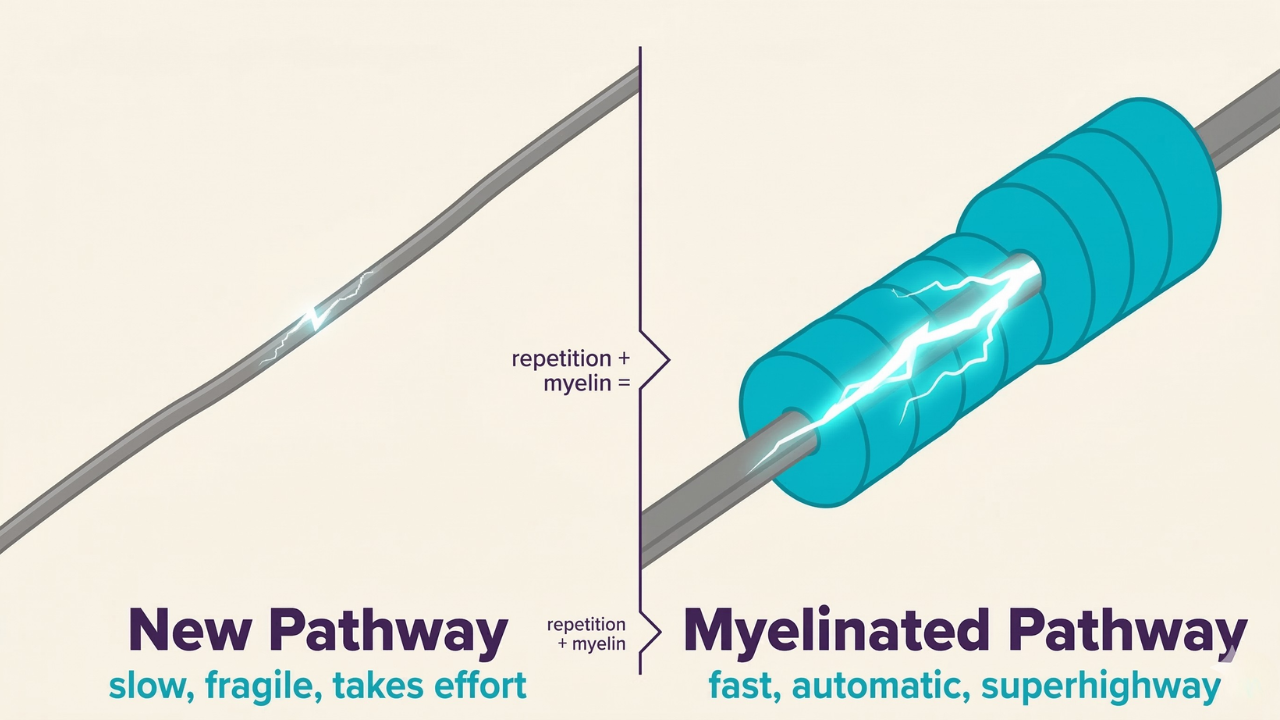

The Emotional Authenticity Method™ Shift — How to Reclaim Your Power
The way out is not more willpower, more scripts, or more positive thinking. The way out is the Emotional Authenticity Method™ — a six-step process that goes directly to the emotional blueprint and rewires it at the root.
Step 1: Somatic Down-Regulation. When the powerlessness floods you — when someone makes a request and your stomach drops, when you feel the pressure to say yes — pause. Focus on what you can hear around you for 15 to 30 seconds. This interrupts the nervous system hijack and brings you back from the child state to the adult state.
Step 2: What am I feeling right now? Not “stressed.” Not “overwhelmed.” Go deeper. Are you afraid? Resentful? Trapped? Ashamed? Use emotional granularity — the more precisely you can name what you feel, the more power you take back from the childhood blueprint.
Step 3: Where in my body do I feel it? The tightness in your chest, the knot in your stomach, the heat in your face — your body is storing the original wound. Locate it.
Step 4: What is my earliest memory of having this exact feeling? This is where the breakthrough lives. When you trace the current powerlessness back to its origin — the first time you felt this helpless, this trapped, this unable to say no — you expose the blueprint. You see that you are not reacting to the present moment. You are reliving a childhood pattern.
Step 5: Who would I be if I never had this thought or feeling again? What would be left over? This is the question that separates the survival persona from the authentic self. The answer is always the same: what would be left is a person who can say no without guilt, who knows their morals and values, who does not need to control outcomes or give themselves away to feel safe.
Step 6: Feelization. Sit in the feeling of that Authentic Self and make it strong. Create a new emotional chemical addiction to replace the old blueprint. Ask: How would I respond to this situation from this feeling? What would I say? What would I do? Visualize and feel yourself operating from your Authentic Self. This is the remapping step — the moment you stop running the old program and begin writing a new one.
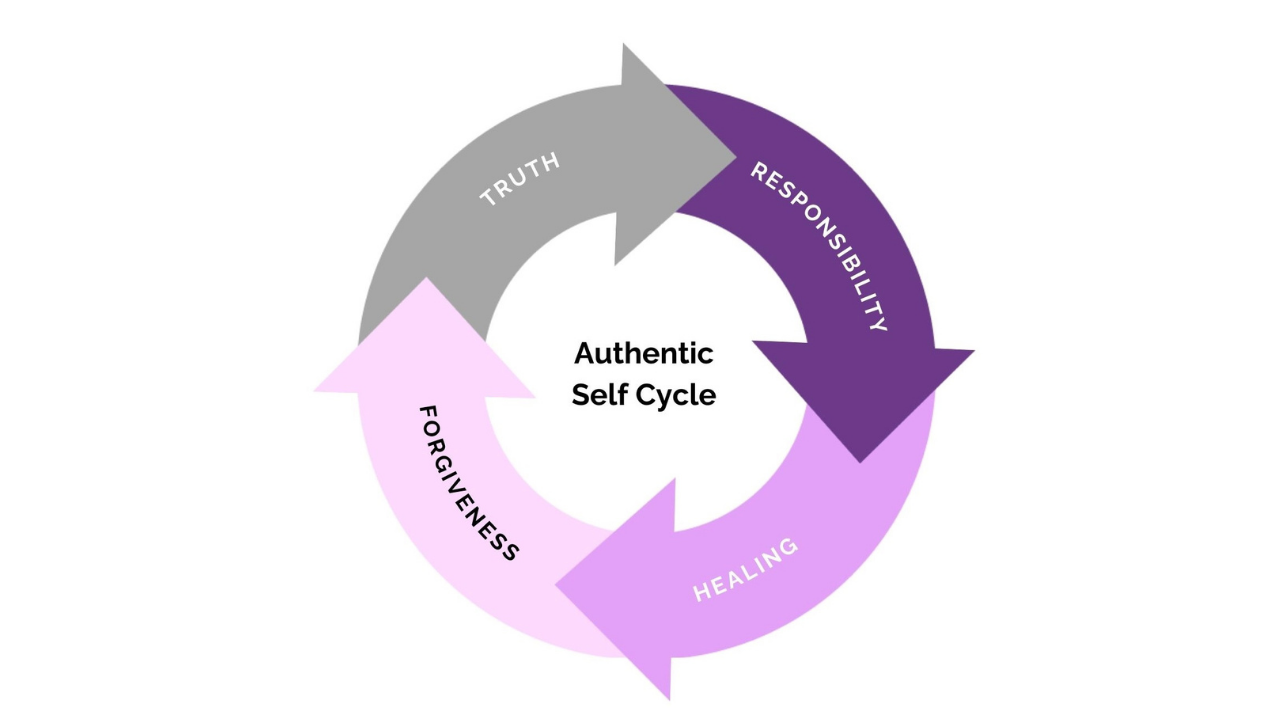
This is how the Authentic Self Cycle™ replaces the Worst Day Cycle™: Truth → Responsibility → Healing → Forgiveness. You tell the truth about what you are feeling and where it comes from. You take responsibility — not blame, responsibility — for continuing the pattern. You heal the original wound by allowing the adult you to be present with the child who was never protected. And you forgive — not to let anyone off the hook, but to release the emotional grip the past has on your present.
What Are the Three Solutions to the Fear of Powerlessness?
Solution 1: Make Two Lists — What You Can and Cannot Control
Make two lists. On the first, write down every person, place, and thing you cannot control. You cannot control people’s actions, choices, or feelings. You cannot control how the world works. On the second list, write down what you can control: your thoughts, your feelings, your actions. You are responsible for everything you do.
When you are stuck in the self-victimizing powerless state — “Oh my God, I’m going to go broke” — use the second list to shift. Ask yourself empowering questions: “How can I make money? What are my options? What can I control?” You can reach out to previous clients. You can check in with your network. You can generate a solution and empower yourself by focusing on what you can control instead of drowning in what you cannot.
That’s you — finally redirecting the energy you have been wasting on catastrophizing toward actual, concrete action.
Solution 2: Define Your Morals, Values, Needs, Wants, Negotiables, and Non-Negotiables
This is your declaration of independence. Without it, you have no compass. You do not know what to say yes to, what to say no to, what to fight for, or what to walk away from. And that is exactly why your parents’ voice is still running the show — because you were never given the choice to develop a self.
Go through every area of your life — friendships, relationships, career, hobbies, spirituality, parenting, finances, intimacy. What do you believe? What do you need? What is negotiable and what is an absolute hard line? Do you believe in monogamy? Is it okay to be intimate before marriage? How do you want to handle finances? What does respect look like to you? How do you want to parent?
A moral is whether you think something is good or bad. Your values are what you believe in and will pursue over something else. Your needs are what you require to survive — food, shelter, money, physical and emotional connection. Your wants are what bring you joy. When you grow up giving yourself away, you pursue your wants at the expense of your needs — credit card debt, burnout, people-pleasing until you collapse. You need to know the difference.
That’s you — the one who has spent decades living by someone else’s values and wondering why you feel so lost.
This is a living document. Your morals and values will change throughout your life. You have changed political affiliations, hobbies, beliefs, preferences. That is normal. But you need to know where you stand today so you can stop giving yourself away today. For a deeper walkthrough, read Negotiables and Non-Negotiables in Codependence Recovery.

Solution 3: Learn the Criteria for When to Say No — And the Magic Phrase
Here is the shift most people miss: what you have been calling “kindness” and “love” is actually manipulation. Most relationships — business or personal — end with both sides saying, “I did this for them, and they never gave me that.” Both feel they were the giving one. So what does that tell you? All of those things you were doing were in the hopes of getting something in return. That is not kindness. That is not love. That is a transaction disguised as generosity. And it is how you make yourself powerless.
That’s you — the one who gave everything and then made them pay for not reciprocating.
Before you say yes to anyone for anything, ask yourself three questions:
1. Am I going to keep score?
2. Am I going to throw it in their face?
3. Will this ever lead to resentment?
If the answer to any of these is yes, you need to say no. Otherwise, you will give your power away, throw it back in their face, and the cycle continues.
And if you struggle with the word “no” — most people do, because “no” as a child meant you were bad, defective, unlovable — here are two magic phrases that change everything:
Magic Phrase #1: “Let me think about it and I’ll get back to you.”
This buys you time. It removes the pressure to respond in the moment, when the child in you is running the show and will say yes out of panic.
Magic Phrase #2: “I thought about it, and it just doesn’t work for me.”
This is magic because they cannot argue with it. Watch:
“What do you mean it doesn’t work for you?”
“It just doesn’t work for me.”
“So what part of it doesn’t work for you?”
“It just doesn’t work for me.”
You do not have to explain yourself. You are no longer a child. You do not have to defend why you do not want to do something. It gives you complete ownership and prevents you from giving yourself away. Do you hear how much self-esteem is in that phrase? “It doesn’t work for me” — it says nothing about them. They do not feel attacked. And you are claiming yourself. Taking responsibility is empowering.
That’s you — finally learning that “no” is not a rejection of someone else. It is a declaration of your own existence.
Real Life Signs Across Every Area of Your Life
Family
You say yes to every family obligation even when it drains you. Your mother’s voice still runs the decisions. Your brother calls daily to check on you like you are still a child. You feel responsible for making everyone happy — your sister’s wedding, your father’s retirement, your parents’ emotions — because the family system trained you to be the emotional manager. You were never shown what a healthy adult relationship looks like inside a family.
That’s you — still performing the role you were assigned at age seven.
Romantic Relationships
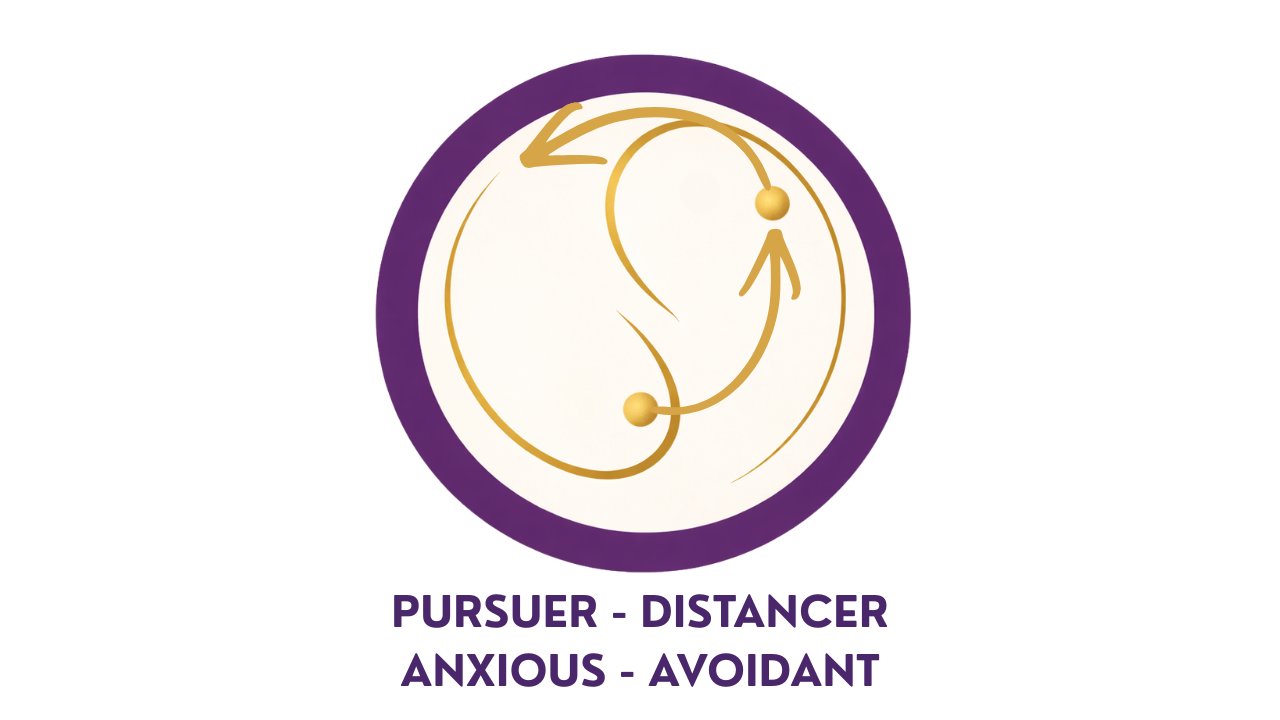
You over-function in the relationship — carrying the emotional weight, anticipating every need, doing everything so perfectly that your partner never has to grow. Or you shut down completely when vulnerability is required, burying yourself in work or productivity because emotions were never safe in your childhood home. Either way, you feel trapped by your partner’s needs and resentful of the very dynamic you created. You have been in the pursuer-distancer pattern so long you think it is normal.
Friendships
You are the friend who always listens, always shows up, always gives — and you are furious that it is never reciprocated. You have trained every friend in your life to expect you to over-function, and now you resent the very expectation you created. When someone asks for help, your body says no but your mouth says yes before you can catch it.
Work
You take on every project because the survival persona says you have to be perfect. Your boss knows you will never say no, and they exploit it — not because they are cruel, but because you have trained them. You work late, skip lunch, carry three people’s workloads, and then feel powerless when you are passed over for the promotion that went to the person who sets boundaries.
That’s you — the one whose reliability is actually a trauma response being exploited by an organization.
Body and Health
Your body is keeping the score. The chronic stress, the high blood pressure, the tension headaches, the digestive problems, the exhaustion that sleep does not fix — these are the somatic consequences of a lifetime of self-abandonment. Studies consistently show that the inability to say no and the resulting emotional turmoil is one of the leading reasons for poor health. Your body is telling you what your mind refuses to accept: you are betraying yourself, and it is costing you everything.
Your Next Small Step
This week, pick one situation where you know you are going to be asked to do something you do not want to do. When the request comes, use Magic Phrase #1: “Let me think about it and I’ll get back to you.” Then sit with it. Ask yourself the three questions: Will I keep score? Will I throw it in their face? Will this lead to resentment? If the answer is yes to any of them, come back with Magic Phrase #2: “I thought about it, and it just doesn’t work for me.” Do not explain. Do not defend. Do not justify. Watch what happens in your body when you claim yourself for the first time.
That’s you — about to experience what it feels like to stop giving yourself away.
This is Step 4 in the five-part How To Stop Stress series. If you have not read Step 3: The Fear of Inadequacy, start there. In Step 5, I will combine all of these concepts and tie them together with a bow.
Go Deeper: Kenny’s Books
Your Journey To Success — Kenny’s foundational book that walks you through the Worst Day Cycle™, the survival persona, and the emotional blueprint that drives every pattern in your life. If you are ready to understand why you keep giving yourself away and how to stop, this is where to start.
Get Your Journey To Success →
Your Journey To Being Yourself — The companion book that takes you deeper into the Authentic Self Cycle™ and the Emotional Authenticity Method™. This book is for the reader who has done the excavation work and is ready to rebuild — to define who they actually are beneath the survival persona and start living from that truth.
Get Your Journey To Being Yourself →
Frequently Asked Questions
Why does stress feel like it is about external circumstances when it is really about fear?
Your nervous system learned in childhood to rename fear as stress because society rewards stress and shames fear. When you say “I’m stressed,” nobody questions it. When you say “I’m afraid,” it feels like an admission of weakness. But the physiological response is identical — your body is in the same fight-or-flight activation. Recognizing that your stress is fear is the first step to tracing it back to the childhood blueprint that created it.
How is the fear of powerlessness different from the fear of rejection or inadequacy?
All three are faces of the same Worst Day Cycle™ pattern. The fear of rejection says “they will leave me.” The fear of inadequacy says “I am not enough.” The fear of powerlessness says “I cannot protect myself.” They often overlap and feed each other — you say yes to avoid rejection, which makes you feel inadequate, which makes you feel powerless. This series covers all three because they work as a system.
What if saying no to my parents or partner feels genuinely dangerous?
If there is actual physical danger, your safety comes first — that is not a boundary conversation, that is a safety conversation. But for most adults, the “danger” of saying no is emotional, not physical. The panic you feel is the childhood blueprint activating — the child who genuinely could not say no to survive is flooding your adult nervous system with that same terror. The magic phrases work precisely because they allow you to say no without it feeling like a confrontation. “It just doesn’t work for me” is about you, not them.
Why do I know my morals and values intellectually but still cannot honor them?
Because knowing and embodying are two completely different nervous system states. Your prefrontal cortex knows what to do. But when the moment arrives, your amygdala hijacks the process and puts the child in charge. The child does not care about your morals and values — the child cares about survival. This is why the Emotional Authenticity Method™ starts with somatic down-regulation: you have to bring the adult back online before any cognitive strategy can work.
Is people-pleasing really a trauma response?
People-pleasing is not a personality trait. It is a fawn response — a survival strategy the child developed to maintain attachment in an emotionally unsafe environment. The child learned that the only way to keep love was to anticipate the parent’s needs, suppress their own, and perform whatever version of themselves was required. In adulthood, this survival strategy becomes invisible because society rewards it. You get called “thoughtful,” “reliable,” “selfless.” But underneath the praise is a person who has completely abandoned themselves. That is the definition of enmeshment — and it is not a compliment.
How long does it take to stop giving yourself away?
The pattern took your entire childhood to build. It will not dissolve in a weekend workshop. But the shift is not linear — it is not about time, it is about depth. One genuine encounter with the Emotional Authenticity Method™, one moment where you trace your current powerlessness back to its childhood origin and allow the adult you to be present with that child, can begin to rewire the blueprint. The goal is not perfection. The goal is catching the pattern one second sooner each time — and eventually choosing differently from the Authentic Self instead of the survival persona.
The Bottom Line
The fear of powerlessness is not a character flaw. It is not because you are weak, too nice, or too sensitive. It is a childhood survival adaptation — born in the moments when your authentic self was too dangerous to express and your only option was to hand your power to someone else in exchange for love. You have been running that program ever since. Every yes that betrays your truth, every boundary you do not set, every time you focus on what you cannot control instead of what you can — you are the child again, trying to survive a house that no longer exists.
But you are not a child anymore. You do not have to defend why something does not work for you. You do not have to earn the right to exist. You do not have to give yourself away to be loved. The Worst Day Cycle™ taught you that power comes from controlling others or collapsing for them. The Authentic Self Cycle™ teaches you that real power — the kind that does not cost you your health, your relationships, or your self — comes from knowing who you are and refusing to abandon that person ever again.
That’s you — the one who is finally ready to stop making yourself powerless in exchange for a connection that was never real.
Recommended Reading
- The Body Keeps the Score by Bessel van der Kolk — The definitive work on how trauma lives in the body and why cognitive approaches alone cannot heal it.
- When the Body Says No by Gabor Maté — How the inability to say no manifests as chronic illness, and the direct link between self-abandonment and disease.
- Facing Codependence by Pia Mellody — The foundational text on how childhood emotional systems create codependent patterns in adult relationships.
- Codependent No More by Melody Beattie — A practical guide to recognizing and interrupting people-pleasing and over-functioning patterns.
Ready to Break the Cycle?
Start here — it’s free: Download the Feelings Wheel and begin building the emotional granularity you need to move beyond “stressed” and into the real feeling underneath.
Go deeper on your own:
- Emotional Blueprint Starter Course — Individual ($79) — Map your emotional blueprint and identify the survival persona patterns driving your powerlessness.
- Why We Can’t Stop Hurting Each Other ($479) — Understand the cycle of giving yourself away and making each other pay for it.
- Why High Achievers Fail at Love ($479) — For the overperformer whose professional success masks deep personal powerlessness.
Go deeper with your partner:
- Emotional Blueprint Starter Course — Couples ($79) — Begin mapping the pursuer-distancer and over-functioning patterns in your relationship together.
- The Avoidant Partner And The One Who Loves Them ($479) — For the partner who walls off, shuts down, and uses distance as a survival strategy.
The full transformation:
- Tier 1: Mapping Your Blueprint ($1,379) — The comprehensive program that walks you through every step of the Emotional Authenticity Method™ and rewires your emotional blueprint at the root.