
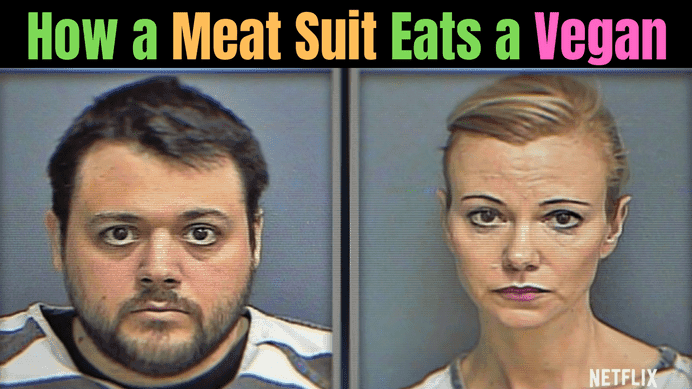
The Bad Vegan Netflix documentary is a case study in how the Worst Day Cycle™ creates trauma bonding — the invisible pattern where childhood wounds drive adults into relationships that repeat the exact emotional injuries they experienced as children. Sarma Melngailis, a successful restaurateur, lost everything to Anthony Strangis, a man she knew was lying to her. This was not stupidity. This was the Worst Day Cycle™ in action: trauma → fear → shame → denial, operating below conscious awareness and overriding logic, intellect, and self-preservation. Trauma bonding is a survival attachment — not weakness, not a character flaw, not a choice. It forms when fear, shame, longing, and intermittent affection become fused together inside the nervous system, creating an emotional chemical addiction to repeat the pain from the past until you heal it.
That’s you… watching a documentary like Bad Vegan and feeling a knot in your stomach because something about her story feels way too familiar.
This article and accompanying video is an analysis of what created the attraction between the ‘meat suit’ — otherwise known as Anthony Strangis — and the bad vegan, Sarma Melngailis. Understanding the Worst Day Cycle™ through their story will allow you to recognize how this same pattern operates in your own life and protect yourself from falling into a trauma bond yourself.

What Creates a ‘Meat Suit’ and What Creates the Person Who Is Attracted to Them?
For those who haven’t yet watched the documentary, the ‘meat suit’ is what Strangis calls his human form, his vessel. He believes he is a ‘non-human’ and that his body is simply here as a physical representation of himself — his meat suit. I will refer to him as the ‘meat suit’ from here on out.
What created the personality of the meat suit? It is something I call the Worst Day Cycle™. The Worst Day Cycle™ explains how we end up in relationships like these and how we fall short in reaching our potential. If you would like to learn the full process and how it is operating in your life — because yes, it is operating in all of our lives — I discuss it at length in my book Your Journey to Success. Your cycle may not be as extreme as what was portrayed in Bad Vegan, but everybody on this planet is caught living in the Worst Day Cycle™.
That’s you… knowing this person is bad for you, knowing they’re lying, knowing you should leave — and staying anyway. Not because you’re weak. Because something in your body won’t let you go.
What Is the Worst Day Cycle™?
The Worst Day Cycle™ consists of four stages: trauma, fear, shame, and denial. On my YouTube channel, I have a 5-part video series which takes you through the WDC called ‘Reclaim Your Authentic Self By Becoming Trauma Informed.’
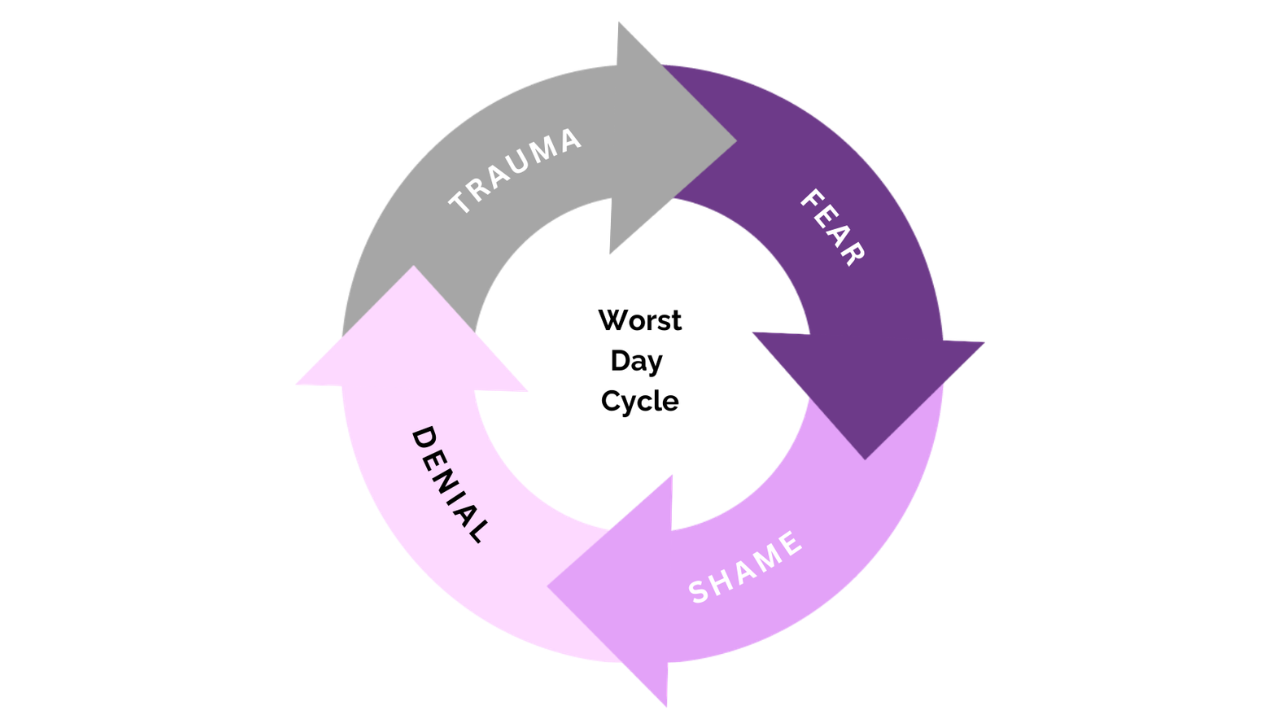
This might be hard to swallow, but every single one of us experiences trauma in childhood — this is unavoidable. For the meat suit in Bad Vegan, he experienced significant neglect and abandonment from his father, who often took him gambling when he was a child. He and his mother were also held hostage, and he watched as his father held a gun to her head. While many of us do not experience this level of trauma, we do experience emotional injuries from our perfectly imperfect caregivers.
That’s you… thinking “my childhood wasn’t that bad” while your entire adult life runs on the blueprint it created.
How the Worst Day Cycle™ Created Sarma’s Trauma Bond
For Sarma, the ‘Bad Vegan,’ she experienced her parents divorcing at 9 years old — a difficult experience for anyone to go through. Her sister, with all best intention, took on a protective role, often talking for Sarma and becoming her voice. This is also what happened in the relationship with Anthony — he became her voice.
Sarma ended up playing the prisoner just as she had as a child and therefore subconsciously looked for this in her partners. Someone who could talk for her and ‘protect’ her — the trauma cycle repeats. This is how the Worst Day Cycle™ works: it drives you to recreate the emotional environment of your childhood in your adult relationships, not because you want to, but because your nervous system treats familiar pain as safety.
Trauma bonding is not an unhealthy attachment — it is a survival attachment. It forms when fear, shame, longing, and intermittent affection all become fused together inside the nervous system. The person does not stay because they want to. They stay because their nervous system believes that leaving is abandonment and staying is safety — even when staying is destroying them.
That’s you… going back one more time. Not because you believe them. Because your body physically cannot tolerate the withdrawal of leaving.
Why Does the Brain Become Addicted to Trauma?
Many people don’t realize that they’ve experienced trauma in their childhoods. They believe they are completely recovered from it, but most often this isn’t the case. When you are living in denial and not accepting that your childhood was less than perfect, you can’t recover or prevent similar events like those in Bad Vegan from happening.
When we go through these emotional and traumatic experiences, our brain actually becomes emotionally addicted to the explosion of fear chemicals and hormones that are released — we become addicted to the trauma. Trauma bonding is not a psychological concept — it is a biochemical reality. The nervous system becomes addicted to the specific chemical cocktail produced by an inconsistent, chaotic, or emotionally unsafe relationship — the same cocktail that was first mixed in childhood.
That’s you… feeling physically sick when you try to leave, like you’re going through withdrawal — because you literally are.
Because we have been conditioned to minimize and suppress our fears, we are all stuck in it. We’ve never been taught the Emotional Authenticity Method™ Method™ to cope with these difficult emotional life experiences. Emotions come first — every thought we have starts with a feeling. And because we haven’t developed the emotional authenticity that we need, our brains automatically replay the unhealed emotions from the past when we experience new things or things that subconsciously trigger the same feelings we experienced as children.
Think of it like a child who really wants something — a four, six, eight-year-old who gets so focused on what they want, they cannot see anything else. They are like a dog on a bone. That obsessive, all-consuming tunnel vision is exactly what happens when you are caught in a trauma bond. You are not fighting for the other person to love you. You are fighting for your parent to love you. You placed this person in that position — it is all you know — and your brain is seeking that type of person because that is how attraction works. We are only attracted to people who mirror the relationships we had with our parents and primary caregivers.
The trauma-bonding cycle operates through seven distinct stages. Stage One is the Intensity Hook — the moment the person meets someone and the chemistry spikes explosively. This is not love at first sight. This is blueprint activation. The nervous system recognizes the emotional signature of the childhood wound and floods the body with dopamine and oxytocin, creating a feeling of being chosen, special, and finally seen. Stage Two is Fear Activation — the moment inconsistency appears and abandonment panic fires. The person begins scanning every text, every tone shift, every silence for signs of withdrawal. Stage Three is the Shame Collapse — the person internally collapses into self-blame. I messed up. I said something wrong. I pushed too hard. I am too much. I am not enough. Stage Four is the Intermittent Reward — the most addictive part of the entire cycle. A text arrives. A moment of affection. A crumb of validation. The brain releases dopamine and oxytocin and relief. This is identical to gambling reinforcement — a slot-machine effect where unpredictability makes it more addictive than consistent love could ever be. Stage Five is the Hope Spike — the intoxicating belief that things will go back to how they were at the beginning. Stage Six is the Rejection-Withdrawal Loop — the partner pulls away again, and the person enters full abandonment alarm. They go into pursuit, appeasing, performing. Stage Seven is Reattachment — the partner returns, apologizes, gives affection. The person feels euphoria and relief. But this is not connection. This is trauma relief mistaken for connection. The cycle restarts stronger.
Trauma chemistry repeats the loop through cortisol, adrenaline, dopamine, emotional intensity, intermittent reinforcement, hypervigilance, then numbness → pursuit → relief → repeat. This is why chaos feels like home, inconsistency feels like attraction, unstable partners feel intoxicating, and healthy relationships feel boring at first. The body is addicted to the emotions of childhood.
That’s you… obsessing over their text messages at 2am, replaying every conversation, unable to eat or sleep — not because you’re pathetic, but because the wounded child inside you is running the show.

What Are the Three Survival Personas That Keep You Trapped?
When childhood trauma happens, we don’t just feel pain — we build an entire identity around avoiding that pain. This is the survival persona. There are three types, and every human being on this planet operates from one of them:
The Falsely Empowered Survival Persona — This is the person who controls, dominates, rages, and intimidates to avoid vulnerability. In the Bad Vegan story, the meat suit operated from this persona. He controlled Sarma through lies, manipulation, and grandiose promises. He could not be vulnerable, so he built an entire fictional identity to maintain power over her.
That’s you… the one who shuts down every conversation before it gets too close to the truth. The one whose anger keeps everyone at a distance because if they got close, they’d see the shame underneath.
The Disempowered Survival Persona — This is the person who collapses, people-pleases, and loses themselves to avoid abandonment. Sarma operated from this persona. She gave away her restaurant, her money, her freedom, her voice — all to keep the connection alive. She could not tolerate the terror of being alone with herself.
That’s you… the one who gives and gives until there’s nothing left, and then gives some more. The one who lost yourself so completely in the relationship that you don’t even know what you want anymore.
The Adapted Wounded Child — This is the person who oscillates between falsely empowered and disempowered depending on the situation. At work, they’re controlling and dominant. At home, they collapse. With their partner, they rage one day and people-please the next. Most people live here.
That’s you… the one who’s a lion at the office and a scared child in your relationship. The one who doesn’t understand why you can run a company but can’t have a hard conversation with your partner without shutting down.
How Does Shame Turn Childhood Pain Into Adult Identity?
The third stage of the Worst Day Cycle™ is shame. As a child, we must physically and emotionally connect to another human being to survive. Therefore, when our parents are imperfect and create emotional injuries inside of us, we adapt and create a survival persona to fit in. It is a survival mechanism to protect ourselves. Because it happens so young, we believe it is the real “us.”
This loss of the authentic self creates a power vacuum. Shame is ultimately a power dynamic. We use this deep shame core as adults to regain our power. How? By choosing hobbies, friends, careers, and relationships that mirror the injuries of our childhood. We do this because even though we have been hurt, who is responsible for the hurt? Ourselves — we CHOSE this person, place, or thing. The overwhelming truth that we are responsible for our self-victimization sends us into denial.
That’s you… choosing the person who makes you feel small because at least “small” is familiar. At least “small” is something your body knows how to survive.
That’s you… wondering why you keep picking the same type of person — controlling, unavailable, emotionally withholding — and not realizing you’re casting the same role your parent played, over and over again.
Shame forms the moment the child concludes: “Something is wrong with me.” “I’m not enough.” “I’m too much.” “My needs cause problems.” Then the brain generates a protective story — “I have to be perfect to be safe,” “I shouldn’t have needs,” “If I open up, I’ll be rejected.” The story becomes the survival persona. And the wound repeats — not because the world is recreating it, but because the nervous system is wired to expect it, notice it, react to it, recreate it, and interpret neutral moments as proof of it. The Shame → Story → Wound Loop is unbreakable until you become aware of it and intentionally rewire it through the Emotional Authenticity Method™.
Why Is Denial the Stage That Locks the Entire Cycle in Place?
Denial is the single greatest killer on the planet today. Not a virus. Not cancer. Not guns. Denial. It is the main reason you don’t have the relationship, career, or life you want. Denial is stage four of the Worst Day Cycle™ — the stage that locks everything in place. Without denial, the cycle cannot sustain itself.
This is exactly what Sarma was caught in — the shame and denial portions of the cycle. She kept going back, choosing to re-victimize herself (shame) by denying the abuse and lies that were right in front of her. Not because she is a bad person, but because as a society we don’t teach about the Worst Day Cycle™ or how to attain emotional authenticity.
That’s you… making excuses for them. Explaining away the lies. Telling yourself “they’ll change” when every cell in your body knows they won’t.
In childhood we have to deny the truth. We have to immediately deny our parents’ perfect imperfections. We condone, justify, repress, suppress all of these things. That’s why most people say “oh my childhood was fine” — because they’ve gone into massive denial. This denial becomes so automatic, so embedded in the nervous system, that as adults we repeat it in our romantic relationships, our friendships, our work environments. We deny the red flags. We deny the pain. We deny what we’re seeing with our own eyes. Denial is the survival mechanism that protected us as children — and it’s the same mechanism that keeps us trapped as adults.
To dive deeper into how denial operates in your life, I recommend checking out my denial and self-deception content so you can learn how your denial is affecting your life and begin the healing journey.
The Worst Day Cycle™ is incredibly powerful. People often think that these sorts of experiences can only happen to people who aren’t smart or are defective in some way, but Sarma was a very clever woman. It happens to all of us. Many people find this very difficult to accept — that even the ‘victim’ could be responsible for bad things happening to them — but learning to accept responsibility for this is the only way to heal. Sarma wanted money, she wanted her dog to be saved, and she made the choice to stay. She did these things because of the Worst Day Cycle™ and her lack of emotional authenticity.

Why Didn’t Therapy, Communication Tools, or Self-Help Books Fix This?
You’ve probably tried everything. Therapy where you talked about your feelings for years but nothing actually changed. Communication scripts that fell apart the moment your nervous system got hijacked. Attachment theory content that helped you label the pattern but didn’t stop you from repeating it. Mindset coaching that told you to “think positive” while your body was screaming in panic.
That’s you… with a shelf full of self-help books and a notes app full of quotes, still stuck in the exact same cycle.
None of those tools failed because they were bad. They failed because they all operate at the surface — at the level of conscious thought, behavior modification, or intellectual understanding. But trauma bonding doesn’t live in your conscious mind. It lives in your nervous system. It lives in the emotional chemical addiction your brain built in childhood. You cannot think your way out of a biochemical pattern. You cannot communicate your way out of a freeze response. You cannot read your way out of a shame core that was installed before you could speak.
The missing piece is the Emotional Authenticity Method™ — a process that works at the level where the wound actually lives: in the body, in the nervous system, in the emotional blueprint that runs every reaction before your conscious mind even knows what’s happening.
What Does the Worst Day Cycle™ Look Like in Real Life?
The Worst Day Cycle™ doesn’t just show up in romantic relationships. It runs every area of your life:
Family: You go home for the holidays and within twenty minutes you’re eight years old again. You’re people-pleasing your mother, shutting down around your father, and leaving with the same sick feeling you had as a child. You swore you wouldn’t let it happen this time.
That’s you… rehearsing your boundaries in the car and abandoning every one of them before dessert.
Romantic Relationships: You keep choosing partners who are emotionally unavailable, dishonest, or controlling — just like Sarma did with the meat suit. The chase feels electric. The withdrawal feels like death. You confuse the intensity for love because intensity is all your nervous system knows.
That’s you… calling it “chemistry” when it’s actually your childhood blueprint on fire.
Friendships: You over-function for everyone. You’re the one who listens, supports, fixes, carries — and when you need something, the room is empty. You’ve trained every relationship in your life to take from you because giving is the only way you learned to earn connection.
Work and Career: You’re the highest performer in the room and the most exhausted person in the building. You cannot tolerate being seen as anything less than exceptional because underneath the achievement is a terrified child who believes they’re worthless without the performance.
That’s you… building an empire to prove you’re enough while collapsing inside because no achievement has ever actually filled the hole.
Body and Health: Your body holds the score. The chronic tension, the insomnia, the gut problems, the autoimmune flares, the panic attacks that come out of nowhere — these are not random. They are your nervous system living in a permanent state of survival because it never learned that the danger ended.
The Path Out: The Authentic Self Cycle™ and the Emotional Authenticity Method™
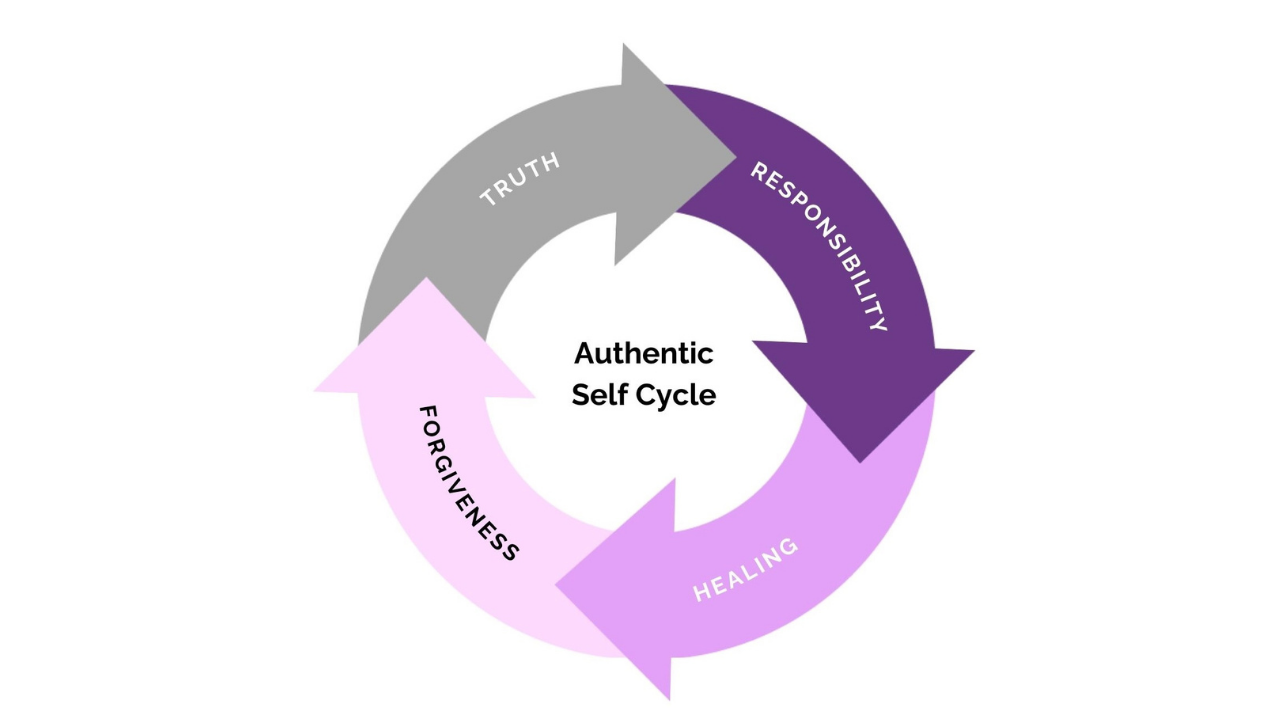
The corrective path out of the Worst Day Cycle™ is the Authentic Self Cycle™: Truth → Responsibility → Healing → Forgiveness. This is not about positive thinking or communication scripts. This is about dismantling the survival persona that was built in childhood and reconnecting with the authentic self that got buried underneath it.
The Emotional Authenticity Method™ is the practical process for doing this work. It has six steps:
- Somatic Down-Regulation — Focus on what you can hear for 15-30 seconds. When your nervous system is hijacked, you cannot think clearly. This step brings you back into your body.
- What am I feeling right now? — Name the feeling with precision. Not “bad” or “anxious” — what specifically? Abandoned? Invisible? Suffocated? Defective?
- Where in my body do I feel it? — Locate the sensation. Your chest, your gut, your throat. The body stores what the mind avoids.
- What is my earliest memory of having this exact feeling? — This is where you find the blueprint. The feeling in this moment is never about this moment. It’s always about the first time.
- Who would I be if I never had this thought or feeling again? — What would be left over? This is the authentic self underneath the survival persona.
- Feelization — Sit in the feeling of the Authentic Self and make it strong. Create a new emotional chemical addiction to replace the old blueprint. Visualize and FEEL yourself operating from your Authentic Self.
Step six — Feelization — is where the rewiring happens. You are not just understanding the pattern. You are creating a new emotional chemical addiction to replace the old one. The brain cannot decipher right from wrong, good from bad — it is an automatic process to repeat what it has already experienced. Feelization gives the nervous system a new experience to repeat. When you sit in the feeling of your Authentic Self — when you truly feel what it would be like to respond from truth instead of fear, from wholeness instead of abandonment terror, from your own values instead of someone else’s approval — you are remapping the emotional circuitry at the neurological level. You are creating a new emotional blueprint. And the more you do this, the more that feeling becomes your default. The body stops reaching for the old addiction. The nervous system finds a new home.
We must become an expert in the Worst Day Cycle™ and how trauma, fear, shame, and denial operate in our lives. When you have the knowledge, skills, and tools, it becomes clear how to avoid being eaten by a meat suit.
That’s you… not yet where you want to be, but finally understanding WHY you’ve been stuck — and that’s the beginning of everything changing.
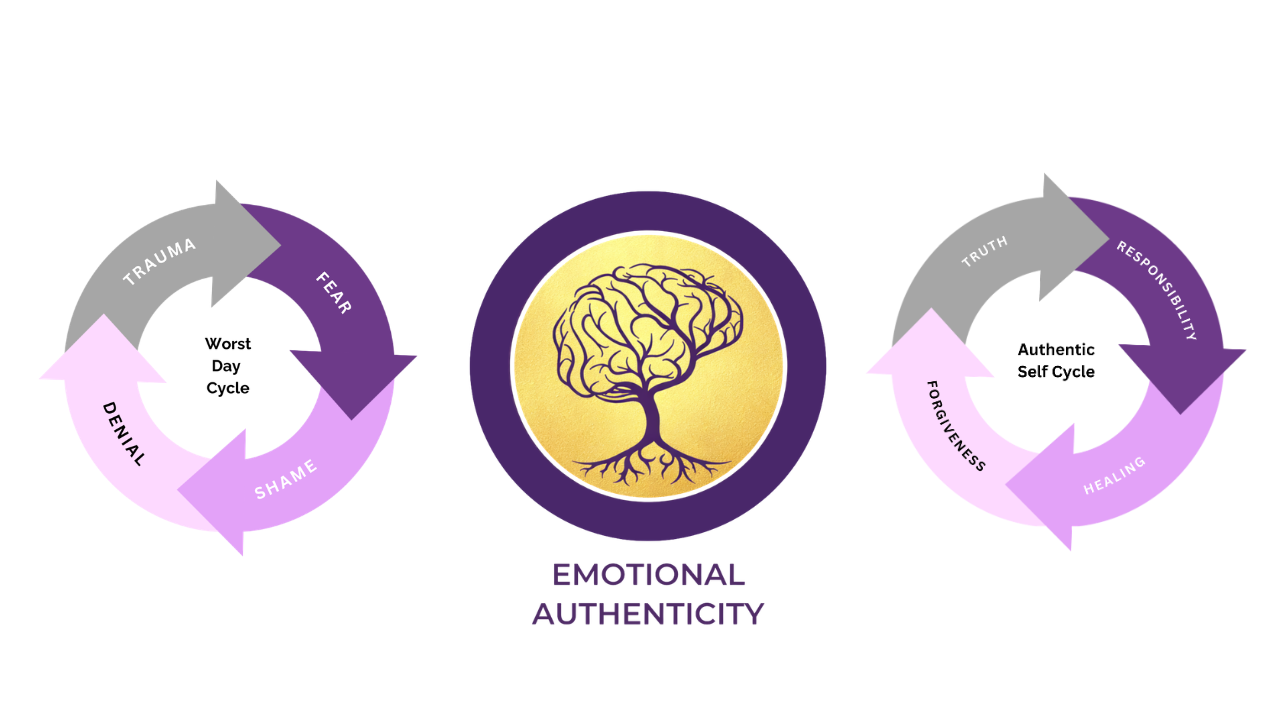
 The Authentic Self Cycle and the Emotional Authenticity Method — The Path Out of the Worst Day Cycle
Your Next Small Step
You don’t need to overhaul your life today. You need one thing: the next time you feel that pull — that desperate, all-consuming urge to go back, to respond, to fix it, to make it work — pause. Don’t act on it. Instead, ask yourself: “What am I really feeling right now? And when is the first time I remember feeling this way?” That’s step one. Just notice. You’re not broken — you’re running a program that was installed before you had any say in the matter. Noticing is how you begin to take the controls back.
Kenny’s Books
If this article hit home, the book goes deeper.
Everything I write about on this site — the Worst Day Cycle™, your childhood emotional blueprint, why you keep repeating the same patterns no matter how hard you try — it all started with my first book, Your Journey To Success: How to Accept the Answers You Discover Along the Way.
This is the book readers call “the first time I found a roadmap I could actually understand and that seemed attainable.” It is the book that walks you through WHY your life hasn’t changed despite all the work you’ve done — and shows you, step by step, exactly how to break free. No fluff. No motivational hype. Just the truth about what was done to you, why it stuck, and what to do about it.
If you’ve read this far, you already know something needs to change. This book is where that change starts.
Get Your Journey To Success on Amazon → https://amzn.to/3nfVphr
Ready to stop understanding the problem and start rewiring it?
The article you just read scratches the surface. My new book, Your Journey To Being Yourself: How to Overcome the Worst Day Cycle & Reclaim Your Authentic Self with Emotional Authenticity, gives you the complete system — the Worst Day Cycle™, the Authentic Self Cycle™, and the full Emotional Authenticity Method™ — all in one place, with the neuroscience behind every step.
This is the book readers call “a genius piece of art in mastering emotion and the art of healing.” It speaks directly to the person who feels stuck, overwhelmed, and confused by the same repeating patterns — the same arguments, the same relationship breakdowns, the same shame — and is done accepting surface-level answers. Every chapter combines powerful stories, clear steps, and practical tools that show you how to rewire your emotional patterns from the inside out.
You are not broken. You were programmed. And this book shows you exactly how to rewrite the program.
Get Your Journey To Being Yourself on Amazon → https://amzn.to/4snRhZp
Frequently Asked Questions
What is trauma bonding?
Trauma bonding is a survival attachment that forms when fear, shame, longing, and intermittent affection become fused together inside the nervous system. It is not weakness or stupidity — it is the brain repeating the emotional patterns it learned in childhood. The person stays in a harmful relationship because their nervous system believes leaving is abandonment and staying is safety.
Why did Sarma stay with Anthony Strangis in Bad Vegan?
Sarma’s childhood created a disempowered survival persona where someone else became her voice and protector. The Worst Day Cycle™ drove her to recreate that dynamic with Anthony. Her nervous system was addicted to the emotional chemicals produced by the chaotic relationship — the same chemicals first produced in childhood. She was caught in the shame and denial stages of the cycle.
Can trauma bonding happen to smart, successful people?
Trauma bonding has nothing to do with intelligence. It is a biochemical and neurological pattern rooted in childhood emotional injuries. Sarma Melngailis was a successful restaurateur, and it happened to her. The Worst Day Cycle™ operates in every person’s life regardless of education, career success, or self-awareness — until you learn to recognize it and heal the underlying wounds through the Emotional Authenticity Method™.
How do I break a trauma bond?
Breaking a trauma bond requires addressing the root cause — the childhood wounds that created the pattern — not just leaving the relationship. The Authentic Self Cycle™ (Truth → Responsibility → Healing → Forgiveness) is the corrective path. You must become an expert in your own Worst Day Cycle™, develop emotional authenticity through the Emotional Authenticity Method™, and dismantle the survival persona that keeps you locked in repeating patterns.
What is the difference between the Worst Day Cycle™ and the Authentic Self Cycle™?
The Worst Day Cycle™ is the unconscious pattern from childhood — trauma, fear, shame, denial — that keeps you stuck in repeating emotional and relationship patterns. The Authentic Self Cycle™ is the corrective path out — truth, responsibility, healing, forgiveness. One is the disease; the other is the cure. You cannot exit the Worst Day Cycle™ without entering the Authentic Self Cycle™, and the Emotional Authenticity Method™ is the bridge between them.
Why do I keep choosing the same type of partner?
Your brain is designed to repeat what it has already experienced. The emotional blueprint installed in childhood drives you toward partners who recreate the same emotional environment — not because you want the pain, but because your nervous system treats familiar pain as safety. The falsely empowered survival persona attracts the disempowered survival persona, and vice versa, creating a cycle that mirrors the original family system. This is the Worst Day Cycle™ operating in your romantic relationships.
The Bottom Line
Sarma Melngailis was not stupid. She was not weak. She was not defective. She was a woman running on a childhood emotional blueprint that she never knew existed — the same blueprint that is running your life right now. The Worst Day Cycle™ does not care how smart you are, how successful you are, or how many books you’ve read. It operates underneath all of that, in the nervous system, in the body, in the chemical addiction to familiar pain that was installed before you could tie your shoes.
If you’re reading this and feeling that knot in your stomach — that’s not shame. That’s recognition. And recognition is the first step out of the cycle. You are not broken. You were never broken. You were programmed by perfectly imperfect caregivers who didn’t know any better, and now you have the chance to rewrite that program. The Authentic Self Cycle™ is waiting for you on the other side of the truth you’ve been avoiding.
That’s you… right here, right now, ready to stop running the program and start living your actual life.
Recommended Reading
- Pia Mellody — Facing Codependence
- Bessel van der Kolk — The Body Keeps the Score
- Gabor Maté — When the Body Says No
- Pete Walker — Complex PTSD: From Surviving to Thriving
Are You Ready to Break the Cycle? Pick the Resource That Fits Where You Are Right Now:
- Emotional Blueprint Starter Course — Individual ($79)
- Emotional Blueprint Starter Course — Couples ($79)
- Why We Can’t Stop Hurting Each Other ($479)
- Why High Achievers Fail at Love ($479)
- The Avoidant Partner And The One Who Loves Them ($479)
- Tier 1: Mapping Your Blueprint ($1,379)
Not sure where to start? Try the Feelings Wheel Exercise — it’s free and it will change the way you understand your own emotions.
To learn more about the signs of enmeshment in your family and how codependence recovery actually works, explore the related posts on the site.