

Self-forgiveness is the Forgiveness stage of the Authentic Self Cycle™ — the moment you release the inherited emotional blueprint and reclaim your authentic identity, not because you’re “letting yourself off the hook,” but because you finally understand the trauma that created the shame in the first place. If you can’t forgive yourself, you’re not weak or broken. You’re caught in the shame stage of the Worst Day Cycle™ — a neurobiological loop that began with childhood trauma and became your default operating system.
Most people think self-forgiveness comes from willpower, therapy, or enough self-help books. But if that’s what worked, you’d be done by now. The real issue is that your emotional blueprint — the deeply ingrained beliefs about your worth, safety, and belonging — was written by people who weren’t emotionally healthy themselves. You inherited their wounds, and now you’re blaming yourself for their damage.
That’s you — caught between knowing better and feeling worse.
’t forgive yourself because childhood trauma installed the belief “I am the problem.” Self-forgiveness requires moving through the Authentic Self Cycle™ (Truth → Responsibility → Healing → Forgiveness), not just thinking positive thoughts. Your inability to forgive yourself is a survival persona protecting you from deeper pain — and it’s time to retire it.
Table of Contents
- Why You Can’t Forgive Yourself
- How the Worst Day Cycle™ Blocks Self-Forgiveness
- Your Survival Persona: The Mask Blocking Forgiveness
- The Authentic Self Cycle™: Your Path to Forgiveness
- The Emotional Authenticity Method™: 5 Steps to Release Shame
- How Self-Forgiveness Struggles Show Up in Every Area of Life
- Frequently Asked Questions About Self-Forgiveness
- The Bottom Line
- Recommended Reading
Why You Can’t Forgive Yourself: It’s Not a Character Flaw
You’ve probably told yourself a thousand times: “I just need to let this go.” You’ve tried journaling, meditation, therapy, and that podcast about self-compassion. And yet — you still wake up at 3 a.m. replaying that mistake. You still feel the heat in your chest when you remember. You still can’t look yourself in the eye without feeling like a fraud.
Sound familiar? That feeling that no matter what you do, you’re still not enough? That’s not motivation. That’s trauma. And trauma doesn’t respond to willpower — it responds to understanding.
When you were a kid, someone made you feel fundamentally wrong. Maybe it was explicit: “You’re so stupid.” “You ruined everything.” Or maybe it was subtler: the disappointed look, the silent treatment, the way they flinched when you made a mistake. Your developing brain had one job: survive. So it learned that you were the problem. If you were the problem, then you could control your safety by being better, doing more, staying smaller.
The inability to self-forgive stems from a core belief installed in childhood: “I AM the problem.” This belief lives in your nervous system, not your rational mind, which is why positive thinking and self-talk often fail to create lasting change in self-forgiveness.
That’s you — still carrying shame that was never yours to carry.
How the Worst Day Cycle™ Blocks Self-Forgiveness
Your emotional blueprint is like your brain’s operating system. When you were young, it was literally life-saving. But now it’s keeping you trapped in a loop of shame and self-punishment. This is the Worst Day Cycle™, and it has four stages: Trauma → Fear → Shame → Denial.
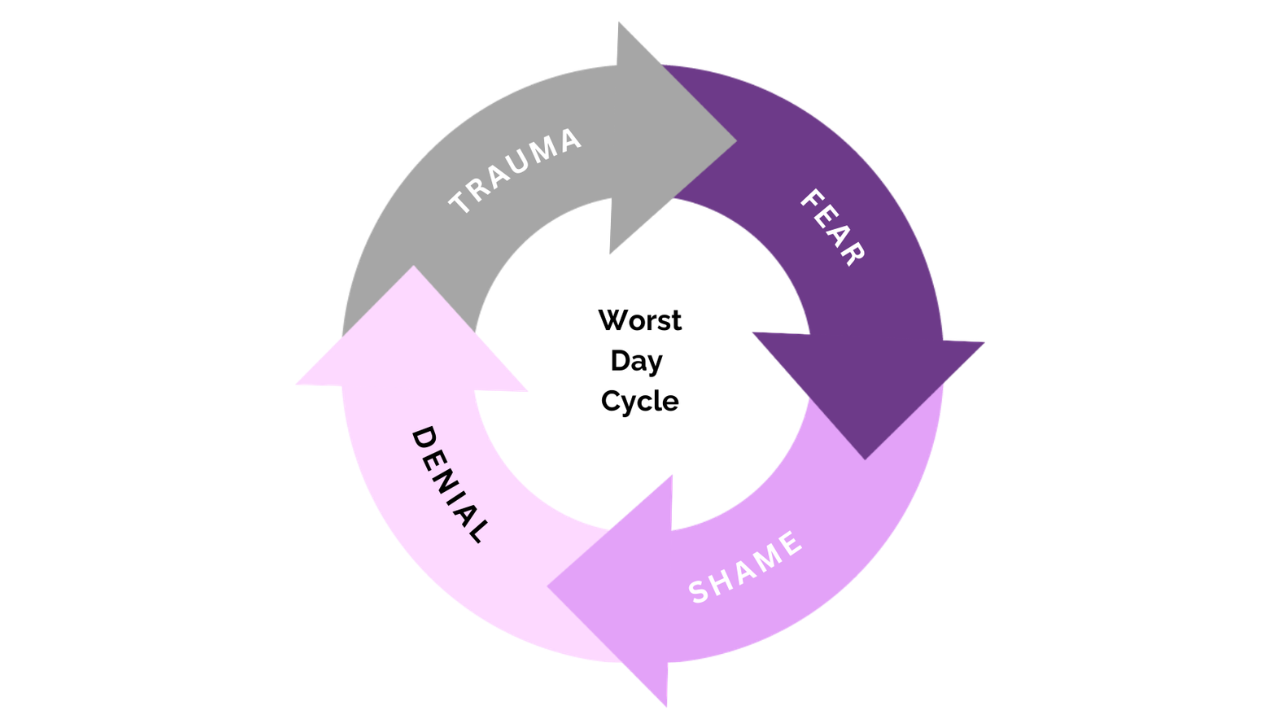
Trauma: Childhood trauma is any negative emotional experience that created painful meanings about who you are. The hypothalamus generates chemical cocktails — cortisol, adrenaline, dopamine, oxytocin misfires — and the brain becomes addicted to these emotional states. This chemical imprint becomes your baseline.
Fear: The brain conserves energy by repeating known patterns. It can’t tell right from wrong — only known from unknown. Since 70%+ of childhood messaging is negative and shaming, your adult brain keeps recreating scenarios that feel emotionally familiar. Fear drives this repetition because the brain thinks repetition equals safety.
That’s the pattern — feeling like you’re destined to repeat the same mistakes with different people. You’re not broken. Your nervous system is operating from a traumatic blueprint.
Shame: This is where you crossed from “I made a mistake” to “I AM a mistake.” Shame is where you lost your inherent worth. This is the critical stage for self-forgiveness because shame fuses your identity with your actions. You can’t forgive yourself because forgiveness requires seeing yourself as separate from your mistakes — and shame won’t let you.
Denial: Denial is the survival persona you created to survive unbearable pain. Brilliant in childhood — absolutely necessary. But in adulthood, it sabotages your relationships, career, and ability to forgive yourself. You can’t forgive what you won’t acknowledge.
The Worst Day Cycle™ explains why self-forgiveness feels impossible — your brain created a neurochemical loop in childhood that equates self-punishment with safety, and it repeats that loop thousands of times per day without conscious awareness.
That’s you — working hard on yourself while secretly believing nothing will actually change. Denial isn’t laziness. It’s a protection mechanism that’s keeping you stuck.
Your Survival Persona: The Mask That’s Blocking Self-Forgiveness
When the world wasn’t safe, you created a persona — a version of yourself that could survive. This wasn’t weakness. It was genius. But now that persona is running your adult life, and it’s the primary barrier to self-forgiveness.
The Falsely Empowered: The high-achiever, the perfectionist. They controls, dominates, and rages. Love was conditional — you got attention by being exceptional. They can’t forgive themselves because forgiveness requires acknowledging weakness, and weakness means abandonment.
That’s you — getting promoted while your marriage collapses, winning at work while losing at home.
The Disempowered: This persona collapses, people-pleases, and disappears. They’re already flooded with self-blame. They think everything is their fault. Forgiveness feels like permission to hurt people — which terrifies them.
That’s the pattern — apologizing for things that aren’t your fault, because taking blame feels like the only way to prevent abandonment.
The Adapted Wounded Child: The chameleon who oscillates between both — raging one moment, collapsing the next. They learned to read the room and become whatever was needed. The barrier to self-forgiveness? They don’t have a stable self to forgive. They’re a collection of masks.
Survival personas are adaptive identities developed in childhood to navigate unsafe emotional environments — they persist in adulthood as barriers to self-forgiveness because they prioritize protection over authenticity.
Sound familiar? One of these personas is running your life right now.
The Authentic Self Cycle™: Your Path to Real Self-Forgiveness
Real forgiveness requires moving through a different cycle. Not the Worst Day Cycle™. The Authentic Self Cycle™: Truth → Responsibility → Healing → Forgiveness.
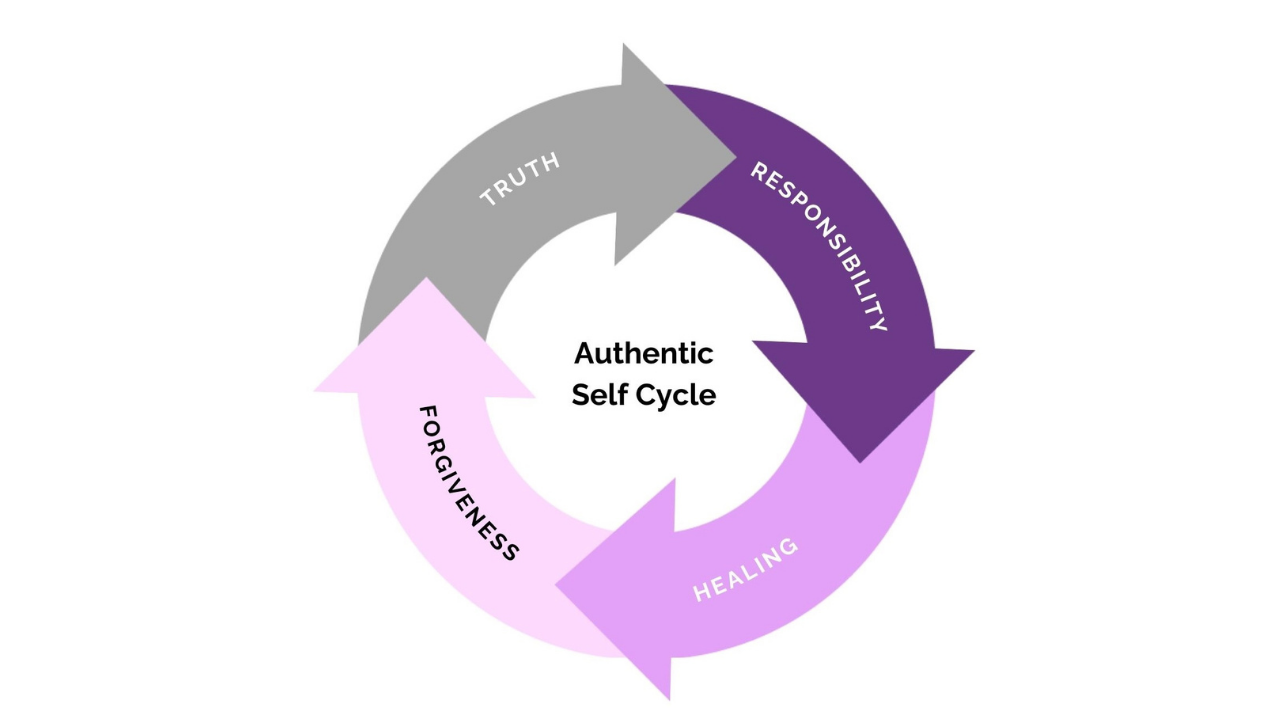
Truth: Name the blueprint. See that “this isn’t about today.” Truth means seeing what actually happened — separating what was done TO you from what you did. “My parent was emotionally unavailable” is truth. “That’s why I feel unlovable” is connecting the dots. Truth is uncomfortable because it means some of this was installed before you had a choice.
That’s you — finally understanding that the voice in your head isn’t your intuition, it’s your parent’s voice.
Responsibility: Own your emotional reactions without blame. Not the pseudo-responsibility of shame (“I’m broken and I deserve this”), but authentic responsibility: “I inherited this pattern. My partner isn’t my parent — my nervous system just thinks they are. How I respond now is my choice.” That’s not punishment. That’s power.
Healing: Rewire the emotional blueprint so conflict becomes uncomfortable but not dangerous, space isn’t abandonment, and intensity isn’t attack. This is where the Emotional Authenticity Method™ does its work — second by second, like the ticks of a clock. Healing is somatic, not just cognitive.
Forgiveness: Release the inherited emotional blueprint and reclaim your authentic self. This creates a NEW emotional chemical pattern that replaces fear, shame, and denial with safety, worth, and connection. You’re not white-knuckling self-compassion. You’re indifferent to that old shame because you’ve built a new identity that isn’t based on being “the problem.”
That’s you — not becoming someone new, but finally meeting who you always were underneath the survival persona.
The Authentic Self Cycle™ is an identity restoration system — it doesn’t teach you to cope with self-blame, it replaces the neurochemical pattern that created it with a new blueprint built on truth, responsibility, and Emotional Authenticity Method™.
The Emotional Authenticity Method™: 5 Steps to Release Shame and Forgive Yourself
Understanding the cycles is crucial, but you need a practical method to do the work. The Emotional Authenticity Method™ is a five-step somatic process that moves you from shame to self-forgiveness.
Step 1: Somatic Down-Regulation with optional Titration. Before you can forgive yourself, your nervous system has to know it’s safe. When you’re triggered, your body is flooded with cortisol and adrenaline. Your prefrontal cortex goes offline. You can’t think, reason, or forgive anything. Step 1 brings your nervous system back to baseline — deep breathing, grounding, or simply slowing down. Titration means going slowly — you don’t force yourself to feel everything at once.
That’s you — noticing that after you breathe for 30 seconds, the panic starts to loosen its grip.
Step 2: What am I feeling? Most people stuck in shame say “I feel bad” or “I feel like a failure.” That’s not emotional granularity — that’s a judgment disguised as a feeling. Using the Feelings Wheel, you get specific: “I feel ashamed AND angry at myself AND afraid I’ll never change.” Once you name the actual feelings, you separate them from the shame story.
Step 3: Where in my body do I feel it? All emotional trauma is stored physically. Your chest tightens. Your stomach drops. Your jaw clenches. Locating the feeling somatically creates a bridge between your nervous system and conscious awareness.
That’s the moment — when you realize the shame isn’t just a thought. It’s a physical sensation that’s been running you.
Step 4: What is my earliest memory of this feeling? Your shame in the present almost never started in the present. Trace it back to its childhood origin. You realize: this isn’t about today. My partner isn’t my parent. My nervous system just thinks they are. This separates “this is my fault” from “this is the blueprint I inherited.”
Step 5: Who would I be if I never had this feeling again? This is the vision step. It connects you to the Authentic Self Cycle™ and gives your nervous system a new destination — not more coping, but actual identity restoration. What if this particular shame was gone? How would you walk? What would you say? Who would you become?
The Emotional Authenticity Method™ works because emotions are biochemical events — you cannot change emotional patterns through thoughts alone. Thoughts originate from feelings, not the other way around.
That’s you — moving from “I can’t forgive myself” to “I’m beginning to see that I was wounded, not damaged.”
How Self-Forgiveness Struggles Show Up in Every Area of Your Life
Family: You’re the peacekeeper. You manage everyone’s emotions. You swallow your reactions at holiday dinners. You feel responsible for your parents’ happiness — even now, as an adult. When you try to set a boundary, the guilt is so overwhelming you cave. Understanding the signs of enmeshment can help you see where your identity blurs with your family’s.
That’s you — still playing the role your family assigned you at age six, and blaming yourself every time you try to step out of it.
Romantic Relationships: You choose partners who need you more than they love you. You tolerate behavior that crosses your boundaries because leaving feels more terrifying than staying. You confuse intensity with intimacy. Then you blame yourself for everything that goes wrong. Recognizing the signs of relationship insecurity helps you see these are wounds, not character flaws.
Sound familiar? The partner who gives everything and then punishes themselves for not giving enough?
Friendships: You’re the friend everyone calls in a crisis but no one checks on. You show up, sacrifice, over-give. When your friend fails to reciprocate, you feel devastated — and blame yourself. Or the opposite: you sabotage friendships because you’re sure they’ll leave, so you leave first.
That’s you — feeling responsible for making every friendship work, as if their distance is evidence you’re unlovable.
Work: You overdeliver. You say yes to everything. You check email at midnight. You’ve been promoted for your self-punishment — and rewarded for it. Imposter syndrome isn’t about incompetence. It’s about shame. Understanding the signs of high self-esteem helps you see what healthy professional confidence actually looks like.
That’s you — getting praised and dismissing it, succeeding and feeling terrified someone will discover you’re a fraud.
Body and Health: Shame lives in the body. When you can’t forgive yourself, your body holds onto the trauma — chronic tension, held breath, numbing. Chronic pain, digestive issues, insomnia, and autoimmune conditions are often the body’s last resort when emotional signals have been ignored for decades.
That’s you — fighting with your body instead of befriending it.
Frequently Asked Questions About Self-Forgiveness
How do I actually forgive myself if what I did was really wrong?
Self-forgiveness isn’t about denying responsibility. It’s about separating the action from your inherent worth. You can own what you did AND be inherently valuable. True self-forgiveness includes making amends, taking responsibility, and committing to different behavior — but it doesn’t require self-hatred to prove you’re sorry.
Is self-forgiveness the same as self-compassion?
Self-compassion is acknowledging pain. Self-forgiveness is releasing shame about the pain. You can be compassionate with yourself without forgiving yourself. Self-forgiveness requires truth about what happened, responsibility for your role, and the conscious choice to release the grip shame has on your identity through the Authentic Self Cycle™.
What if I forgive myself but nothing changes?
If you’ve “forgiven yourself” but nothing shifted, you probably haven’t actually moved through the Authentic Self Cycle™ yet. You’ve just intellectually decided to stop blaming yourself, which is different from rewiring the nervous system that holds the shame. Real forgiveness creates internal change first — you feel lighter, sleep better, stop sabotaging.
How long does self-forgiveness take?
Self-forgiveness isn’t a one-time event. It’s a practice. The timeline depends on how deep the wound is and how much healing work you do. But each time you practice the Emotional Authenticity Method™, you’re rewiring your nervous system. The loops get smaller. The shame loses its grip. Eventually, what you couldn’t forgive becomes a memory of healing, not a wound.
What if the person I hurt won’t forgive me?
Self-forgiveness doesn’t require other people’s permission. Have you taken responsibility? Made amends when possible? Committed to different behavior? If yes, their forgiveness is a gift you might receive, but it’s not required for your self-forgiveness to be valid. Sometimes the people we hurt are carrying their own wounds. That’s their journey. Self-forgiveness is yours.
If I forgive myself, won’t I just keep repeating the same mistakes?
The belief that forgiveness equals permission to hurt is the core fear that keeps people in shame. In reality, shame doesn’t create accountability — it creates repetition because you’re stuck in the Worst Day Cycle™. When you move into forgiveness through the Authentic Self Cycle™, you’re building new neural pathways, new beliefs, new choices. You’re less likely to repeat because you’re operating from wholeness, not from wound.
The Bottom Line
Self-forgiveness isn’t a luxury. It’s a necessity for everyone who inherited shame from childhood. It’s not a character flaw that you can’t let things go. It’s a neural pattern that was installed before you could consent, and it’s still running your life.
The good news? Neural patterns can be rewired. Shame can be released. The authentic self — the part of you that existed before the shame — is still in there. Waiting.
That belief doesn’t come from affirmations. It comes from moving through the Authentic Self Cycle™: naming the truth of your emotional blueprint, taking responsibility for your adult responses, actively healing your nervous system, and choosing to release the inherited shame. That’s real forgiveness. That’s liberation.
That’s you — not the person who made the mistake. The person who finally stopped punishing themselves for it.
You don’t need more shame. You don’t need more punishment. You need the truth about what happened to you. You need tools that work at the nervous system level. And you need to know that every single time you choose self-forgiveness over self-punishment, you’re building a new neural pathway. You’re becoming free.
That’s you — becoming free, one forgiveness at a time.
Recommended Reading
These books deepen your understanding of self-forgiveness, shame, and trauma recovery:
Facing Codependence by Pia Mellody — the foundational text on how childhood trauma creates codependent patterns and self-punishment cycles.
The Body Keeps the Score by Bessel van der Kolk — the science of how trauma lives in the body, not just the mind, and why self-forgiveness requires somatic work.
When the Body Says No by Gabor Maté — how chronic self-punishment manifests as physical illness and disease.
Codependent No More by Melody Beattie — a practical guide to recognizing how codependence keeps you trapped in shame.
The Gifts of Imperfection by Brené Brown — how shame drives self-punishment and how vulnerability is the path back to self-forgiveness.
Take the Next Step
Understanding self-forgiveness intellectually is one thing. Rewiring your nervous system is another. These courses help you move through the Authentic Self Cycle™ and release the shame running your life:
Emotional Blueprint Starter Course — Individual ($79) — Your personal roadmap to understanding your emotional blueprint, survival persona, and path to authenticity.
Relationship Starter Course — Couples ($79) — For couples ready to break the cycle of reactivity and build interdependence.
Why We Can’t Stop Hurting Each Other ($479) — Deep-dive into how unhealed shame cycles through relationships.
Why High Achievers Fail at Love ($479) — For high achievers who’ve mastered their career but can’t figure out self-forgiveness in relationships.
The Shutdown Avoidant Partner ($479) — Understanding emotional withdrawal through the lens of trauma chemistry and survival personas.
Tier 1: Mapping the Blueprint ($1,379) — The comprehensive program for the Emotional Authenticity Method™.
Download the Feelings Wheel — the free tool used in Step 2 of the Emotional Authenticity Method™ to build emotional granularity.
Explore more: The Signs of Enmeshment | 7 Signs of Relationship Insecurity | 7 Signs of High Self-Esteem | How to Determine Your Negotiables and Non-Negotiables | 10 Do’s and Don’ts for a Great Relationship