

Childhood emotional neglect (CEN) is the absence of emotional attunement, validation, and responsiveness during developmental years—a parent failing to notice, name, or normalize a child’s feelings, leaving adult children unable to recognize, trust, or manage their own emotions. It’s different from abuse; it’s what wasn’t there. No yelling, no hitting—just silence, dismissal, or parental emotion taking precedence. The child learns that their inner world doesn’t matter, that feelings are dangerous, that asking for help is weakness. By adulthood, they’re numb, disconnected from their body, unable to know what they want or need. They feel like ghosts in their own lives.
That’s you—the one who can’t remember the last time you cried, who talks about painful things with clinical detachment, who feels more comfortable taking care of others than being taken care of.
Table of Contents
- What Is Childhood Emotional Neglect?
- Why CEN Is Invisible
- The Worst Day Cycle™: How CEN Creates Ongoing Pain
- Survival Personas: Three Types That Emerge From Neglect
- Signs of Childhood Emotional Neglect Across Life Areas
- The Emotional Authenticity Method™: How Healing Actually Works
- From Worst Day Cycle to Authentic Self Cycle™
- FAQ: People Also Ask
- The Bottom Line
What Is Childhood Emotional Neglect?
Childhood emotional neglect isn’t about what happened to you—it’s about what didn’t happen. You weren’t beaten. You weren’t told you were worthless. You just weren’t *seen*.
That’s you—the one whose parent was “fine,” who never raised their voice, who seemed to have it all figured out—except they never asked how you were feeling.
CEN occurs when parents are physically present but emotionally absent. They may be preoccupied (their own trauma, work stress, addiction, depression), overwhelmed, or operating from their own emotionally neglectful blueprint. They don’t validate your feelings. They don’t help you name emotions. They don’t create space for your sadness, anger, fear, or joy. Instead, your feelings are met with:
- Silence: You cry and they look uncomfortable, change the subject, leave the room
- Dismissal: “You’re fine,” “Stop being so sensitive,” “That’s not a big deal”
- Parental emotion priority: Your parent’s mood becomes the climate of the home; you learn to manage their feelings instead of your own
- Conditional acceptance: Love feels tied to achievement, obedience, or keeping the peace—not to your inherent worth
The child internalizes: My feelings don’t matter. Asking for help is burden. Vulnerability is weakness. I must be independent and perfect. By adulthood, you feel numb, disconnected, unable to access your own emotional world. You don’t know what you want. You can’t ask for what you need. You’re “fine” all the time—the kind of fine that’s actually a prison.
Why Childhood Emotional Neglect Is Invisible
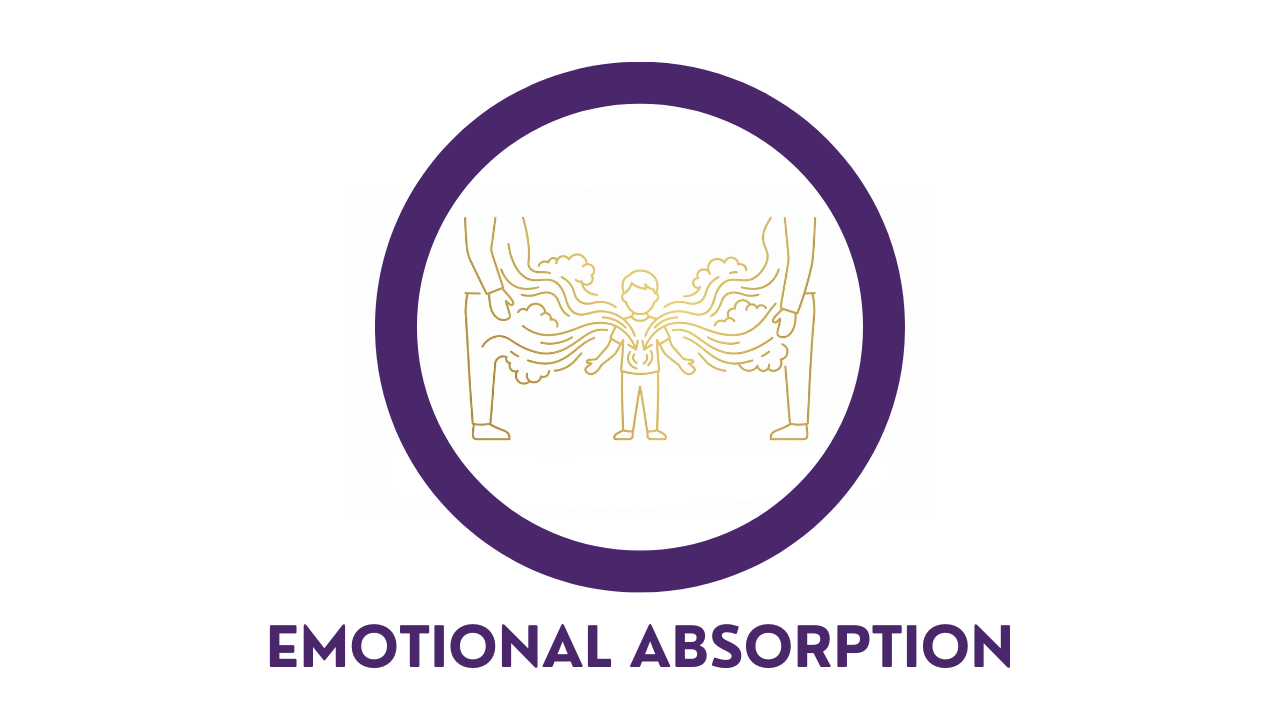
CEN is the stealth trauma. It leaves no physical scars. The home looks “normal.” Parents may be kind, responsible, successful. So you grow up telling yourself: I wasn’t abused. I shouldn’t complain. I’m ungrateful. What’s wrong with me?
That’s you—the one who minimizes your childhood, who says “it wasn’t that bad,” who feels ashamed even discussing it because you know other people had “real” trauma.
CEN stays hidden for three reasons:
1. Absence Doesn’t Announce Itself
You can’t point to what wasn’t there. You can’t prove a hug that never happened. You can’t document conversations that never occurred. Your brain doesn’t code absence the way it codes harm. So you feel the pain—the disconnection, the numbness, the sense that something is fundamentally wrong with you—but you can’t explain it.
2. You Were “Well-Behaved”
Kids who experience CEN often become hyperresponsible. They don’t act out because they learned early that their needs weren’t welcome. They become invisible, compliant, “easy.” Adults look at them and see a well-adjusted kid. What they don’t see is the child learning to abandon themselves, to silence their own voice, to survive by becoming invisible.
That’s you — the kid who never caused trouble, who got straight A’s, who everyone praised as “so mature for their age” — and nobody noticed you were disappearing.
3. The Culture Validates It
Western culture celebrates independence. “Don’t be clingy.” “Tough it out.” “Stop being so emotional.” These messages sound like wisdom. They’re actually instructions for emotional abandonment. So when your emotionally neglectful parent raised you with these values, it felt normal. It felt like parenting. It felt like love.
That’s you — the one who was praised for being “tough” and “independent” when really you were just abandoned and learned to call it strength.
The Worst Day Cycle™: How Childhood Emotional Neglect Creates Ongoing Pain
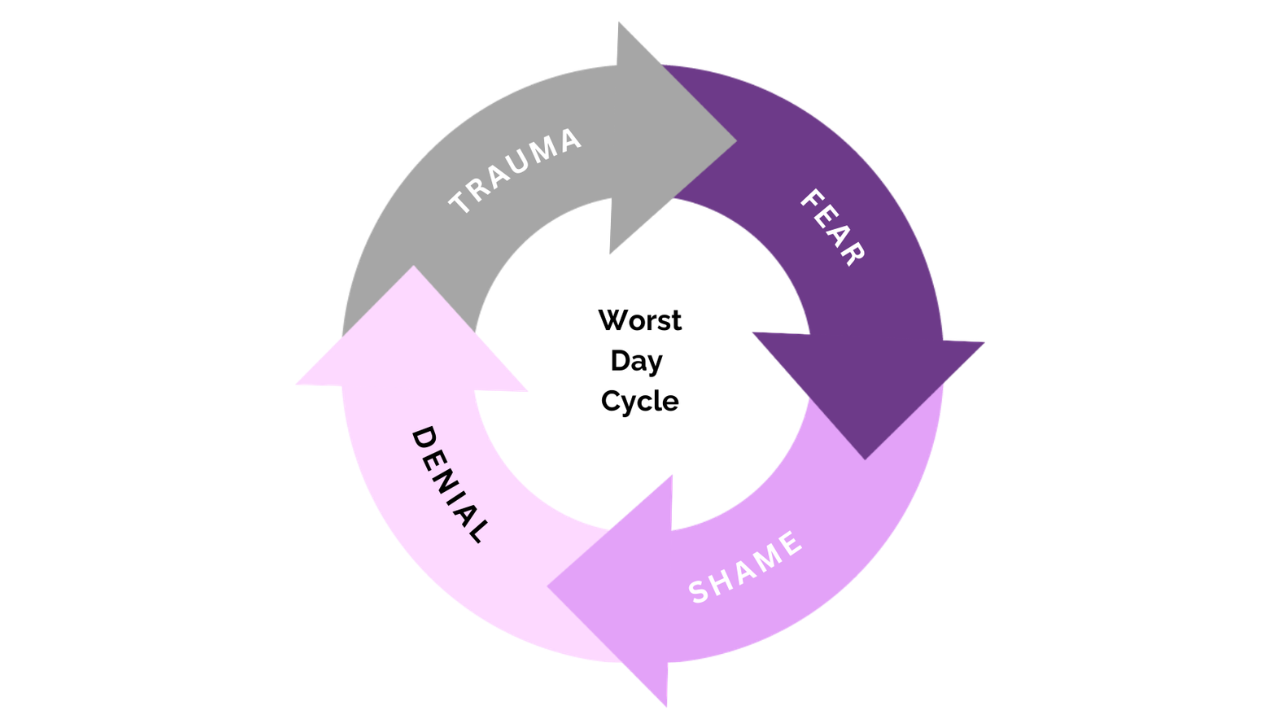
Childhood emotional neglect doesn’t just happen in childhood. It creates a psychological and neurochemical pattern that repeats throughout your adult life. This pattern is called the Worst Day Cycle™ (WDC)—a four-stage loop that plays out in relationships, work, health, and every area of life.
That’s you—the one who keeps having the same fight with different partners, who reaches success and feels empty, who takes care of everyone and burns out, who can’t relax no matter how much you achieve.
The Worst Day Cycle™ has four stages:
Stage 1: Childhood Trauma (The Original Wound)
Trauma isn’t just big events. Any experience that creates a painful, dangerous, or confusing meaning about yourself, others, or the world is trauma. Being emotionally neglected tells your child-brain: “You’re alone. Your feelings don’t matter. You must survive without support.” Your hypothalamus generates a neurochemical storm—cortisol (stress), adrenaline (hypervigilance), dopamine (addiction to the drama), oxytocin misfires (disconnection from others). Your brain becomes chemically addicted to this state.
Stage 2: Fear (The Nervous System Hijack)
Your brain is designed to conserve energy. Once it learns a pattern, it repeats that pattern because repetition = safety, even if the pattern is painful. Since 70%+ of your childhood emotional messaging was dismissive, shaming, or absent, your nervous system learned fear as a baseline. Now, in adulthood, your nervous system sees relationships, vulnerability, asking for help, or emotional expression as dangerous. Fear drives the repetition.
Stage 3: Shame (Identity Loss)
Fear eventually metastasizes into shame—the deepest belief that you are the problem. Not “I did something wrong” (guilt—fixable). But “I am wrong” (shame—identity-level). This is where you lost your inherent worth. You abandoned yourself because you learned your self-abandonment was the price of survival. Shame is the glue that holds the Worst Day Cycle™ in place.
Stage 4: Denial (The Survival Persona)
Shame is unbearable. So your psyche creates a survival persona—an identity designed to protect you from that shame. This persona is brilliant in childhood. It keeps you safe. It keeps you functional. By adulthood, it’s sabotaging everything. The denial keeps you from seeing the pattern, from grieving what was lost, from healing.
Survival Personas: Three Types That Emerge From Neglect
When you survive childhood emotional neglect, you don’t just survive—you transform. You create a survival persona, an identity built to keep you safe. There are three primary types, and understanding which one (or combination) is yours is critical to healing.
That’s you—the one whose strength is actually numbness, whose independence is actually abandonment of yourself, whose flexibility is actually collapse.
The Falsely Empowered Persona
Core belief: “I must be in control to survive.”
This persona overcompensates by dominating, controlling, or raging. They appear strong, confident, commanding. Internally, they’re terrified of vulnerability, powerlessness, or being seen as weak. They struggle with:
- Difficulty receiving help or admitting limitations
- Anger outbursts when their control is threatened
- Perfectionism masking deep shame
- Relationships where they feel superior or contemptuous
- Workaholic patterns and high achievement tied to self-worth
The Disempowered Persona
Core belief: “I am helpless. I need others to survive.”
This persona collapses into others. They people-please, self-abandon, seek validation constantly. They appear agreeable, accommodating, selfless. Internally, they’re drowning in shame and desperate for proof that they matter.
That’s you — the one who gives everything to everyone and then wonders why you feel invisible, used up, and utterly alone.
They struggle with:
- Inability to say no or set boundaries
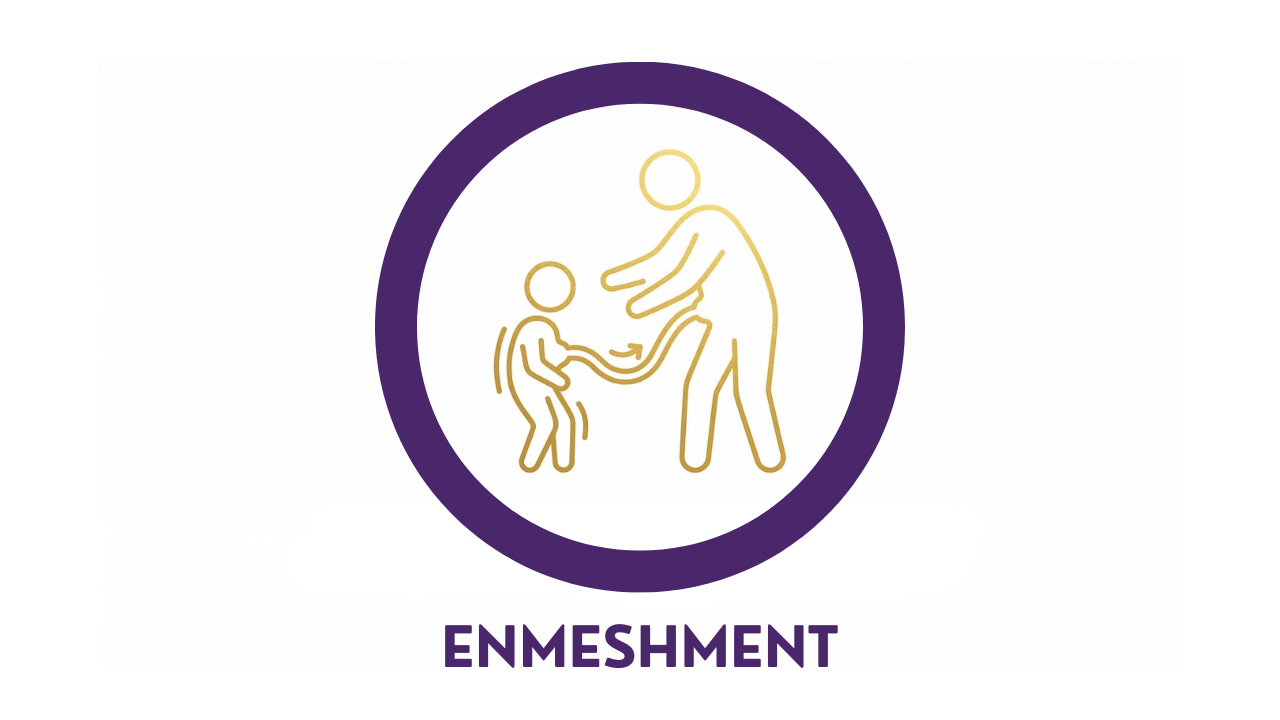
- Codependence and enmeshment in relationships
- Chronic anxiety about others’ approval
- Self-sacrifice that becomes resentment
- Depression and feelings of invisibility
The Adapted Wounded Child Persona
Core belief: “I oscillate between control and collapse depending on how safe I feel.”
This persona swings between falsely empowered and disempowered, depending on context. With authority figures, they collapse. With subordinates, they control. They appear flexible but are actually deeply unstable internally. They struggle with:
- Inconsistent behavior across different relationships
- Difficulty knowing their own core values
- Relationships that feel chaotic and unpredictable
- Shame-driven mood swings
- Inability to maintain consistent boundaries
Signs of Childhood Emotional Neglect Across Life Areas
CEN doesn’t announce itself in one symptom. It shows up differently in each life area, which is why so many people don’t recognize it. You might be high-functioning at work but completely disconnected in relationships. You might be empathic with others but completely numb to your own pain. Here’s where to look:
In Family Relationships
- Still trying to earn your parent’s emotional attunement or approval
- Feeling like you’re reporting your life to them, not sharing it
- Unable to have vulnerable conversations with family members
- Taking care of your parent’s emotions instead of the reverse
- Feeling like an outsider in your own family
- Not knowing if your parent actually knows you or just your accomplishments
That’s you — still performing for your parents at age 40, still hoping that this time they’ll finally see you, still leaving family gatherings feeling hollow.
In Romantic Relationships
- Difficulty asking for emotional support; feeling like a burden when you do
- Numb during intimacy or completely dissociated during vulnerability
- Oscillating between neediness and complete emotional withdrawal
- Choosing partners who are emotionally unavailable (familiar pattern)
- Unable to communicate what you need or want
- Sabotaging relationships when they get too intimate
- Feeling more comfortable taking care of your partner than being cared for
Sound familiar? You chose the partner who needs you more than they love you — because that’s the only kind of love your nervous system recognizes.
In Friendships
- Friendships where you’re the giver and they’re the taker
- Difficulty maintaining friendships after they become vulnerable
- Feeling awkward when friends want to support you
- Choosing friends who are “below” you (easier to maintain control)
- Friendships that feel surface-level despite years of knowing each other
- Not sharing your real struggles or pain with friends
At Work
- Overworking to prove your worth
- Difficulty receiving feedback without internalizing shame
- Not expressing your needs or opinions in meetings
- High achievement that doesn’t feel fulfilling
- Difficulty building authentic relationships with colleagues
- Burnout despite external success
- Unable to celebrate your own accomplishments
That’s you — the one who’s been promoted for their self-abandonment, who gets praised for working through lunch and answering emails at midnight, who wears burnout like a badge of honor.
In Your Body and Health
- Chronic numbness; difficulty feeling your body at all
- Can’t identify physical sensations (hunger, tiredness, pain) until they’re extreme
- Stress-related illness (tension, IBS, chronic pain) that doctors can’t explain
- Addictive patterns (food, alcohol, work, sex) that numb or distract
- Difficulty with self-care; only taking care of yourself when you “collapse”
- Dissociation during sexual intimacy
- Difficulty asking for help when sick or injured
That’s you — the one whose body has been screaming for years while you keep pushing through, because resting feels like failure and asking for help feels like weakness.
The Emotional Authenticity Method™: How Healing Actually Works
Here’s what most healing approaches get wrong: they try to fix emotional problems with thoughts. They teach you to “reframe” your story, to “think positively,” to “challenge your thoughts.” This fails because emotions aren’t generated by thoughts. Emotions are biochemical events. Your thoughts come from your feelings, not the other way around.
That’s you—the one who can think your way into understanding your pain but still feels numb, the one who knows logically that you’re worthy but still feels shame, the one who has “done the work” intellectually but nothing has changed in how you feel.
True healing requires rewiring your emotional blueprint at the somatic (nervous system) level. This is where the Emotional Authenticity Method™ Method™ (EAM) comes in—a five-step process that moves you from childhood emotional abandonment into authentic emotional presence.
Step 1: Somatic Down-Regulation (Optional Titration)
Before you can access your authentic emotional world, your nervous system must be calm enough to do so. If you’re in fight-flight-freeze, your prefrontal cortex (thinking brain) is offline. You’re trapped in your limbic system (emotional/survival brain).
The practice: Use grounding techniques to activate your parasympathetic nervous system. Name five things you see, four you can touch, three you hear, two you smell, one you taste. Or simply place one hand on your heart, one on your belly, and take three slow, deep breaths. These aren’t fancy. They’re basic. But they signal safety to your nervous system.
Step 2: What Am I Feeling? (Emotional Granularity)
People with CEN have massive emotional vocabulary poverty. You know you feel “bad” or “stressed.” You don’t know if you’re angry, scared, sad, disappointed, lonely, or ashamed. But each emotion carries different information and requires different action.
That’s you — the one who answers “I’m fine” a hundred times a day because you literally don’t know what else to say.
The practice: Use the Feelings Wheel to increase emotional granularity. Instead of “I’m stressed,” you might discover you’re actually “hurt” (sadness) + “unheard” (anger) + “uncertain” (fear). Once you name the actual emotion, your nervous system can respond appropriately.
Step 3: Where In My Body Do I Feel It? (Somatic Location)
Emotional trauma lives in your body. The childhood shame, fear, and abandonment that you learned to deny and ignore? It’s stored as tension, numbness, or disconnection in your physical form. You can’t think your way out of it because it’s not in your thoughts—it’s in your soma (body).
The practice: Once you name the emotion, locate it. “I feel hurt as a heaviness in my chest.” “I feel anger as tension in my jaw and fists.” “I feel fear as a knot in my stomach.” This is the opposite of dissociation. This is integration—bringing your awareness into your body instead of escaping it.
Step 4: What Is My Earliest Memory of This Feeling? (Childhood Origin)
Your adult nervous system is responding to a child-level wound. Your partner said something slightly dismissive and you completely shut down. That’s not about today. That’s about a thousand moments in childhood when you were dismissed and learned that your needs would not be met.
The practice: When you’re feeling a strong emotion, trace it back. “When did I first feel this?” Often, you’ll remember a childhood scene—your parent dismissing you, ignoring you, choosing themselves over you. This is the myelin pathway (neural highway) that’s been reinforced through repetition. Recognizing it is the first step to rewiring it.
Step 5: Who Would I Be If I Never Had This Feeling Again? (The Vision Step)
This is where healing transitions from understanding to creating. This step is the bridge from the Worst Day Cycle™ to the Authentic Self Cycle™. It’s the vision of who you become when you’re no longer running your childhood blueprint.
The practice: Ask yourself: “If I never had this fear/shame/abandonment feeling again, who would I be? How would I move through the world differently? What would become possible?” Don’t try to make it real yet. Just vision it. Feel it in your body. This vision is essential because you’re not healing toward “less pain.” You’re healing toward “more aliveness.”

From Worst Day Cycle™ to Authentic Self Cycle™
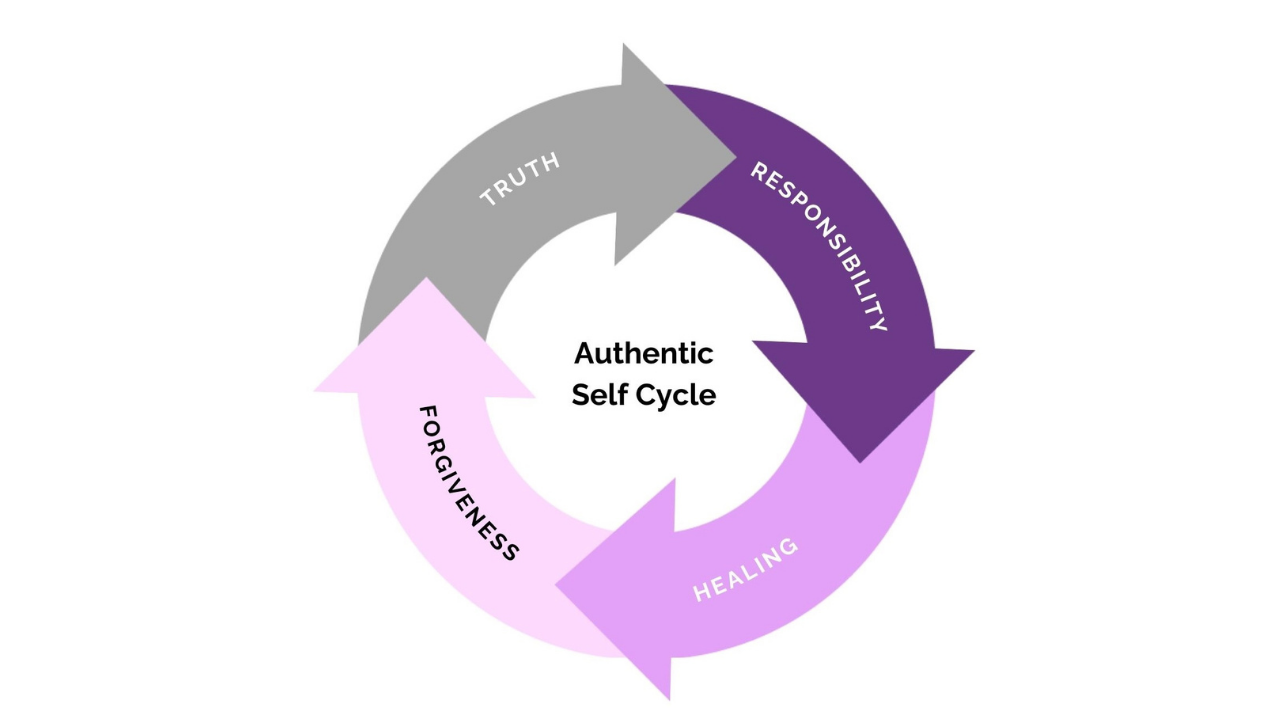
The Emotional Authenticity Method™ works because it creates a new neurochemical pattern. You’re not just thinking differently—you’re rewiring your emotional blueprint. This creates the Authentic Self Cycle™ (ASC), the healing counterpart to the Worst Day Cycle™.
That’s you—the one who begins to recognize your patterns, who starts asking for help without shame, who can sit with your own sadness without abandoning yourself, who’s becoming whole again.
Stage 1: Truth (Naming the Blueprint)
You recognize the pattern. “This isn’t about today. My nervous system learned this in childhood. This is the blueprint.” You’re no longer trapped in the story of “my partner is cold” or “I’m broken.” You’re in the truth: “This is a familiar pattern from childhood. I’m safe now, but my nervous system doesn’t know that yet.”
Stage 2: Responsibility (Owning Your Nervous System)
You own your emotional reactions without blame. “My partner isn’t my parent. My nervous system just thinks they are. I’m responsible for updating that information.” This isn’t blame—it’s agency. You can’t change what you don’t own. Once you own your nervous system’s habitual response, you can rewire it.
Stage 3: Healing (Rewiring the Blueprint)
Through consistent practice (the EAM steps, boundaries, safe relationships), you rewire your emotional blueprint. Conflict becomes uncomfortable but not dangerous. Space in a relationship isn’t abandonment—it’s breathing room. Intensity in someone’s voice isn’t attack. You’re literally rewiring the myelin pathways that were formed in childhood.
Stage 4: Forgiveness (Releasing Inheritance)
You release the inherited emotional blueprint. Not by minimizing what happened (“it wasn’t that bad”) but by acknowledging it, grieving it, and choosing not to pass it on. You forgive your parent not because they deserve it but because you deserve to be free. Forgiveness is the final myelin pathway—you’re no longer controlled by the past.
FAQ: People Also Ask About Healing Childhood Emotional Neglect
Can you heal from childhood emotional neglect if your parents did their best?
Yes. Healing from CEN isn’t about blame. Your parents may have been doing their best with the emotional resources they had. They probably had their own CEN. But the impact on you is real regardless of their intentions. You’re not healing to punish them—you’re healing to free yourself. The truth is both: your parents did their best AND you were emotionally neglected. Both are true. Holding both truths is where growth happens.
Is childhood emotional neglect the same as attachment issues?
CEN and attachment issues overlap but aren’t identical. Attachment is about your relationship with your primary caregiver—whether you learned the world is safe or unsafe. CEN is specifically about emotional attunement—whether your feelings were seen, named, and validated. You can have secure attachment and still have CEN (parent was safe but emotionally unreactive) or insecure attachment without CEN (parent was emotionally present but chaotic). Most people with CEN develop some form of insecure attachment, but they’re distinct issues.
How long does it take to heal from childhood emotional neglect?
Healing isn’t linear. You might feel dramatically different within weeks once you understand the pattern and start applying the Emotional Authenticity Method™. But myelin rewiring takes consistent practice—typically 6-12 months to create noticeable changes in your automatic responses, and 2-3 years to fully rewire your emotional blueprint. That said, the moment you understand “this is a pattern, not the truth about me,” something shifts. Relief starts immediately.
Can I heal from CEN without talking to my parent about it?
Absolutely. Healing happens in your nervous system, not in a conversation with your parent. In fact, many people try to have the “healing conversation” with their parent and feel retraumatized when their parent doesn’t understand or dismisses their experience. Your parent may never “get it.” That’s okay. Your healing doesn’t require their validation. It requires you honoring your own experience and rewiring your blueprint with safe people and through consistent practice.
What’s the difference between childhood emotional neglect and intentional abuse?
Abuse is intentional harm. CEN is the absence of attunement. A parent who ignores your crying is emotionally neglectful. A parent who yells at you for crying is abusive. Most people with CEN actually experienced some abuse mixed in—verbal, sometimes physical. But the core wound of CEN is the message: “You don’t matter enough for me to show up emotionally for you.” That wound often runs deeper than abuse because it says something is wrong with your very existence, not just your behavior.
How do I know if I have high self-esteem or if I’m just operating from a falsely empowered survival persona?
High self-esteem is quiet. It doesn’t need to prove itself. The falsely empowered persona is loud, defensive, needing constant validation through control or achievement. High self-esteem can receive criticism without spiraling. The falsely empowered persona experiences any feedback as attack. High self-esteem can be vulnerable. The falsely empowered persona sees vulnerability as weakness. Read more about the signs of genuine high self-esteem to understand the difference.
The Bottom Line: You Were Seen
Childhood emotional neglect teaches you that you’re invisible, that your inner world doesn’t matter, that feelings are a liability. You learned to survive by abandoning yourself. You became a ghost in your own life.
But here’s what’s true now: You were always worthy of attention. Your feelings always mattered. The failure to see you was never about your lovability—it was about your parent’s own emotional capacity. You internalized their limitation as your identity.
Healing means reclaiming yourself. It means learning to see yourself the way you always deserved to be seen. It means moving from the Worst Day Cycle™ (where you keep repeating childhood patterns) into the Authentic Self Cycle™ (where you’re building something new). It means using the Emotional Authenticity Method™ to rewire your nervous system, to return home to your body, to recognize that your feelings are data, not defects.
That’s you becoming yourself again—not the survival persona designed to protect a wounded child, but the authentic human underneath, finally safe enough to breathe.
Recommended Reading
Deepen your understanding of childhood emotional neglect and healing:
- Jonice Webb — Running on Empty: Overcome Your Childhood Emotional Neglect (the foundational book on CEN)
- Bessel van der Kolk — The Body Keeps the Score (how trauma lives in the nervous system)
- Gabor Maté — When the Body Says No (how emotional suppression manifests as illness)
- Pia Mellody — Facing Codependence (the foundational text on childhood trauma and codependence)
- Melody Beattie — Codependent No More (breaking patterns of self-abandonment)
- Brené Brown — Daring Greatly (vulnerability as strength, not weakness)
- Pete Walker — The Tao of Fully Feeling (emotional awareness and the four trauma responses)
- John Bradshaw — Homecoming: Reclaiming and Championing Your Inner Child (reparenting and self-compassion)
Ready to Heal Your Emotional Blueprint?
Understanding your Worst Day Cycle™ is the first step. Actually rewiring it requires consistent practice with the Emotional Authenticity Method™. These courses will guide you through the full healing process:
Emotional Blueprint Starter Course — Individual ($79) — Master your own emotional blueprint
Relationship Starter Course — Couples ($79) — Healing childhood patterns together
Why We Can’t Stop Hurting Each Other ($479) — How your Worst Day Cycle™ shows up in relationships
Why High Achievers Fail at Love ($479) — Healing the falsely empowered survival persona
The Shutdown Avoidant Partner ($479) — Understanding disempowered and adapted personas
Tier 1: Mapping the Blueprint ($1,379) — Deep dive into the EAM with live group work
Start with the free Feelings Wheel exercise to increase your emotional granularity right now. Then explore how your insecurity patterns show up in relationships, or learn to set boundaries without guilt. And if you’re in a relationship, these dos and don’ts will help you communicate from a healed place.
Finally, if you recognize your family patterns in enmeshment dynamics, that’s often where CEN is most visible. Healing there changes everything.