
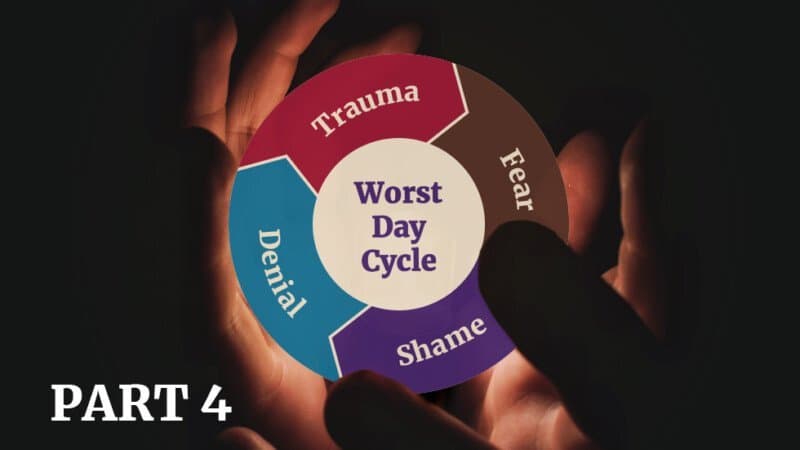
Shame in the Worst Day Cycle™ is the stage where you lose your inherent worth — the moment childhood trauma convinces you that you ARE the problem, not that you HAVE a problem, and it is the hidden engine that drives every pattern of self-sabotage, people-pleasing, perfectionism, and emotional shutdown in your adult life. If you’ve ever pushed yourself to the point of burnout, tolerated treatment you know is wrong, or felt hollow inside despite external success — shame is the invisible force running the program. And it started long before you had words for it.
That’s you — the one who works harder than everyone in the room because deep down, you believe that if you stop producing, you’ll be exposed as worthless.
This is Part 4 of my series on healing the Worst Day Cycle™. In Part 1, we explored how childhood trauma creates the cycle. In Part 2, we examined how the emotional blueprint runs your adult life. In Part 3, we explored how fear drives repetition. Now we arrive at the stage that locks the entire cycle in place: shame.
What Is Shame in the Worst Day Cycle™?
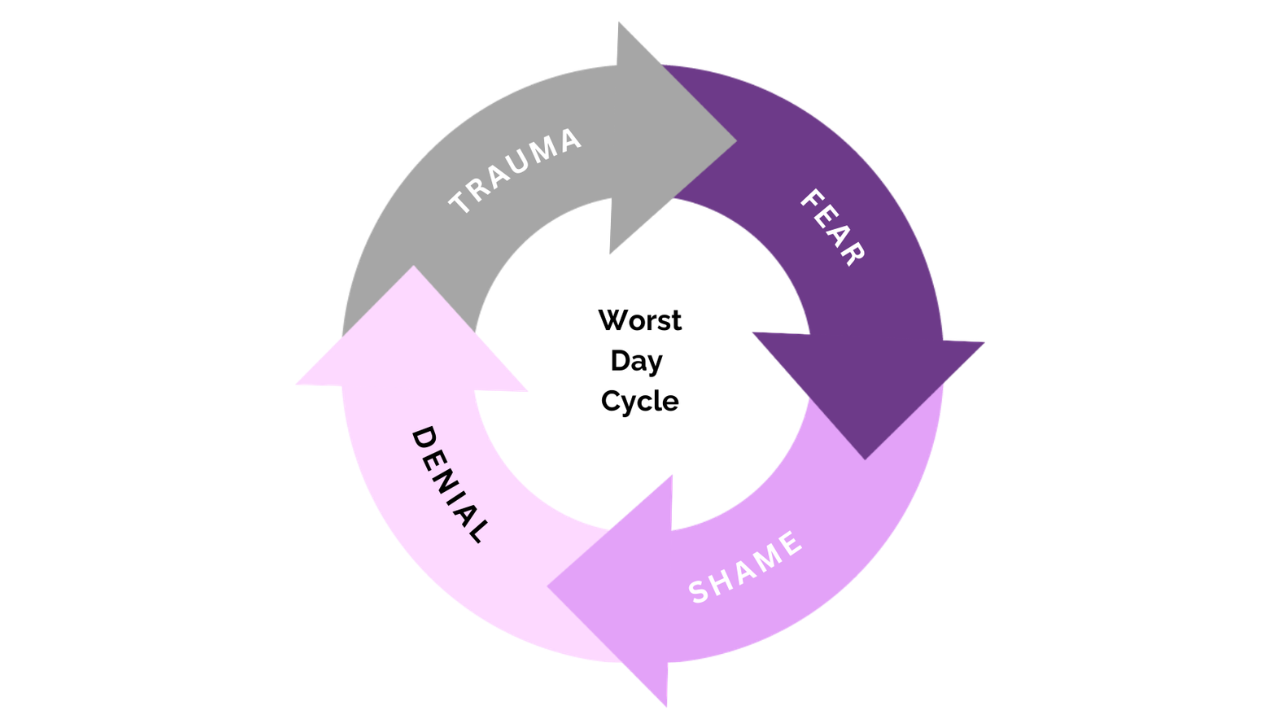
Shame is the third stage of the Worst Day Cycle™ — the four-stage neurochemical loop of Trauma → Fear → Shame → Denial that runs underneath every self-sabotaging pattern in your life. Shame sits at the center of your Worst Day Cycle™. It is the glue of trauma repetition. It is the prison of the adapted child-self.
That’s you — feeling a wave of worthlessness wash over you after a small mistake at work, and wondering why your reaction is so much bigger than the situation deserves.
Shame is not guilt. Guilt is healthy — it says “I did something against my values” and motivates repair. Shame says something entirely different. Shame says: “I AM the problem.” Not “I made a mistake” — but “I am fundamentally broken, defective, unworthy of love.” That belief didn’t come from nowhere. It was installed in childhood, and it has been running your operating system ever since.
Shame is the stage of the Worst Day Cycle™ where childhood trauma convinces you that your inherent worth is conditional — that you must perform, produce, please, or prove yourself to deserve love, connection, or even basic safety.
How Does Childhood Trauma Create Shame?
As a species, we need two things to survive: attachment to another human being and the ability to pursue our authentic selves. Because our caregivers are human — and therefore perfectly imperfect — every child faces a brutal choice: drop your authentic self to maintain attachment, or risk losing connection entirely.
That’s you — the child who stopped crying because tears made your parent uncomfortable. The child who learned that being “easy” was the only way to be loved.
The loss of your authentic self creates shame. Here’s how the Worst Day Cycle™ builds it:
Stage 1 — Trauma: Any negative emotional experience in childhood that created painful meanings about you. It doesn’t have to be dramatic — a parent who was emotionally unavailable, a household where feelings were weakness, a caregiver whose love was conditional on performance. These experiences create a massive chemical reaction in the brain and body. The hypothalamus generates chemical cocktails — cortisol, adrenaline, dopamine, oxytocin misfires — and the brain becomes addicted to these emotional states.
Stage 2 — Fear: Fear drives repetition. The brain conserves energy by repeating known patterns — it can’t tell right from wrong, only known from unknown. Since 70%+ of childhood messaging is negative and shaming, adults repeat these painful patterns in relationships, career, hobbies, health — everything. The brain thinks repetition equals safety.
That’s you — choosing the same emotionally unavailable partner over and over, not because you want to, but because your nervous system is terrified of anything unfamiliar.
Stage 3 — Shame: This is where it all collapses inward. The powerlessness within fear is what creates shame. Instead of seeing the fear as your nervous system’s response to a childhood wound, you internalize it as truth about yourself. “There’s something wrong with me because I can’t figure this out.” Shame strips you of your inherent value and worth and your authentic power.
Stage 4 — Denial: To survive the overwhelming nature of those feelings, you create denial. Denial is the moment shame kicks in the survival persona, suppresses the pain from childhood, and runs the old program. “I’m fine. I just have high standards. I just need to keep moving.” Instead of feeling the original wound, you deny it and throw yourself into more work, more fixing, more taking care of everybody else but yourself.
That’s the cycle — and it repeats thousands of times per day without your conscious awareness. You wake up and the shame engine fires up. You feel the fear it creates. You deny it by pushing harder. You get temporary relief. And then boom — the void. And the process repeats over and over and over.
The Worst Day Cycle™ reveals that shame is not a character flaw — it is a neurochemical survival pattern your brain created in childhood to make sense of unbearable pain, and it has been running on autopilot ever since.
How Does Shame Strip Your Inherent Worth?
Every human being has inherent value and worth — whether they are being perfect or imperfect. Worth is not something you earn through achievement, performance, usefulness, or compliance. It exists at birth and can never be lost.
But shame convinces you otherwise.
That’s the lie shame tells — that your value is conditional. That you must perform, produce, or please others to deserve love. That without your achievements, your gifts, you could never be loved and would never have been loved.
As John Bradshaw explains, “The wounded inner child contaminates intimacy in relationships because he has no sense of his authentic self.” When a parent cannot affirm a child’s feelings, needs, and desires, they reject that child’s authentic self. A survival persona must then be set up to replace the authentic self. And that persona runs on shame.
Shame is the core motivator of both the super-achiever and the under-achiever. The super-achiever uses accomplishment to prove they have worth — “If I just work harder, achieve more, become more impressive, maybe I’ll finally feel enough.” The under-achiever has given up the fight entirely — “Why bother? I’ll never be enough anyway.” Both are running the same shame program. Both have lost contact with their inherent worth.
That’s you — either grinding yourself into the ground trying to prove you’re worthy, or collapsed under the weight of believing you never will be. Two sides of the same shame coin.
Trying to be perfect is actually self-rejection — it is choosing to give up your own identity and making yourself powerless. The single greatest way to love yourself and develop self-worth is to follow your own morals, values, needs, and wants — and to accept that you are a human being with overwhelming inherent worth regardless of what you’ve done or what’s been done to you.
Shame creates a counterfeit identity system — it convinces you that your authentic self is unlovable, so you build a survival persona to earn the love that was always your birthright, and that persona becomes the prison you live in for decades.
How Do the Three Survival Personas Use Shame?
Your survival persona is the identity your brain built in childhood to navigate an emotionally unsafe environment. It’s not who you are — it’s who you had to become. And shame is the fuel that powers every version of it.
Whether falsely empowered, disempowered, or adapted wounded child — it’s all a power game. Shame strips us of our inherent value and worth and our authentic power. So the survival persona tries to get that power back — through control, through collapse, or through oscillating between both.
The Falsely Empowered: This persona controls, dominates, and rages. The shame engine tells them: “If I’m in charge, if I win, if I’m perfect, people can’t hurt me or abandon me.” They’re driven by a deep terror of vulnerability and powerlessness. Work is their addiction, success is their medication, and failure is their nightmare. They use achievement to deny how deeply unworthy they feel — not because that’s true, but because that’s the message that was placed into them.
That’s you — the one who’d rather burn out than admit you’re exhausted, because admitting weakness feels like proof that you are fundamentally flawed.
The Disempowered: This persona collapses, people-pleases, and disappears. The shame engine tells them: “If I make myself small, if I sacrifice myself, if I’m always available, people won’t leave me.” They hide their shame behind being the “nice” person. But being nice is a covert way of playing the victim — the nice person wants recognition for being such a nice person while continually picking people and situations where they give more and do more.
Sound familiar? The feeling that you have to earn love through sacrifice, that saying no will cause abandonment, that your own needs are selfish?
The Adapted Wounded Child: This persona oscillates between falsely empowered and disempowered depending on the context. One moment they’re raging and controlling, the next they’re collapsed and people-pleasing. They’re unpredictable even to themselves. This person is exhausted by their own inconsistency.
That’s you — the one who can’t understand why you blow up at your partner one moment and then become a doormat the next, wondering why you can’t just be consistent.
All three survival personas use shame as a control mechanism — they tell you that if you step out of your survival role, if you become vulnerable, if you ask for what you need, you’ll be exposed, abandoned, or destroyed. Self-sabotage is the collision between the authentic self and the shame-based survival persona.
How Does Shame Show Up in Every Area of Your Life?
Shame doesn’t stay in one corner of your life. It’s a system that runs everything — because it’s your nervous system trying to keep you safe.
Family: You’re either still trying to earn your parents’ approval (falsely empowered) or completely dependent on their validation (disempowered). You can’t set healthy boundaries because boundaries feel like abandonment. Shame makes you feel less than — and when someone in the family brings up a topic that touches your unhealed wound, that childhood shame jumps up and you lash out or shut down. You try to create a diversion so you don’t have to admit what you’re really feeling.
That’s you — still playing the role your family assigned you at age six, managing everyone’s emotions at holiday dinners while your own feelings sit unvisited.
Romantic Relationships: The shame engine ensures you choose partners who trigger your childhood wounds. You recreate the Worst Day Cycle™ with your partner over and over. Something triggers your fear, you shame yourself, you activate your survival persona (control or collapse), and your partner reacts to the persona — not the real you. Both of you are having two completely different conversations: one in the present and one in the past.
That’s you — unable to have a conversation about a legitimate need without either exploding or shutting down, wondering why your relationships never feel secure.
Friendships: You’re the friend who always has it together and secretly resents that others never check on you. Or you’re the friend who abandons yourself completely and becomes bitter when others don’t reciprocate. You don’t let people see you struggle. You feel lonely even when surrounded by people because no one actually knows you — they know your survival persona.
Work: The falsely empowered shame engine shows up as burnout, perfectionism, and inability to delegate. The disempowered shame engine shows up as underearning, underselling yourself, and accepting terrible treatment from employers. Either way, you’re not working from your real motivation — you’re working from fear and shame. You’re proving something instead of creating something.
Sound familiar — working 60+ hours a week because you believe that’s the only way you’re valuable, or staying in a job that pays you 30% less than your market value because you don’t think you deserve better?
Body and Health: Shame creates disconnection from your body. You push through pain and exhaustion (falsely empowered) or abandon self-care entirely (disempowered). Chronic pain, digestive issues, insomnia, and autoimmune conditions are often the body’s last resort when emotional signals have been ignored for decades. Your body has been trying to tell you something — but shame taught you to stop listening.
That’s your body keeping score — every swallowed feeling, every suppressed need, every moment you abandoned yourself to keep someone else comfortable.
Why Can’t You Think Your Way Out of Shame?
Affirmations. Willpower. Positive thinking. Cognitive reframing. You’ve probably tried all of these. You’ve probably spent years telling yourself you’re worthy, capable, enough. And you probably still feel the shame.
Here’s why: shame is not a thought — it’s a nervous system state. Your emotions are biochemical events, not intellectual ones. Thoughts originate from feelings, not the other way around. You cannot think your way out of a nervous system that’s still running the Worst Day Cycle™.
That’s you — repeating “I am worthy” while your nervous system is screaming that you’re not, and then shaming yourself for not being “positive enough.”
As John Bradshaw wrote, “Cognitive addictions are a powerful way to avoid feelings. Thinking can be a way to avoid feelings.” Every thought starts as a feeling — the emotion comes first. Yet we all try to think our way through things, which is a waste of time because you can’t change your thoughts until you change your feelings.
When your nervous system is in the shame state, it doesn’t care what your mind says. It’s running on survival code written in childhood. Your conscious mind is no match for your nervous system’s survival patterns. And that’s exactly why you need a practice that speaks your nervous system’s language — not just your intellect’s.
Shame cannot be resolved through intellectual understanding because it is stored as a neurochemical pattern in the body — the brain created a chemical addiction to worthlessness in childhood, and that addiction runs below conscious awareness thousands of times per day.
How the Emotional Authenticity Method™ Rewires Shame
The only way to rewire the shame pattern is to change your nervous system’s emotional blueprint. And that requires the Emotional Authenticity Method™ Method™ — a somatic, nervous-system-based approach that actually changes your neurochemistry.
Step 1: Somatic Down-Regulation. Focus on what you can hear for 15-30 seconds. Before you can process anything, you have to get your nervous system out of survival mode. If you’re highly dysregulated, use titration — feel a little bit of the emotion, get regulated, then feel a little bit more. You’re teaching your nervous system that this feeling won’t destroy you.
That’s you — finally understanding that “handling it” means pausing to calm your nervous system first, not pushing through with willpower.
Step 2: What am I feeling right now? Most people respond to shame with “I feel bad” or “I’m stressed.” Your nervous system needs more specificity to heal. Use the Feelings Wheel to develop emotional granularity — the ability to name specific emotions instead of lumping everything into surface-level labels.
Step 3: Where in my body do I feel it? All emotional trauma is stored physically. Your chest tightens. Your stomach drops. Your jaw clenches. Locating the feeling in your body is how you move from intellectual understanding to somatic processing. You’re moving from “I AM ashamed” to “I FEEL shame in my chest” — and that difference is everything.
Step 4: What is my earliest memory of having this exact feeling? This is where the real rewiring happens. You trace today’s shame reaction back to its childhood origin. You realize: this isn’t about today. My partner isn’t my parent. My boss isn’t my father. My nervous system just thinks they are.
That’s the moment everything shifts — when you see that your shame reaction belongs to a five-year-old, not a forty-year-old. The reason it’s so scary is that at some point in your childhood, you didn’t have the answer, you were imperfect, and your caregivers sent the message that there’s something defective about you.
Step 5: Who would I be if I never had this thought or feeling again? This is the vision step. It connects you to the Authentic Self Cycle™. When clients are asked this question, the answer is always some version of: “I feel lighter. I feel calm. I feel free. I feel more like myself.” They don’t describe a new survival persona — they describe their authentic self. That emotional experience is the truth of who they are without the Worst Day Cycle™, without the faulty emotional blueprint, without the shame voice.
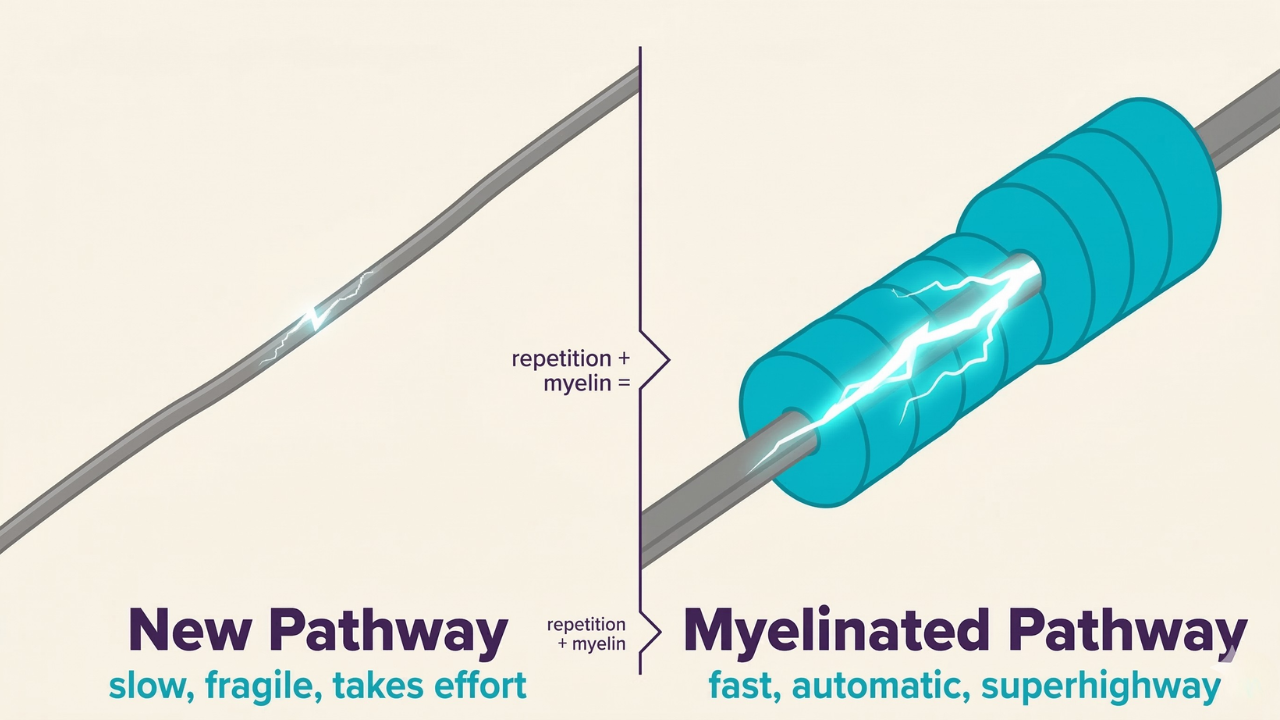
Step 6: Feelization. Sit in the feeling of the Authentic Self and make it strong. Create a new emotional chemical addiction to replace the old blueprint. Ask: how would I respond to this situation from this feeling? What would I say? What would I do? Visualize and FEEL yourself operating from your Authentic Self. This is the emotional blueprint remapping and rewiring step — you’re building a new neurochemical neural pathway that works for you instead of the Worst Day Cycle™ working against you.
That’s you — not just thinking about who you could be, but feeling it in your body. Creating the emotional experience of your Authentic Self so your nervous system has something real to move toward.
The Emotional Authenticity Method™ works because emotions are biochemical events — you cannot change emotional patterns through thoughts alone. Thoughts originate from feelings, not the other way around. The EAM speaks your nervous system’s language and rewires shame at the source.
How the Authentic Self Cycle™ Replaces Shame With Worth
While the Worst Day Cycle™ traps you in Trauma → Fear → Shame → Denial, the Authentic Self Cycle™ restores your identity through Truth → Responsibility → Healing → Forgiveness. It is the healing counterpart — an identity restoration system that creates a new emotional chemical pattern to replace fear, shame, and denial.
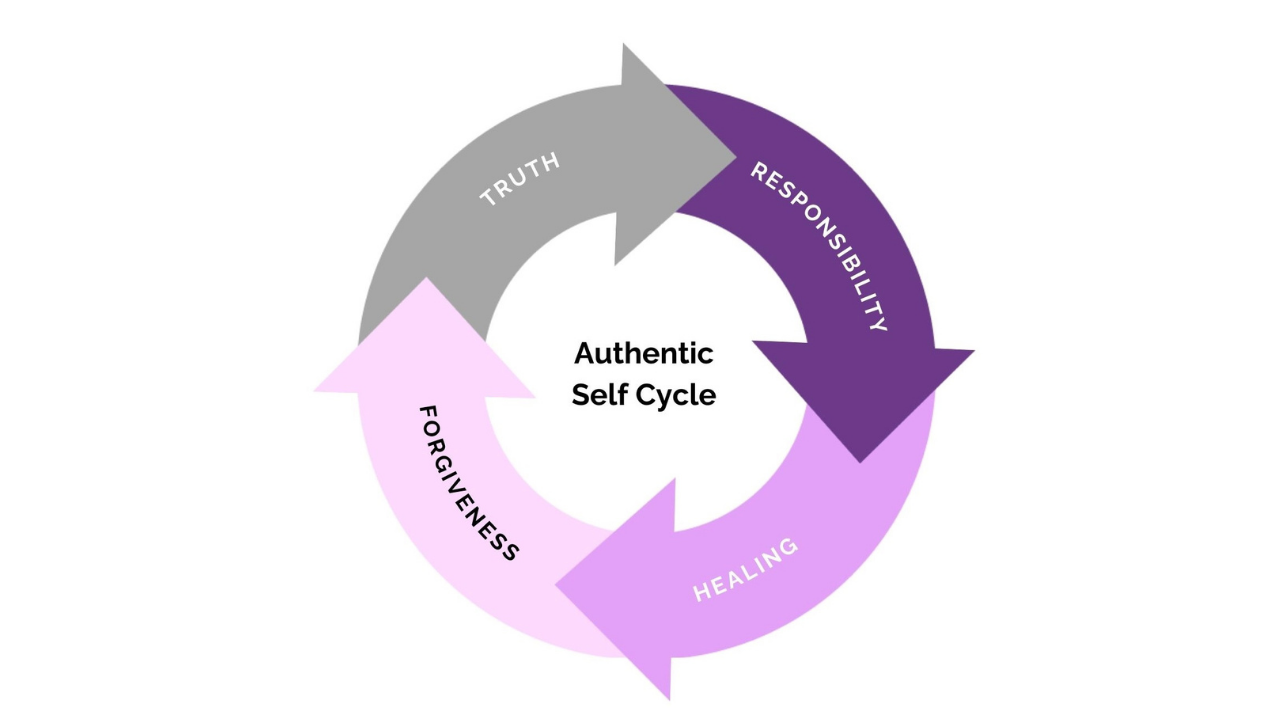
Truth: Name the blueprint. See that “this isn’t about today.” When your colleague gives you critical feedback and your chest tightens, truth says: “This feeling is from childhood. My colleague isn’t my critical parent — my nervous system just thinks they are.” Truth breaks the wall of denial and exposes that the fixer, the giver, the survival personas are not the authentic self but adaptations.
That’s the first step out of shame — seeing the pattern instead of being trapped inside it.
Responsibility: This is not blame or shame. You did the best you could with what you knew at the time. Responsibility means owning that “this survival pattern kept me safe, but now it’s time to let it go.” You are always responsible for how you are making yourself feel, protecting yourself, and meeting your needs and wants — without controlling or changing the other person.
Sound familiar? The relief of finally understanding that you can’t control anyone else, but you CAN rewire how you respond to them.
Healing: Rewire the emotional blueprint so conflict becomes uncomfortable but not dangerous, space isn’t abandonment, and intensity isn’t attack. This is where the Emotional Authenticity Method™ does its work — reparenting the inner child, becoming the parent who chooses you. When you do that, you break the shame story, heal the fear-based chemical addiction, confront the emotional memory your body carries, and create emotional safety inside your own nervous system.
Forgiveness: Forgiveness is not condoning what happened. Forgiveness is the moment the adult self consistently takes the driver’s seat from the child self and the shame voice. It says: “Hey kids, love you, but back seat. I’m driving now.” It is forgiving yourself: “I see it now. I’ve been stuck in this survival persona. I don’t need to shame myself for that. I was brilliant to come up with that. But I can see now it’s no longer fit for the adult world.”
That’s you — not becoming someone new. Finally meeting who you always were underneath the survival persona and the shame that built it.
Because I live in truth, responsibility, healing, and forgiveness, I can forgive myself for being imperfect and that I still have healing to do. Our authentic self knows at all times whether we are being perfect or imperfect — and that we always have value and worth.
The Authentic Self Cycle™ creates a new emotional chemical pattern that gradually replaces the fear/shame/denial pattern — as this new pattern strengthens through daily Feelization practice, your survival persona becomes less necessary and your authentic self becomes your default operating system.
Frequently Asked Questions About Shame and Healing
What is the difference between shame and guilt?
Guilt is healthy — it says “I did something against my values” and motivates you to repair. Shame says “I AM the problem” — it attacks your identity, not your behavior. Guilt leads to accountability. Shame leads to self-destruction, people-pleasing, or perfectionism. In the Worst Day Cycle™, shame is the third stage that strips your inherent worth and creates your survival persona.
Why is shame so hard to heal?
Shame is hard to heal because it is stored in the body as a neurochemical pattern, not as a thought. Your brain became chemically addicted to the emotional state of worthlessness in childhood — cortisol, adrenaline, and stress hormones became your nervous system’s baseline. The Emotional Authenticity Method™ addresses shame at the somatic level where it actually lives, not just the cognitive level where most approaches stop.
Can shame be healed without therapy?
You can make real progress using the Emotional Authenticity Method™ on your own. But your nervous system learned shame in relationship, so it heals most powerfully in relationship — whether that’s coaching, therapy, group work, or a trusted partner who understands the Worst Day Cycle™. Having someone witness your process accelerates healing dramatically.
How does shame create self-sabotage?
Self-sabotage is the collision between the authentic self and the shame-based survival persona. When you start to succeed, your survival persona panics — because if you live in your authentic self, the persona loses its connection to the old attachment patterns. If you actually succeed, it means the survival persona was always wrong. So it pulls you back into the Worst Day Cycle™ to keep you stuck in the known pattern.
What are the three survival persona types?
The three survival personas are the falsely empowered (controls, dominates, rages to avoid vulnerability), the disempowered (collapses, people-pleases, disappears to avoid abandonment), and the adapted wounded child (oscillates between both depending on the situation). All three are driven by shame and are attempts to reclaim the power that childhood trauma stole.
How long does it take to rewire shame?
Most people see shifts within weeks of consistent practice with the Emotional Authenticity Method™, but real neurological rewiring takes months and years. The key is repetition, not intensity. Within weeks, your reactions become less automatic. Within months, shame has less power. After a year of consistent work, your baseline nervous system state will be fundamentally different. The Authentic Self Cycle™ provides the framework for long-term identity restoration.
The Bottom Line
Shame told you that you are the problem. It has been running that message since you were a child — through your relationships, your career, your friendships, your body, and the quiet moments when the noise stops and the void creeps in.
But shame lied.
You were never the problem. You were a child in an impossible situation who created a brilliant survival strategy to stay alive. That strategy — the survival persona — was genius at age seven. But you’re not seven anymore. And the shame that powers it has been keeping you from the one thing you’ve been searching for your entire life: your authentic self.
There’s nothing wrong with any of us — we’re all perfectly imperfect, we’re human, we’re limited, and we always have inherent value and worth even in our imperfections.
That’s you — not the survival persona grinding for approval. Not the people-pleaser swallowing your needs. Not the adapted wounded child swinging between both. The real you. The one underneath all of it. The one who has been waiting to be seen, chosen, and valued — not for what you do, but for who you are.
The Worst Day Cycle™ runs on shame. The Authentic Self Cycle™ runs on truth. And healing begins the moment you choose truth over denial — even for one breath, one moment, one small act of emotional authenticity.
It’s not an easy journey, but I promise if you choose to do this healing work, you’ll discover the truth about the world and about yourself — and that truth will produce real freedom in your life.
Recommended Reading
Healing the Shame That Binds You by John Bradshaw — the foundational work on toxic shame and how it colonizes identity.
Facing Codependence by Pia Mellody — how childhood trauma creates the survival patterns that shame powers.
The Body Keeps the Score by Bessel van der Kolk — the neuroscience of how trauma and shame live in the body, not the mind.
When the Body Says No by Gabor Maté — how chronic shame and emotional suppression manifest as physical illness.
Codependent No More by Melody Beattie — a practical guide for recognizing shame-driven codependent patterns.
The Gifts of Imperfection by Brené Brown — how shame drives performance-based identity and why vulnerability is the path back to worth.
Daring Greatly by Brené Brown — shame resilience and the courage to be imperfect.
Take the Next Step
If you’re ready to rewire the shame pattern and reclaim your authentic self, Kenny Weiss offers courses designed for people who are done performing and ready to heal:
Emotional Blueprint Starter Course — Individual ($79) — Your personal roadmap to understanding the Worst Day Cycle™ and beginning the journey from shame to your authentic self.
Relationship Starter Course — Couples ($79) — For couples ready to break the shame-driven cycle of reactivity and build interdependence.
Why We Can’t Stop Hurting Each Other ($479) — Deep-dive into the Worst Day Cycle™ and how childhood shame creates relationship pain.
Why High Achievers Fail at Love ($479) — Built specifically for the falsely empowered survival persona and the shame engine driving success addiction.
The Shutdown Avoidant Partner ($479) — Understanding avoidant attachment through the lens of trauma chemistry and shame-driven survival personas.
Tier 1: Mapping the Blueprint ($1,379) — The comprehensive program for learning and practicing the Emotional Authenticity Method™ to rewire shame at the nervous system level.
Download the Feelings Wheel — the free tool used in Step 2 of the Emotional Authenticity Method™ to build emotional granularity beyond surface-level shame responses.
Explore more: The Signs of Enmeshment | 7 Signs of Relationship Insecurity | 7 Signs of High Self-Esteem | How to Determine Your Negotiables and Non-Negotiables | 10 Do’s and Don’ts for a Great Relationship