
Toxic shame isn’t just feeling bad about yourself—it’s the devastating belief that you ARE the problem. This core wound, formed in childhood trauma, splits your personality into a “survival persona” that kept you safe back then but now sabotages your relationships, career, and health. In this article, you’ll learn exactly how toxic shame creates these three distinct survival personas, why willpower and affirmations fail to fix it, and the precise steps to reclaim your authentic self.
Toxic shame develops from childhood trauma when you internalize the message “I am bad/unlovable/wrong.” Your brain creates a survival persona (one of three types) to protect you from that pain. This persona works brilliantly for a traumatized child but catastrophically fails in adult relationships, work, and health. The Emotional Authenticity Method™ and Authentic Self Cycle™ rewire your emotional blueprint so you can release this protective mask and become whole.
What Is Toxic Shame? (And Why You Might Not Know You Have It)
Toxic shame is different from regular guilt. Guilt says “I did something bad.” Toxic shame says “I AM bad.” It’s the core belief that you are fundamentally flawed, unlovable, or defective—and that belief was installed in your nervous system before you were old enough to question it.
That’s you… if you’ve always felt like there’s something wrong with you that everyone else just doesn’t see yet.
Unlike acute shame (which you feel and then move on from), toxic shame is chronic. It’s baked into your neurobiology. Your nervous system genuinely believes you are the problem—and it runs this belief 24/7, whether you’re consciously aware of it or not.
Here’s the thing: Toxic shame doesn’t feel like shame. It feels like truth. It feels like “just knowing” you’re not enough, not worthy, too much, not enough of the right thing. It’s the whisper that says “if people really knew you, they’d leave.” It’s the underlying current beneath everything you do.
That’s you… if you’re always waiting for the other shoe to drop, even when things are going well.
The Anatomy of Toxic Shame
Toxic shame has specific markers. You might experience:
- A feeling of being “found out” — terrified that people will discover who you really are
- Chronic self-consciousness — always aware of how you’re being perceived
- Perfectionism or rebellious chaos — trying to prove you’re either perfect or beyond the rules
- Deep isolation — feeling like you have to handle everything alone
- Hypersensitivity to criticism — criticism feels like proof of what you already believe about yourself
- Difficulty receiving compliments — deflecting kindness because you don’t believe it
- Compulsive self-judgment — narrating every “mistake” you make
That’s you… if someone compliments you and your first instinct is to argue with them or minimize what they said.
How Childhood Trauma Creates Your Emotional Blueprint
Here’s what most people don’t understand: Your childhood wasn’t neutral. Every negative message you received didn’t just pass through you like wind. It got encoded into your nervous system as THE TRUTH about who you are, who other people are, and how the world works.
That’s you… if you’re repeating patterns you swore you’d never repeat—the same fights with partners, the same conflicts at work, the same health issues—and you have no idea why you can’t just stop.
Research shows that 70% or more of childhood messaging is negative, shaming, or critical. Your parents (usually doing the best they could with what they had) said things like:
- “What’s wrong with you?”
- “You should be ashamed of yourself.”
- “You’re too much / not enough.”
- “If you were a better kid, I wouldn’t have to…”
- “You always ruin everything.”
- “Nobody’s going to love you if you keep acting like that.”
Your brain, which is literally designed to survive, took these messages and created a story: “I am the problem. There’s something fundamentally wrong with me.” This isn’t a thought—it’s a neural pathway. A belief. An identity.
Citation: Childhood emotional experiences create lasting neural patterns through a process called “emotional encoding.” When a child experiences repeated trauma or shaming messages paired with fear and pain, the amygdala (emotional processing center) and hypothalamus (stress response center) create deep neurochemical associations. The child’s developing brain conserves cognitive energy by automating these patterns, making them feel automatic and “true” in adulthood, even when circumstances have completely changed.
That’s you… if you find yourself reacting to your adult partner like they’re your parent, or to your boss like they’re your critical father, even though you rationally know they’re different people.
The Chemical Cascade of Childhood Trauma
When a child experiences trauma (any negative emotional experience that creates painful meanings), the hypothalamus releases a chemical cocktail: cortisol (the stress hormone), adrenaline (the fight/flight chemical), dopamine (often dysregulated in trauma), and misfiring oxytocin (the connection chemical, now twisted with fear).
Your brain becomes chemically addicted to these emotional states because they become associated with survival. Your nervous system literally can’t tell right from wrong—it only knows familiar versus unfamiliar. And since the painful patterns are familiar, the brain perceives them as safe.
That’s you… if you feel more comfortable in conflict or crisis than in peace and calm—like something’s missing when things are actually going okay.
The Three Survival Persona Types (And Which One Are You?)
When a child is drowning in shame, the psyche does something brilliant: it creates a survival persona—a protective identity that helps the child endure the unbearable. This persona was never meant to be permanent. It was a lifesaving invention. But then the child grows up, and the persona stays in the driver’s seat, sabotaging every relationship, career move, and attempt at intimacy.
That’s you… if you’ve ever caught yourself acting in a way that doesn’t feel like the real you, but you can’t seem to stop.
There are three primary survival persona types:
The Falsely Empowered Persona
This persona says “I won’t be vulnerable or controlled.” In childhood, this kid learned that love comes with pain, so they decided to never need anyone. They became the controller, the executor, the one who dominates situations and relationships.
Adults with this persona tend to:
- Control their partners, friends, or team members
- Rage when they don’t get their way
- Present as confident but live in fear of being exposed as a fraud
- Achieve a lot externally but feel empty inside
- Have intense, short-lived relationships that blow up
- Struggle with true intimacy because vulnerability feels dangerous
That’s you… if people describe you as intimidating, or if you’ve noticed that the more successful you become, the more alone you feel.
The Disempowered Persona
This persona says “I won’t take up space or have needs.” In childhood, this kid learned that their feelings were too much, too loud, or not valued. They became the people-pleaser, the one who collapses, the one who disappears into what everyone else needs.
Adults with this persona tend to:
- Say yes to everything even when they’re drowning
- Lose track of what they actually want or need
- Feel resentful because nobody asks them what they need
- Get depressed or anxious easily
- Attract partners or friends who take advantage of their generosity
- Feel like victims of everyone else’s demands
That’s you… if you’ve realized you don’t even know what you want anymore, or if people describe you as “always there for everyone.”
The Adapted Wounded Child Persona
This persona oscillates. Sometimes it’s Falsely Empowered (controlling, raging), sometimes it’s Disempowered (collapsing, people-pleasing). These folks flip between the two depending on stress levels, relationship dynamics, or nervous system state.
Adults with this persona tend to:
- Have intense, chaotic relationships where things go from great to terrible unpredictably
- Feel confused about who they actually are
- Have inconsistent career trajectories (great success followed by burnout)
- Experience extreme mood swings
- Feel desperate for connection but sabotage it when it gets close
- Have a hard time setting boundaries (or setting them too rigidly)
That’s you… if your friends say “I never know which version of you I’m going to get,” or if your relationships feel like a roller coaster.
The Worst Day Cycle™: How Shame Becomes Your Default
The Worst Day Cycle™ (WDC) explains exactly how childhood trauma keeps you locked in patterns that no amount of willpower can break.
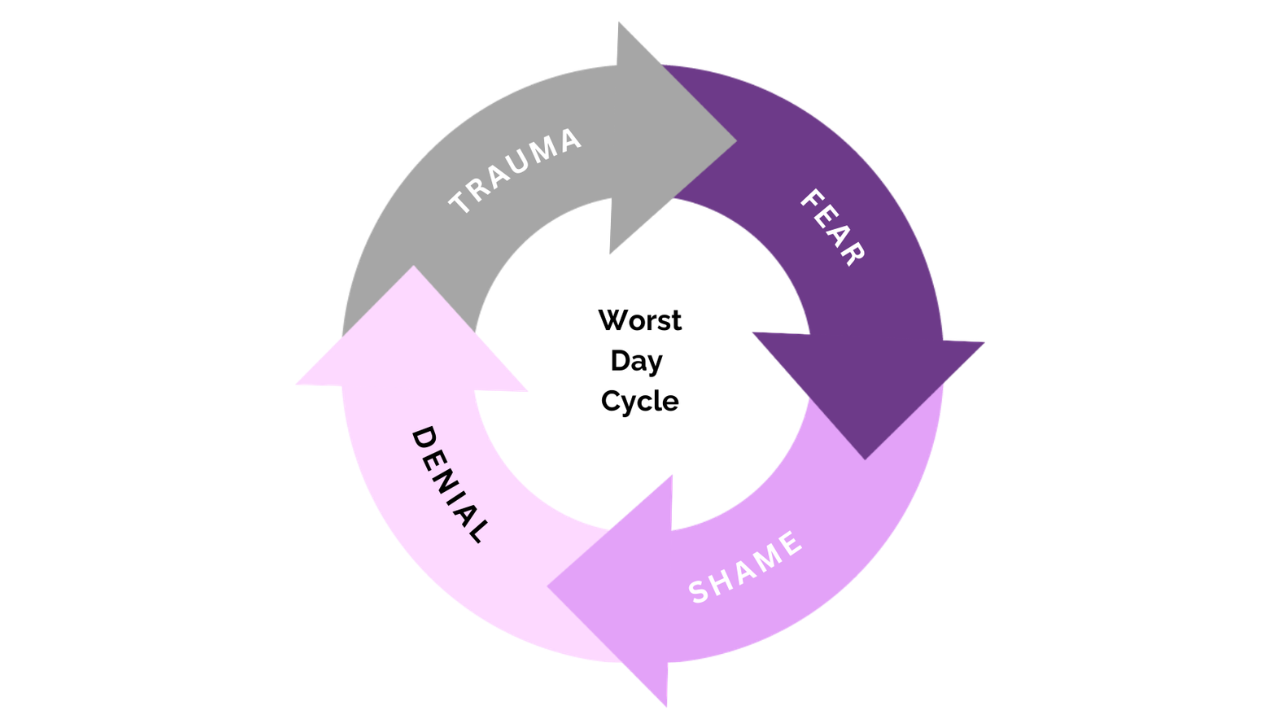
The WDC has four stages:
Stage 1: Trauma
Childhood trauma (any negative emotional experience that created painful meanings about yourself, relationships, or safety). This isn’t just “big” trauma—it includes emotional neglect, criticism, parentification, enmeshment, abandonment, or conditional love.
That’s you… if you minimize your childhood pain because “it wasn’t that bad” compared to other people’s stories.
Stage 2: Fear
The trauma creates fear, and the brain becomes addicted to fear-based chemistry. Fear is the brain’s way of saying “This is how you survive.” Your nervous system gets locked into hypervigilance—always scanning for danger, always ready to protect you.
That’s you… if you’re exhausted even when nothing’s wrong, or if you find yourself bracing for impact in situations that should feel safe.
Stage 3: Shame
Over time, fear becomes internalized as shame. “I’m afraid” becomes “I’m the problem.” Shame is where you lost your inherent worth. It’s the belief that something is fundamentally, unfixably wrong with you.
That’s you… if you feel like an imposter, like you don’t deserve good things, or like you’re broken.
Stage 4: Denial (The Survival Persona)
Shame is unbearable, so the psyche creates a survival persona—a protective identity that denies the pain underneath. This persona becomes your default way of being in the world.
That’s you… if your survival persona feels like who you are, not like something you’re doing.
Here’s the critical part: The survival persona was brilliant in childhood. It kept you safe. It helped you survive unbearable circumstances. But now you’re an adult in an adult situation, and the survival persona is running your life like you’re still six years old and your parent is still threatening to leave.
Citation: The Worst Day Cycle™ represents a neurobiological feedback loop where childhood trauma becomes encoded in the amygdala and creates automatized threat-detection patterns. Fear-based responses become the nervous system’s default because the brain prioritizes familiar patterns over accuracy. The survival persona (what some call the “protective self”) is a dissociative adaptation that allowed the child to function despite overwhelming pain, but in adulthood, these same protective mechanisms prevent genuine connection, emotional healing, and authentic self-expression.
How Your Survival Persona Shows Up in Every Area of Your Life
Toxic shame and your survival persona don’t just affect one area. They contaminate everything. Here’s how:
In Romantic Relationships
Your survival persona is running the show. If you’re Falsely Empowered, you might control your partner or rage when they want independence. You keep them at arm’s length because intimacy feels dangerous. If you’re Disempowered, you might lose yourself entirely in the relationship, becoming whoever your partner needs you to be. You accept treatment you wouldn’t accept from anyone else. If you’re Adapted Wounded Child, you cycle between closeness and distance, creating chaos and confusion.
That’s you… if your relationships always seem to follow the same painful pattern, no matter who the partner is.
Internal Link: If you’re struggling with enmeshment or codependency patterns, read The Signs of Enmeshment for deeper insight into how your survival persona shows up in your closest relationships.
In Friendships
Your survival persona determines the friendships you attract and how you show up in them. The Falsely Empowered person often has surface-level friendships and struggles with true vulnerability. The Disempowered person may have friendships where they give constantly and receive rarely. The Adapted Wounded Child oscillates between being the hero and the victim.
That’s you… if your friendships feel one-sided, or if you can’t remember the last time you asked a friend for help.
In Your Career
Shame shows up as the imposter syndrome that makes you work twice as hard for half the recognition. It shows up as the tendency to either overextend yourself (proving your worth) or sabotage your success (because you don’t deserve it). It shows up as difficulty with authority figures or as struggling to set boundaries with your team.
That’s you… if you’ve achieved significant success but feel like a fraud, or if you self-sabotage right when things are about to break through.
In Your Health and Body
Chronic shame creates chronic stress, which becomes chronic inflammation, which becomes chronic illness. Your survival persona may manifest as eating disorders, addiction, or compulsive behaviors—using food, alcohol, sex, work, or other substances to numb the pain. Or it may manifest as hyper-awareness of your body, perfectionist exercise routines, or complete disconnection from your body.
That’s you… if you use substances, food, or behaviors to manage difficult emotions, or if you’ve noticed that your health seems to decline during high-stress periods.
In Your Family of Origin
If you grew up in a shame-based family, your survival persona might mean you either repeat the cycle with your own children or overcorrect and fail to set any boundaries at all. You might oscillate between enabling family dysfunction and distancing yourself entirely.
That’s you… if you feel insecure even with your own family, or if you’re terrified of becoming your parent.
Why Positive Thinking and Affirmations Can’t Heal Toxic Shame
Here’s what doesn’t work: “You are enough” affirmations.
Why? Because you don’t actually believe them. Your nervous system doesn’t believe them. Affirmations are like putting a new bumper sticker on a car that’s fundamentally broken. They might feel good for five minutes, but they don’t change the underlying blueprint.
That’s you… if you’ve tried all the affirmations, journaling, vision boards, and meditation—and you still feel broken underneath.
 Emotional Authenticity Method™ Method rewires your emotional blueprint at the nervous system level" width="600" style="max-width:100%;height:auto;" />
The reason affirmations fail is neurobiology. Your nervous system is literally running an old operating system. When you try to override it with positive thinking, the nervous system perceives positive thoughts as lies. This creates what psychologists call “cognitive dissonance”—the discomfort of holding two conflicting beliefs. Your nervous system resolves this by rejecting the new belief and strengthening the old one.
You need to rewire the blueprint itself. And that requires understanding and working with your nervous system, not against it.
Citation: Positive affirmations without nervous system regulation fail because they attempt to override limbic system encoding through cortical processing. The amygdala (emotional processing center) and neural pathways that store trauma memories operate below conscious awareness and cannot be contradicted by rational thought alone. Genuine healing requires somatic (body-based) processing, emotional integration, and nervous system recalibration—not cognitive reframing alone. This is why willpower-based approaches to healing shame are neurobiologically ineffective.
The Emotional Authenticity Method™: Five Steps to Release the Pain
The Emotional Authenticity Method™ (EAM) is a five-step process that works at the nervous system level, not just the thinking level.
Step 1: Somatic Down-Regulation with Optional Titration
Before you can think clearly, your nervous system needs to feel safe. This means bringing your body down from hypervigilance. You might use breathwork, movement, progressive muscle relaxation, or cold water immersion. Titration means doing this gently—just enough to calm the nervous system, not so much that you dissociate or go numb.
That’s you… if you’ve tried to “talk” your way out of anxiety and found that thinking harder just made it worse.
Step 2: What Am I Feeling? (Emotional Granularity via the Feelings Wheel)
Most people experiencing toxic shame collapse all their emotions into “bad,” “broken,” or “wrong.” The Feelings Wheel helps you get specific. Are you angry? Scared? Lonely? Sad? Disappointed? Getting specific is neurobiology—the more precise you are about what you’re feeling, the more your cortex (thinking brain) can engage, and the less your amygdala (panic center) hijacks you.
That’s you… if someone asks “How are you feeling?” and you draw a blank or say “fine” even when you’re clearly struggling.
Access the Feelings Wheel and other life-changing exercises to develop emotional granularity and start rewiring your emotional blueprint today.
Step 3: Where in My Body Do I Feel It?
Emotions aren’t just thoughts—they’re sensations. The shame might be in your throat (constriction), your chest (heaviness), your stomach (knot), or your limbs (paralysis). When you locate the emotion in your body, you’re creating a bridge between your thinking brain and your feeling/sensing brain. This integration is where real healing happens.
That’s you… if you get criticized and immediately feel like you can’t breathe, or if fear shows up as a knot in your stomach.
Step 4: What Is My Earliest Memory of This Feeling?
Here’s where the magic happens. This feeling—this exact sensation and emotion—likely shows up in your current life because it’s familiar from childhood. By connecting the dots between the past and present, you create what’s called “narrative integration.” Your cortex (thinking brain) realizes “Oh. I’m not actually in danger right now. This is a memory.” This realization, held in your body, begins to rewire the emergency system.
That’s you… if you suddenly understand why your partner’s tone reminds you of your critical parent, even though they’re saying something kind.
Step 5: Who Would I Be If I Never Had This Feeling Again?
This is the vision question. Not “Who do I want to be?” (which can feel fake), but “Who would I be if this particular pain wasn’t driving my choices?” This opens up possibility. It lets your nervous system practice being something other than afraid, ashamed, or defended.
That’s you… if you’ve never really imagined a life where you don’t feel broken, unworthy, or like you’re one mistake away from being abandoned.
The Authentic Self Cycle™: From Survival to Wholeness
While the Worst Day Cycle™ shows you how you got stuck, the Authentic Self Cycle™ (ASC) is the healing counterpart—the identity restoration system that leads you out.
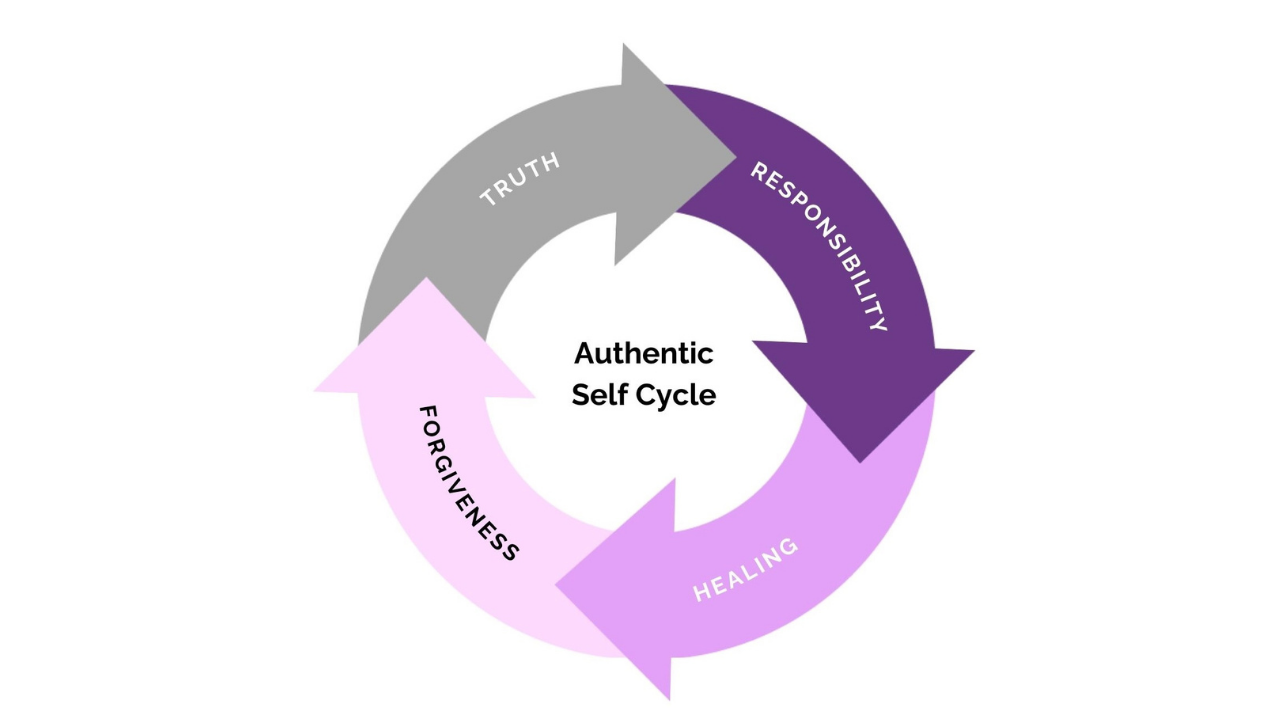
The ASC has four stages:
Stage 1: Truth
Name the blueprint. See that “this isn’t about today.” You’re not broken because of what happened yesterday or this morning—you’re responding from an old operating system. The truth is that the survival persona was a brilliant invention by a child who was trying to survive an impossible situation. The truth is that you internalized shame messages that were never about you.
That’s you… if recognizing the blueprint for the first time feels like you’ve suddenly put on glasses and the world comes into focus.
Stage 2: Responsibility
Own your emotional reactions without blame. This is the critical step that separates accountability from shame. “My partner isn’t my parent, but my nervous system just thinks they are” is responsibility. It’s not “Your fault your partner triggered you,” and it’s not “You’re a bad partner for reacting.” It’s “My reaction makes sense given my blueprint, and I’m responsible for rewiring it.”
That’s you… if you find yourself defending your survival persona instead of taking ownership for how it affects other people.
Stage 3: Healing
Rewire the emotional blueprint so conflict becomes uncomfortable but not dangerous. You’re literally teaching your nervous system that it’s safe to be vulnerable, that disagreements don’t mean abandonment, that your authentic self won’t be abandoned for existing. This is where the Emotional Authenticity Method™ comes in—the somatic, body-based work that changes your nervous system, not just your thoughts.
That’s you… if you’re starting to notice that situations that used to trigger a full panic response now just feel uncomfortable—which means you’re rewiring.
Stage 4: Forgiveness
Release the inherited emotional blueprint and reclaim your authentic self. This isn’t about forgiving the people who hurt you (though that may happen). It’s about forgiving yourself for the ways you’ve had to protect yourself. It’s about releasing the grip of the survival persona and stepping into a life where you don’t have to work so hard to be lovable—you already are.
That’s you… if you’re starting to imagine a life where you don’t have to prove your worth, manage other people’s emotions, or perform to deserve love.
Citation: The Authentic Self Cycle™ represents a neuroscience-informed healing pathway that moves from cognitive awareness (truth-naming) through nervous system responsibility to somatic integration (healing through rewiring) and finally to identity restoration (forgiveness and reclamation). This progression aligns with modern trauma treatment protocols that integrate cognitive, somatic, and relational processing. The cycle works because it addresses all three levels: the story (truth), the body (responsibility and healing), and the identity (forgiveness and wholeness).
People Also Ask (FAQ)
Is toxic shame the same as low self-esteem?
No. Low self-esteem is thinking “I’m not doing things well.” Toxic shame is believing “I AM not well—I’m fundamentally broken.” Low self-esteem responds to achievement and affirmation. Toxic shame persists even when you’re objectively successful because it’s not about your performance—it’s about your perceived worth as a human being.
Can you have a high-achieving career and still have toxic shame?
Absolutely. In fact, high achievers often use achievement to try to outrun or overcome their shame. They climb the ladder, get the promotion, make the money—and then find themselves depressed and isolated at the top because the external success never healed the internal wound. Their survival persona (usually the Falsely Empowered type) is actually their shame, dressed up.
If my survival persona kept me safe as a child, is it bad?
No, it’s not bad—it was brilliant. But brilliant then doesn’t mean wise now. Your survival persona was a lifesaving adaptation. The problem is that it’s still in charge, making adult decisions based on childhood logic. It’s like trying to navigate modern relationships using a map drawn by a six-year-old. The map was perfectly appropriate at the time. It’s just outdated now.
Can the Emotional Authenticity Method™ work if my trauma is really severe?
Yes, but often with professional support. The EAM works at the nervous system level and can be profound for anyone, but severe trauma often requires a trained therapist or coach to guide the process safely. The five steps work, but they work faster and deeper when you have someone who understands complex trauma holding space for you.
How long does it take to rewire your emotional blueprint?
Rewiring happens gradually. Some people notice shifts within days (the nervous system can learn quickly). Some changes take weeks or months. Deep identity shifts often take 6-18 months of consistent practice. The timeline depends on how deeply encoded the blueprint is, how much support you have, and how consistently you practice. But here’s the thing: you don’t have to wait until you’re “fixed” to start feeling better. Relief often comes in the first few weeks as your nervous system begins to recognize that it’s safe.
What if my survival persona is all I know? Who am I without it?
That’s the question, isn’t it? And it’s terrifying. But here’s what people discover: underneath the survival persona is your authentic self—the part of you that existed before the shame, before the fear. You don’t have to invent a new person. You just have to remember who you were before you learned to protect yourself. The authentic self isn’t an achievement—it’s a return home.
The Bottom Line
Toxic shame created your survival persona as a lifesaving adaptation to childhood trauma. That survival persona kept you safe, and for that, it deserves gratitude. But it’s still treating you like you’re six years old, traumatized, and in danger.
You’re not. You’re an adult with the capacity to feel, to choose, to connect authentically. You don’t have to prove your worth. You don’t have to control everything or disappear or oscillate between the two. You don’t have to spend your life in the Worst Day Cycle™.
The Emotional Authenticity Method™ gives you the neurobiological tools to rewire your emotional blueprint. The Authentic Self Cycle™ shows you the path from survival to wholeness. And your authentic self—the part of you that’s whole, lovable, and genuinely you—is waiting on the other side of this healing.
It’s time to come home to yourself.
Recommended Reading
- Mellody, P. (1992). Facing Codependence — The foundational framework for understanding how childhood trauma creates adult relational patterns.
- Maté, G. (2003). When the Body Says No — How suppressed emotions and shame become illness; the body-mind connection explained.
- Beattie, M. (1989). Beyond Codependency — Moving from codependent patterns toward authentic self.
- Brown, B. (2012). Daring Greatly — The power of vulnerability and how shame disconnects us from connection.
- Van der Kolk, B. (2014). The Body Keeps the Score — How trauma is stored in the nervous system and why traditional talk therapy often isn’t enough.
Start Your Healing Journey Today
Ready to move from survival to authenticity?
Start with our foundational courses designed to rewire your emotional blueprint and reclaim your authentic self:
- Emotional Blueprint Starter Course — Individual ($79) — Map your survival patterns and chart your path to authenticity
- Relationship Starter Course — Couples ($79) — Heal relational patterns with your partner
- Why We Can’t Stop Hurting Each Other ($479) — Deep-dive into the Worst Day Cycle™ and Authentic Self Cycle™
- Why High Achievers Fail at Love ($479) — For the Falsely Empowered persona: success without intimacy
- The Shutdown Avoidant Partner ($479) — Understanding avoidance as a survival strategy
- Tier 1: Mapping the Blueprint ($1,379) — The complete system: Nervous system rewiring, the EAM™, and identity restoration
Each course includes video modules, workbooks, and the proven frameworks that have helped thousands reclaim their authentic selves.
Internal Navigation
Explore more on related topics:
• Negotiables and Non-Negotiables in Codependence Recovery — Setting boundaries from your authentic self
• Signs of High Self-Esteem — What genuine confidence looks like beyond the survival persona
• 10 Dos and Don’ts for a Great Relationship — Applying these principles to partnership