
How much communication should there be with an ex depends entirely on your emotional blueprint, your survival persona, and whether the contact is serving your healing or feeding your addiction to a familiar pattern. If your partner’s ex is constantly texting, calling, and showing up in your relationship — or if you’re the one who can’t stop reaching out to someone who’s already gone — the real question isn’t about communication frequency. The real question is: what childhood wound is driving this behavior, and what does it reveal about the emotional blueprint running your relationship?
Most people approach this question from a rules-based perspective: “Is it okay to text your ex once a week? Should I be worried if they talk every day?” But rules without emotional awareness are meaningless. A person with a secure emotional blueprint can have a brief, logistical conversation with an ex about co-parenting and feel nothing. A person running a codependent survival persona can receive a single “how are you?” text from an ex and spiral into obsession, hope, fantasy, and self-abandonment for weeks.
That’s you if you’ve been monitoring your partner’s phone, replaying their conversations with their ex in your head, or telling yourself “it’s fine” while your body screams that something is wrong.
The inability to fully disengage from an ex — or the inability to tolerate your partner’s contact with theirs — is not a communication problem. It is a codependence problem rooted in childhood trauma, unresolved grief, and a survival persona that cannot tolerate the uncertainty of authentic adult relationships.
Table of Contents
- Why You Can’t Stop Communicating With Your Ex
- The Trauma Bond: Why It Feels Like Love
- The Worst Day Cycle™: The Loop That Keeps You Reaching Out
- Three Survival Personas and Ex Communication
- When Your Partner Won’t Stop Talking to Their Ex
- The 6-Step Boundary Framework for Ex Communication
- The Emotional Authenticity Method™: Rewiring the Urge
- The Authentic Self Cycle™: From Obsession to Freedom
- Signs Across Your Life
- When No Contact Is the Only Boundary
- Frequently Asked Questions
- The Bottom Line
- Recommended Reading
- Your Next Step
Why You Can’t Stop Communicating With Your Ex
The reason you can’t stop texting, calling, checking their social media, or finding excuses to reach out has nothing to do with love. It has everything to do with your nervous system’s addiction to a familiar emotional pattern. Your emotional blueprint — formed in childhood through how your caregivers handled connection, withdrawal, conflict, and repair — created a template for what “love” feels like in your body. If love in your childhood meant chasing someone who was emotionally unavailable, then losing your ex activates that same desperate pursuit.
That’s you if you’ve deleted their number three times and still have it memorized. That’s you if you tell your friends you’re “over it” but check their Instagram every morning before your feet hit the floor.
Your brain is not choosing this person because they’re good for you. Your brain is choosing this person because they’re known. The brain conserves energy by repeating familiar patterns — it cannot tell right from wrong, only known versus unknown. And unknown feels dangerous to a nervous system that was trained in childhood to associate familiarity with survival.
Every time you reach out to your ex, you are not reconnecting with them. You are reconnecting with the childhood wound they activated. The obsession to understand them, fix them, or get them back is your nervous system’s attempt to finally resolve the original abandonment that happened decades ago.
That’s you if the longing you feel for your ex is almost identical to the longing you felt as a child — waiting for a parent to come back, to show up, to finally choose you.
The Trauma Bond: Why Contact With Your Ex Feels Like Love
If you want to go deeper on this, I walk through the full framework in this video: How to Stop Going Back to an Ex.
A trauma bond is a neurochemical addiction to someone who cycles between cruelty and intermittent reinforcement. The narcissist, the avoidant partner, the emotionally unavailable ex — they give you just enough hope to keep you hooked. One kind text after weeks of silence floods your nervous system with dopamine and oxytocin. Your body registers this relief as love. But it is not love. It is the same chemical pattern as addiction.
That’s you if one text from your ex can erase three months of healing in thirty seconds. That’s you if the relief of hearing from them feels better than anything stable has ever felt.
When someone goes no contact, we should respect that. Honor that — no matter how heartbroken we are. They’re done with us, and we need to honor that. The impulse to keep reaching out, to explain yourself one more time, to send that final message that will “make them understand” — that impulse is not love. It is codependence. It is your wounded child self saying: “I don’t care that you hate me and want to be with somebody else. What matters is that I get what I want.” That is a child’s strategy. That is codependence recovery and childhood trauma recovery work.
Sound familiar? That’s you if you’ve sent the “just checking in” text that was really a plea for them to come back.
The Worst Day Cycle™: The Loop That Keeps You Reaching Out
The Worst Day Cycle™ is the four-stage neurological loop that drives your inability to stop communicating with your ex: Trauma → Fear → Shame → Denial.
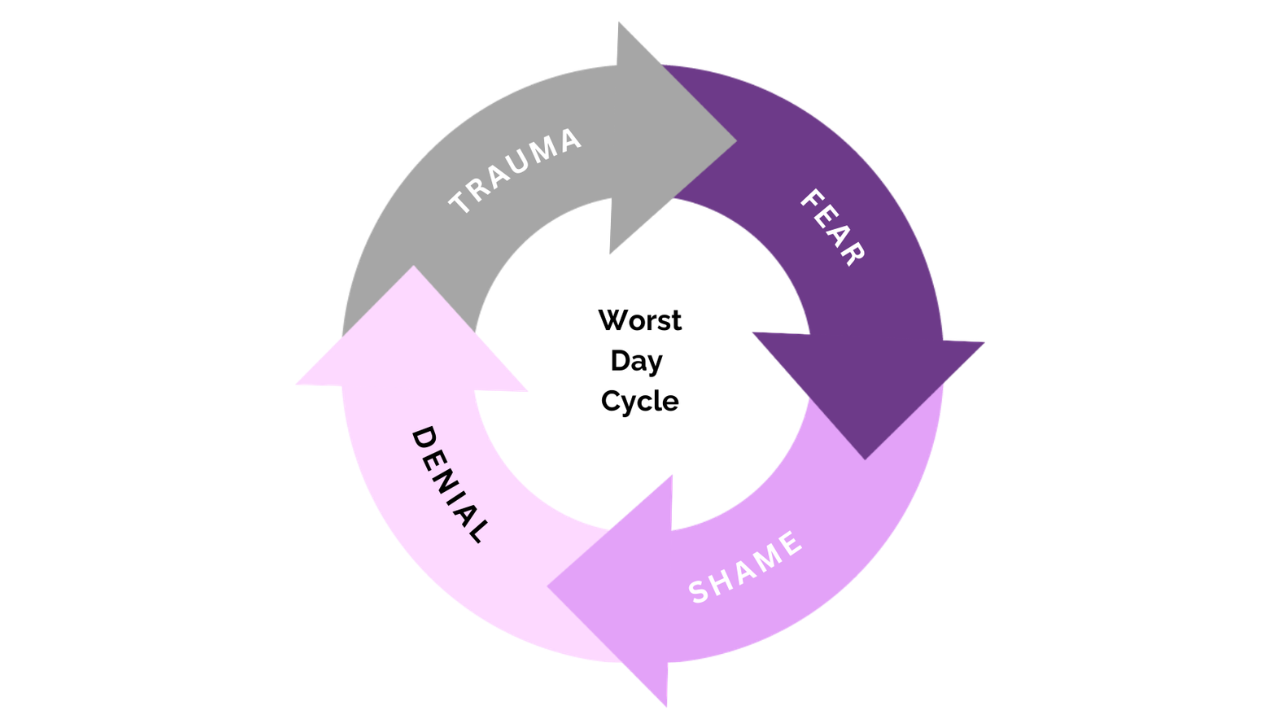
Stage 1: Trauma. Childhood trauma is any negative emotional experience that created painful meanings about yourself, others, or the world. Your parent withdrew during conflict. Your caregiver was emotionally unavailable. You learned that love disappears without warning. Now your ex’s silence activates the same neurological alarm that fired when your parent left the room and didn’t come back. The hypothalamus generates chemical cocktails — cortisol, adrenaline, dopamine misfires, oxytocin disruptions — and your brain becomes addicted to these emotional states because the brain conserves energy by repeating known patterns.
Stage 2: Fear. Fear drives repetition. Your brain thinks repetition equals safety. Since 70%+ of childhood messaging is negative and shaming, adults repeat these painful patterns in relationships, career, hobbies, health — everything. Your brain can’t tell right from wrong, only known versus unknown. So you text your ex because the silence of not knowing feels more dangerous than the pain of rejection. The unknown — life without them, a future you haven’t rehearsed — terrifies your nervous system more than the familiar cycle of hope and disappointment.
That’s you if unfamiliar peace feels scarier than familiar chaos. That’s you if being alone in silence triggers more anxiety than being in a toxic relationship.
Stage 3: Shame. This is where you lost your inherent worth. Shame whispers: “They left because you weren’t enough. If you were lovable, they would have stayed. Something is fundamentally wrong with you.” Not “I made mistakes in the relationship” (responsibility), but “I AM the reason it failed” (shame). This shame drives you to keep reaching out — because if you can just get them back, maybe the shame was wrong.
Stage 4: Denial. Your nervous system creates a survival persona — a protective identity that romanticizes the relationship, minimizes the problems, and creates the fantasy that “maybe they’ve changed.” Three survival persona types emerge: falsely empowered (controls, dominates, rages), disempowered (collapses, people-pleases), and adapted wounded child (oscillates between both). Denial is the survival persona’s greatest tool — it rewrites the relationship so staying connected feels reasonable.
That’s you if you’ve told yourself “we’re just friends” when every cell in your body knows you’re still in love. That’s the denial stage keeping the Worst Day Cycle™ spinning.
Three Survival Personas and Ex Communication Patterns
Your survival persona is the adaptive identity you built in childhood to keep you safe. In adulthood, it determines exactly how you handle communication with an ex — and exactly how you get stuck.

The Falsely Empowered Survival Persona
This persona controls, dominates, and over-functions. With an ex, the falsely empowered persona keeps communicating to maintain control over the narrative. You need to know what they’re doing, who they’re seeing, whether they’ve “moved on.” You might disguise it as friendship, but underneath, you’re managing the situation so you never feel blindsided. You monitor. You strategize. You keep one foot in the door so you can manage your own anxiety about being left.
That’s you if you’ve maintained a “friendship” with your ex primarily because cutting contact would mean surrendering control — and control is how your nervous system survives uncertainty.
The Disempowered Survival Persona
This persona collapses, people-pleases, and disappears into relationships. With an ex, the disempowered persona keeps communicating because saying goodbye feels like death. You’re available whenever they reach out. You respond immediately. You accept breadcrumbs — a late-night text, a vague “I miss you,” a holiday check-in — and treat them like a five-course meal because your survival persona says: “Something is better than nothing. Any connection is better than abandonment.”
That’s you if you respond to every text within minutes, even though they take days. That’s you if you’re still emotionally available for someone who is clearly not emotionally available for you.
The Adapted Wounded Child Survival Persona

This persona oscillates between both. One week you block them. The next week you unblock them. One day you’re furious and swear you’ll never speak to them again. The next day you’re texting at 2 AM because the loneliness activated your childhood wound and your adapted wounded child just needs someone to make it stop.
That’s you if you’ve blocked and unblocked them so many times you’ve lost count. That’s the adapted wounded child trying every survival strategy it learned — and none of them work because the wound underneath has never been addressed.
When Your Partner Won’t Stop Talking to Their Ex
If your partner is the one maintaining constant communication with an ex, the issue is equally complex. Their ongoing contact may be innocent — co-parenting logistics, mutual friendships, genuine closure. Or it may be a sign that they have not emotionally disengaged from their former relationship, which is a significant sign of codependence and unhealed attachment.
That’s you if your partner’s ex texts when you’re lying in bed together, when you wake up in the morning, and throughout the day — and your partner insists it’s “just friendship” while you feel like you’re sharing your relationship with a ghost.
Here is what most relationship teachers get wrong: they tell you to demand your partner stop talking to their ex. That is not a boundary. That is control. A boundary is not about changing someone else’s behavior — it is about clearly communicating your truth, your feelings, and what you will do if the situation remains unchanged.
The key with boundaries is understanding that they are not meant to control or change the other person. Our goals are to be known, to meet our need to love ourselves, and to share how we feel with our partner. This way, both can decide if they want to be in the relationship.
That’s you if you’ve been silently seething about your partner’s ex contact, hoping they’ll “just know” how you feel without you having to say it — because saying it feels too vulnerable, too risky, too much like the child who asked for something and was told their needs didn’t matter.
The 6-Step Boundary Framework for Ex Communication
Here’s the video where I unpack this in full: How Much Communication Should There Be With an Ex.
Whether you’re setting a boundary with yourself about contacting your ex, or setting a boundary with your partner about their ex, the process is the same. Think of a boundary like a fence around your yard — not a cage around someone else. The fence doesn’t force anyone to stay in or out. It simply communicates: “This is where I end and you begin. You can choose how you behave — I choose what I allow in my yard.”
Step 1: Share what you observe. State the behavior without judgment. “I’ve noticed you and your ex text every morning and throughout the day.” No accusation. No interpretation. Just what you see.
Step 2: Share your feelings about what you observe. Use the Feelings Wheel for emotional granularity. Not “I’m fine” or “I’m upset.” Specific: “I feel replaced. I feel inadequate. I feel like I’m sharing you with someone else.” Whatever your true feelings are, express them.
Step 3: Share what you “make up” about your feelings. Own that you are making an interpretation — not stating a fact. “The story I’m telling myself is that you’re still in a relationship with this person” or “What I make up is that I don’t matter as much as they do.” This is crucial: you’re being honest about your interior experience without making it the other person’s fault.
Step 4: Ask for what you want and need. “Would you be willing to consider putting a plan in place to reduce the communication?” or “Would you be open to discussing what feels appropriate for both of us?” You’re asking, not demanding. The difference is everything.
Step 5: Celebrate their “no.” This is where most people fall apart. If your partner says no to your request, celebrate it. Not because you got what you wanted — but because they are advocating for themselves. They have every right to their own choices. A boundary is not about getting your way. It is about self-love and being known.
Step 6: Have a plan for their “no.” This is your backup plan — not a threat, not a punishment, but a clear statement of what you will do to take care of yourself. “I appreciate that this is your choice, and I respect it. But it doesn’t work for me. I will take some time to decide what I need to do next.” Your choice might be sleeping in the spare bedroom, taking space, or ultimately ending the relationship. It depends on your own morals, values, needs, wants, negotiables and non-negotiables.
That’s the beauty in setting a boundary: both people step back and evaluate the relationship from a place of truth. They decide if they want to be with someone uncomfortable with their communication. You decide if you want to be with someone who won’t adjust. Both people win because both people have clarity.
The Emotional Authenticity Method™: Rewiring the Urge to Reach Out
The Emotional Authenticity Method™ Method™ is a six-step process that rewires your nervous system so the urge to contact your ex — or the anxiety about your partner’s ex — loses its grip on your body.

Step 1: Somatic Down-Regulation. When the urge to text your ex hits — or when your partner’s phone buzzes and your stomach drops — pause. Focus on what you can hear for 15-30 seconds. Wind. Traffic. Your own breath. This activates your parasympathetic nervous system and brings your prefrontal cortex back online. If you’re highly dysregulated, use titration: cold water on your face, stepping outside, holding ice. You cannot make a healthy choice from a triggered state.
Step 2: What am I feeling right now? Use emotional granularity with the Feelings Wheel. Not “I miss them.” Are you feeling abandoned? Terrified of being alone? Ashamed that they chose someone else? Desperate for validation? The more specific you are, the more you interrupt the survival persona’s vague, overwhelming “I just need to talk to them.”
Step 3: Where in my body do I feel it? All emotional trauma is stored physically. The ache in your chest when you think about texting them — that is not love. It is a somatic memory. The tightness in your throat when your partner mentions their ex — that is not jealousy. It is a childhood wound stored in your body. Locate the feeling physically.
Step 4: What is my earliest memory of having this exact feeling? The longing for your ex echoes something much older. When was the first time you felt this exact sensation? When a parent left? When a caregiver chose someone or something else? When you felt invisible? Your ex didn’t create this feeling — they activated a blueprint that was already there.
That’s you if the pain of your breakup feels strangely familiar — like you’ve been here before, in a different body, at a much younger age.
Step 5: Who would I be if I never had this thought or feeling again? Not “I’d be happy.” Specific: “I’d be someone who doesn’t check their ex’s social media. I’d be someone who can sit in silence without reaching for my phone. I’d be someone who trusts that I’m worth staying for.” This plants the seed of your Authentic Self — the you beneath the survival persona.
Step 6: Feelization — The New Chemical Addiction. Sit in the feeling of the Authentic Self and make it strong. Feel it in your body. Feel the confidence, the groundedness, the worthiness, the peace. Create a new emotional chemical addiction to replace the old blueprint. Ask yourself: “How would I respond to this urge from this feeling? What would I say? What would I do?” Visualize and FEEL yourself choosing yourself instead of choosing the familiar pain. This is the emotional blueprint remapping and rewiring step.
That’s you if you’ve never been taught that you can literally rewire your nervous system by changing what you practice feeling. You don’t think your way out of the urge to contact your ex — you feel your way into a new identity that doesn’t need to.
The Authentic Self Cycle™: From Obsession to Freedom
The Authentic Self Cycle™ is the healing counterpart to the Worst Day Cycle™ — a four-stage identity restoration system: Truth → Responsibility → Healing → Forgiveness.
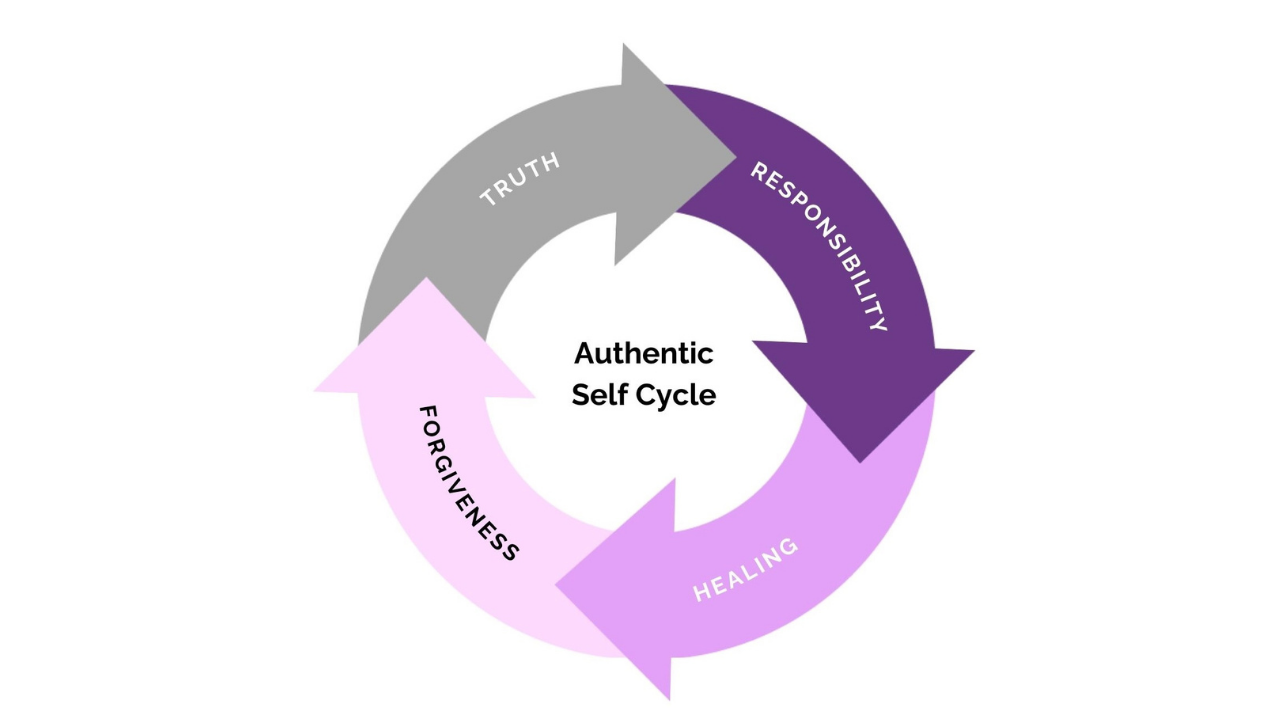
Stage 1: Truth. Name the blueprint. “This isn’t about my ex. My nervous system bonded to them because they replicated my childhood pain. The intensity I felt wasn’t love — it was my Worst Day Cycle™ recognizing home. My partner isn’t my parent; my nervous system just thinks they are.”
That’s you if you’re finally seeing the pattern — that every relationship has followed the same arc, with different faces but the same emotional script.
Stage 2: Responsibility. Own your emotional reactions without blame. “I chose to stay available. I chose not to set boundaries. I chose to accept breadcrumbs because my childhood taught me that crumbs were all I deserved.” Not “I’m bad for staying.” But “I’m responsible for my choices moving forward.” This is where you reclaim agency — you move from victim to author of your own life.
Stage 3: Healing. Rewire the emotional blueprint so silence becomes comfortable, solitude becomes peaceful, and stable people become attractive. This creates a NEW emotional chemical pattern that replaces fear, shame, and denial. When boring people become attractive — that’s when you know you’ve healed. Your nervous system is no longer seeking the chemical intensity of the Worst Day Cycle™.
Stage 4: Forgiveness. Release the inherited emotional blueprint and reclaim your authentic self. Forgiveness is not about excusing what happened. It is about releasing your attachment to the person and the pattern. You’ll know you’ve broken the cycle when you can think about your ex without rage, obsession, or longing — and feel genuine gratitude for what they taught you about your own wounds.
That’s the Authentic Self Cycle™ — the shift from obsessive attachment to authentic freedom. From chasing what hurts to choosing what heals.
Signs of Unhealthy Ex Communication Across Your Life
Family Relationships
Your family enables the contact. Your mother says “just give them another chance.” Your siblings encourage you to “stay friends.” Your family system normalizes enmeshment — blurred boundaries, emotional fusion, and the inability to let go — because that is how your family has always operated.
That’s you if your family treats your breakup as their problem to solve, your ex as still part of the family, or your grief as something you should “just get over.”
Romantic Relationships
You can’t fully invest in a new relationship because part of you is still tethered to the old one. You compare every new person to your ex. You keep your ex as a backup plan — not because you want them, but because the survival persona needs an escape route in case the new relationship triggers your abandonment wound. Or your current partner’s ex contact makes you feel like you’re sharing them. Learn more about signs of relationship insecurity.
That’s you if you’ve sabotaged a good relationship because you were still emotionally entangled with someone who was wrong for you.
Friendships
You’ve made your friends into an audience for the ex drama. You retell the story. You analyze their texts. You ask for opinions. Your friendships have become therapy sessions about a person who is no longer in your life — and your friends are exhausted.
That’s you if the same three friends have heard the same breakup story fourteen different ways, and nothing has actually changed.
Work and Career
You can’t concentrate. Your productivity drops. You check your phone compulsively during meetings. Your emotional bandwidth is entirely consumed by the ex situation, leaving nothing for professional growth or genuine self-esteem that comes from meaningful contribution.
That’s you if you’ve read the same email three times because your mind keeps drifting back to whether they’ve responded to your last text.
Body and Health
You can’t sleep. You can’t eat — or you eat everything. Your body is in a constant state of fight-or-flight because your nervous system interprets the loss of this person as a survival threat. Chronic stress from unresolved attachment activates your cortisol system, disrupts your immune response, and keeps your body locked in the same chemical patterns that drove the relationship.
That’s you if your body has been keeping score — insomnia, stomach problems, headaches, exhaustion — while your mind insists you’re “handling it.”

When No Contact Is the Only Boundary
If this is hitting close to home, here’s the video where I walk through the exact blueprint: Stop Obsessing Over Their Every Move.
For many people, the healthiest boundary with an ex is complete no contact. Not as punishment. Not as a power move. As self-preservation. When you keep a line of communication open with someone who activated your deepest childhood wounds, you’re keeping the Worst Day Cycle™ alive. Every text is a hit of the old chemical cocktail. Every conversation resets your healing to zero.
That’s you if you’ve tried “limited contact” and it always spirals back into full emotional enmeshment within days.
Saying “yes” to contact that goes against your morals, values, needs, wants, negotiables and non-negotiables is not loving. That is codependency. The only boundary you can truly set is with YOU: “I choose not to spend time communicating with someone who keeps my wounds open.”
Frequently Asked Questions
Is it normal for my partner to text their ex every day?
Daily texting with an ex — especially personal, emotional conversations rather than co-parenting logistics — is a sign of emotional enmeshment. It suggests they have not fully disengaged from the former relationship. This is not a judgment, but it is information. The question is not whether it’s “normal” but whether it aligns with your values and what kind of relationship you want to be in.
How do I know if my ex communication is trauma bonding or genuine friendship?
Ask yourself: does the contact bring you peace or anxiety? Can you go days without hearing from them and feel fine? Or does every text send your nervous system into overdrive? Genuine friendship feels neutral. Trauma bonding feels urgent, desperate, and chemically intense. If you feel a “high” when they reach out, that is trauma chemistry — not friendship.
What if we have children and need to co-parent?
Co-parenting requires communication — but it requires logistical communication, not emotional intimacy. Use business-like communication: schedules, pick-up times, school events, medical appointments. Keep it factual. The Emotional Authenticity Method™ helps you regulate your nervous system before and after co-parenting interactions so the old patterns don’t hijack you.
Why does it hurt so much to stop contacting my ex?
Because you’re not just losing a person — you’re losing a chemical pattern your nervous system has been addicted to. The withdrawal from a trauma bond mirrors substance withdrawal: anxiety, insomnia, obsessive thinking, physical pain. This is real neurobiology, not weakness. The Worst Day Cycle™ created an addiction, and breaking it requires the same commitment as breaking any other addiction.
How long does it take to stop wanting to contact them?
The urge diminishes as your nervous system rewires through the Emotional Authenticity Method™. For most people, the most intense urges soften within 6-12 weeks of consistent practice. But the timeline depends on how deep the childhood wound runs, how much support you have, and how committed you are to choosing yourself every time the old pattern fires.
Can setting boundaries about ex communication save my current relationship?
Boundaries don’t save relationships — they reveal them. When you share your truth with your partner about how their ex contact affects you, you create an opportunity for authentic intimacy. If they respond with empathy and willingness to find a solution, you have a real relationship. If they dismiss your feelings, minimize your experience, or refuse to engage — that is also information about what kind of partnership you’re in. Either way, boundaries give you clarity. Check out the 10 do’s and don’ts for a great relationship for more.
The Bottom Line
The question was never “how much communication should there be with an ex?” The real question is: “What childhood wound is driving this behavior, and am I willing to heal it?”
Whether you’re the one who can’t stop reaching out, or you’re the one watching your partner stay emotionally entangled with their past — the answer is the same. This is not a communication problem. This is an emotional blueprint problem. Your nervous system learned in childhood that love means chasing, waiting, hoping, and sacrificing yourself for someone who may never show up. That blueprint is running your adult relationships on autopilot.
But you can rewrite it. Through the Worst Day Cycle™, you can see how trauma, fear, shame, and denial keep you trapped. Through the Emotional Authenticity Method™, you can rewire your nervous system so the urge to reach out loses its power. Through the Authentic Self Cycle™, you can move from obsession to freedom — from chasing what hurts to choosing what heals.
Boundaries are not about controlling your ex or your partner. Boundaries are about advocating for yourself, sharing your authentic truth, and being known. When you set a boundary, you’re saying: “I matter. My needs matter. My feelings matter. And I’m willing to protect all of that — even if it means letting go of someone I love.”
That’s the hardest part. And that’s where healing begins.
Recommended Reading
- Facing Codependence by Pia Mellody — The foundational text on how childhood trauma creates survival personas, codependent patterns, and the loss of authentic self in relationships.
- The Body Keeps the Score by Bessel van der Kolk — Essential reading on how trauma lives in the nervous system and why healing requires more than talk therapy or willpower.
- When the Body Says No by Gabor Maté — How emotional repression and unresolved relationship patterns manifest as physical illness and chronic stress.
- Codependent No More by Melody Beattie — The classic guide to setting boundaries and stopping the cycle of self-abandonment in relationships.
- The Gifts of Imperfection by Brené Brown — A guide to wholehearted living that directly counters the shame keeping you bonded to toxic patterns.
Your Next Step
Reading this post is awareness. Awareness is the first step. But awareness without action is just intellectual understanding — and you cannot think your way out of an emotional pattern.
- Emotional Blueprint Starter Course — Individual ($79) — Your personal roadmap to understanding your emotional blueprint and breaking the patterns that keep you stuck in unhealthy ex dynamics.
- Relationship Starter Course — Couples ($79) — If you’re in a relationship and ex communication is creating conflict, this helps both partners understand the patterns together.
- Why We Can’t Stop Hurting Each Other ($479) — A deep dive into relationship patterns and how to interrupt them at the root.
- Why High Achievers Fail at Love ($479) — If your survival persona shows up as perfectionism and performance in every relationship.
- The Shutdown Avoidant Partner ($479) — Understanding dismissive-avoidant attachment and why your partner might struggle to fully let go of their ex.
- Tier 1: Mapping the Blueprint ($1,379) — A comprehensive program for deep rewiring of your emotional blueprint.
Start with the Feelings Wheel exercise — it’s free, and it’s the first step to reconnecting with your emotional life. Then explore the signs of enmeshment to understand how blurred boundaries formed in your childhood and are showing up in your adult relationships today.