

Your mother called you her best friend. Your father called you his confidant. The whole extended family said, “Wow, your family is so close.” And for most of your adult life, you wore that closeness like a badge — proof that your childhood was the good kind, the lucky kind, the kind other people wished they’d had.
Here’s the truth nobody wanted to say out loud: if you heard that your whole life, what actually happened in your house was that you were raised to raise your parents. And thirty years later, you still can’t stop raising everyone you care about. You scan your partner’s face before you even set your bags down. You absorb your mother’s, your brother’s, your friend’s mood the second they say hello. You manage the emotional temperature of every dinner, every text thread, every silence. And you call it being thoughtful when the truth is your nervous system has not had a day off since you were six years old.
That’s you… walking into every room already scanning for who needs you, who’s upset, who’s about to break — before anyone has said a single word.
Before we go any further, I want you to take a breath. Just for fifteen to thirty seconds. Focus only on what you can hear. Because before I explain any of this, I want your body to know one thing: this isn’t who you really are. This is a survival persona — a protective identity you had to develop because of what was done to you, not for you. It’s called parentification, and once you see it clearly, everything about your exhaustion, your over-functioning, and your relationships starts to make sense.
What Parentification Actually Is (and Why It’s Emotional Incest, Not Closeness)
I want to be precise with you, because almost every therapist, coach, and book in this space softens what this really is. Parentification is not just having too much responsibility as a kid. It is not just being “the mature one.” It is not just a form of enmeshment, though enmeshment is part of it.
Parentification contains elements of emotional incest. That is the clinical, correct term — first named by Dr. Patricia Love in 1990 and expanded by Dr. Kenneth Adams in his book Silently Seduced. It means a parent is using the child for the intimacy, companionship, advice, emotional regulation, and ego fulfillment they should be getting from another adult. The things the parent was supposed to pursue in an adult relationship, they pulled from the child instead.
Let me be even clearer. In parentification, the child isn’t just helping out with the dishes or babysitting a younger sibling. The child is being used as:
- A surrogate spouse — hearing your father complain about your mother, or being your mother’s “only person who understands.”
- A therapist — processing a parent’s anxiety, depression, rage, or relational pain at an age when you should be worrying about your own crayons.
- A co-parent — running the household, managing the siblings, mediating between the adults.
- An ego-fulfiller — being groomed to perform for the parent’s pride, identity, or unmet dreams.
That’s you… realizing the “special bond” with your mother was actually a job, and it started before you could read.
This is why the pain of parentification is so confusing. It doesn’t look like the stereotypical image of childhood abuse. There was no yelling. Maybe there was no hitting. On the outside it looked like devotion. The culture called it closeness. Your relatives called it being an “old soul.” But your nervous system has been paying the bill for decades.
I need to say something else that will land hard and land true: the vast majority of parents who do this are not aware they’re doing it. We don’t teach about it. Their own parents did it to them. They were never shown the difference between intimacy and ego fulfillment. They genuinely thought they were being close, being honest, being a “good mom” or a “dedicated dad.” The culture rewarded them for it. Two things can be true at the same time: your parent could have loved you and not had the skills or emotional capacity to love you appropriately. Both are true. Holding both is where healing starts.
Meet Stephanie: Age 8 at the Kitchen Table
I want to tell you about a client — I’ll call her Stephanie. Stephanie came to me because she was running two households. Hers. And her mother’s. She was paying two sets of bills, managing two sets of crises, and when I asked her why, she said it almost casually, like she was reading the weather: “My worth is in keeping everyone together.”
That’s you… saying the exact sentence that runs your life out loud and not even flinching, because you’ve been saying it inside your head since you were a child.
I asked her to say it again, but this time I asked her to feel it in her body as she said it. That’s when her chin started shaking. That’s when she remembered the first time that sentence was written into her.
She was eight years old. Her father had just left. Her mother sat her down at the kitchen table and said: “You’re the only one I can talk to.”
In that single moment, Stephanie stopped being a daughter and started being a spouse, a therapist, and a co-parent. Her mother did not hit her. Her mother did not scream. Her mother reached for her child as if that child were an adult partner — and the child, to keep the attachment she needed to survive, said yes. Not in words. In her nervous system. The rest of Stephanie’s life was rewritten in that single sentence at that single kitchen table at age eight.
That’s you… driving home from your mother’s house at forty-two, still carrying a suitcase you were handed at eight.
The Reversed Umbilical Cord — The Metaphor That Changes Everything
Here is the picture I want you to hold. An umbilical cord is supposed to flow in one direction. From the parent to the child. Feeding the child everything the child needs to grow — nutrients, regulation, safety, presence.
In parentification, the cord gets reversed. The parent sucks and drains the emotional life out of the child to feed and regulate themselves. That is the mechanism. That is what happened to you. That is why you grew up exhausted in a way you could never explain. Your body was feeding a parent who was supposed to be feeding you.
This is why well-meaning advice like “just set a boundary” or “just stop over-functioning” never works. You can’t willpower your way out of a plumbing system that was installed backwards before you had teeth. The cord was reversed in your body. It has to be re-threaded in your body, not just in your head.
That’s you… tired in a way sleep doesn’t fix, because you’ve been the power source for a system that was never supposed to pull from you.
The Identity Sentence That Becomes Your Operating System
When a child lives inside a reversed umbilical cord long enough, the child learns one sentence. And that sentence becomes their emotional operating system for the rest of their adult life:
“I only matter if I’m useful to you.”
Read that again. Slowly. Notice what happens in your chest, your throat, your stomach. Because that sentence is not a thought. It is a body-level conviction. It was written before you had words. And every single survival persona you’ve built as an adult is just that sentence looking for new people to prove itself on.
That’s you… realizing you have never taken a vacation in your body, even when your calendar said you were on one.
From that identity sentence, your survival persona is constructed. And parentified children tend to build one of three.
The Three Survival Personas Parentification Builds
I want you to be honest with yourself as you read these. Most of you are not purely one. Most of you are a braid of two, switching based on who’s in the room.
That’s you… scanning this list and already flinching at the one you don’t want to admit is yours.
1. The Falsely Empowered Parentified Adult
You run every household, every project, every family crisis. You drag everyone to the finish line. You know the answer, you take the lead, you pay the bills, you book the specialist, you mediate the siblings. And underneath it, you resent them the entire way. You become the falsely empowered codependent — controlling, over-functioning, unable to rest, quietly furious that no one else ever steps up, and unable to see that the reason no one steps up is that you’ve been standing in the spot the whole time.
That’s you… being the one everyone calls in a crisis and the one no one calls when things are calm.
2. The Disempowered Parentified Adult
You collapse into whoever you’re with. You people-please. You disappear inside a partner, a boss, a parent, a friend group. You can’t identify your own needs because every emotional room you enter, you become whoever that room needs. You read energy before you enter a space, and by the time you’re in it, you’ve already surrendered yourself at the door.
That’s you… not knowing what you want on a menu because you’re waiting to see what everyone else orders.
3. The Adapted Wounded Child

This is most parentified adults. You oscillate. You’re the falsely empowered one at work and the disempowered one at home with your mother. You’re dominant with your partner and collapsed with your father. You rage in one relationship and freeze in another. The survival persona shape-shifts depending on the emotional stakes — but both versions are still running the same childhood blueprint: earn love by being useful, avoid pain by disappearing, never rest.
None of these personas are your authentic self. All three are survival programs the parentified child built to keep the attachment they needed. And all three are running the same Worst Day Cycle™ underneath.
How the Worst Day Cycle™ Locks the Pattern In
This is where I have to introduce you to the framework that explains why parentification doesn’t just “go away” when you become an adult. I call it the Worst Day Cycle™, and it has four stages that loop endlessly until you heal it at the root.
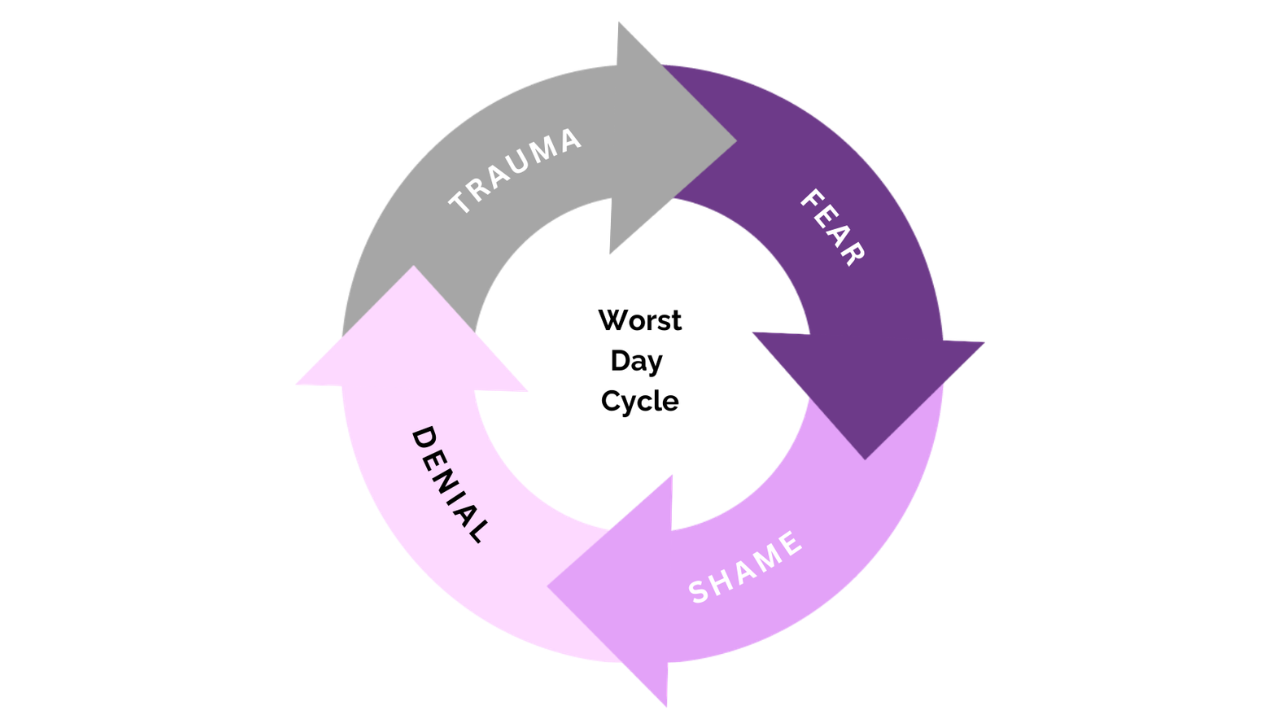
Let me walk you through it using Stephanie’s moment at the kitchen table. Because the same four stages are playing on repeat in your body right now.
Stage 1 — Trauma. Stephanie’s mother sitting her down and saying “You’re the only one I can talk to” was trauma. Her mother — unconsciously — traumatized her child by handing her an adult’s job. That single sentence made Stephanie responsible for her mother’s emotional regulation. It didn’t feel like trauma. It felt like being chosen. That’s what makes it devastating.
Stage 2 — Fear. The nervous system response was immediate. Stephanie’s fear became: if I stop performing, the whole family will collapse. It depends on me. That fear didn’t leave. It became a baseline. Her nervous system became fear-calibrated — permanently scanning for emotional instability in the people she loved so she could prevent collapse before it started.

That’s you… feeling a cold jolt in your chest when your mother’s name pops up on your phone, no matter how peaceful your day was a second earlier.
Stage 3 — Shame. Trauma and fear collapse into toxic shame. The child hardens around a single belief: if I have needs or wants of my own, they are a burden. My individuality is selfish. My desires are dangerous. The only way I earn love is by having no needs and being endlessly useful. Shame becomes the identity. Shame becomes the silent narrator of every choice.
Stage 4 — Denial. Because no child can survive being conscious of all three of those stages at once, the fourth stage kicks in to protect them: this is just who I am. I’m the strong one. I don’t mind. It’s not a big deal. My parents loved me. She did the best she could. I’m fine. You make excuses for them. You minimize. You suppress. You condone. You rewrite your own history. And the Worst Day Cycle™ closes its loop, and the cycle starts over again at the next dinner, the next text, the next request.
That is why nothing has worked so far.
Why Therapy, CBT, and Mindset Work Never Touched It
Talk therapy helped a little. Cognitive behavioral therapy gave you language. Mindset work helped you push through. Maybe plant medicine cracked something open for a week. Maybe a new boundary book felt like revelation on page ninety and irrelevant by Thanksgiving.
Here’s why. None of those approaches ever touched the original emotional blueprint. The blueprint isn’t a thought. It’s an emotional trauma chemistry that was written into your body before you had words for it. You cannot intellectually reframe parentification. You cannot willpower a reversed umbilical cord. You cannot coach your way out of a nervous system that was fear-calibrated at eight.
You have to feel it at its root. And then you have to learn the process to rewire it.
That’s you… finishing another book, taking another course, finishing another sixty-minute session — and feeling like something underneath is still untouched.
This is why healthy love feels boring to you. This is why you’re exhausted in your marriage. This is why you keep choosing partners who need fixing, friends who drain you, bosses who can’t function without your vigilance. This is why rest makes you anxious and taking a day off makes you guilty. You are not lazy. You are not bad at relationships. You are still trying to earn the attachment you never got by being useful enough. And you will keep doing it forever, in every role, until you heal the blueprint.
The Way Out: The Authentic Self Cycle™
The way out of the Worst Day Cycle™ is what I call the Authentic Self Cycle™. It’s four stages, and it’s the mirror-opposite of the cycle that trapped you.
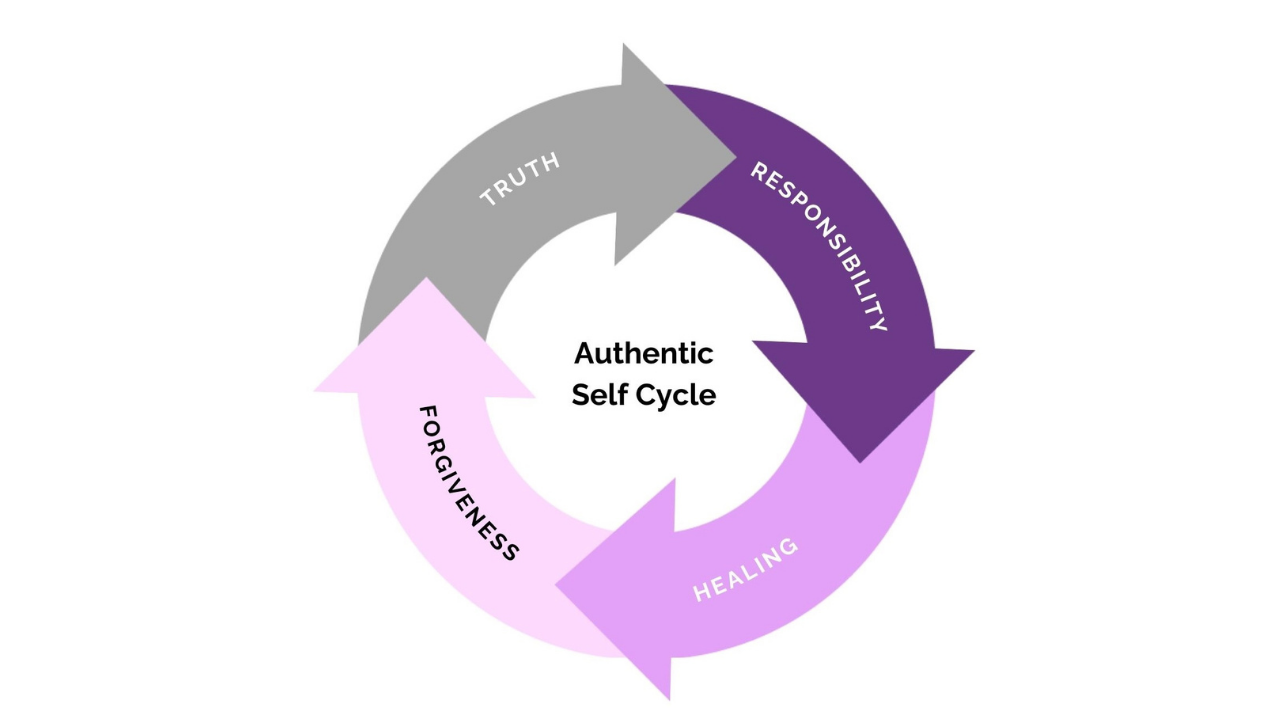 Emotional Authenticity Method™ — by Kenny Weiss" width="600" style="max-width:100%;height:auto;" />
Truth. What happened to you was emotional incest. It was not love. It was not kindness. It was not connection. It was not intimacy. It was not closeness. It was a parent who did not have the capacity to properly attach to you and love you because they didn’t have the capacity in themselves. Both things are true: they could have loved you and lacked the skills to love you well. Truth is not blame. Truth is accuracy.
Responsibility. This is not about blaming your mom or dad. We do not teach this in our culture. They did the best they could with the emotional vocabulary they had. But it is also loving to tell the truth about what happened — because what they did was wrong, even when they couldn’t see it. And now that you are an adult, you are responsible for recognizing the parentified pattern that was placed into you. No one is coming to do it for you. You can’t magically time-travel back to your kitchen table at eight and get properly reparented. You have to learn to reparent yourself.
That’s you… realizing the person you’ve been waiting your whole life to come save you is the adult version of yourself who finally tells the truth.
Healing. This is where the practical mechanism lives. This is where the rewiring happens. And that mechanism is the Emotional Authenticity Method™.
Forgiveness. Forgiveness comes last, and it only comes honestly. Not the forced forgiveness of spiritual bypass. Not the “just let it go” of people who were never parentified. True forgiveness is the natural byproduct of truth, responsibility, and healing. It is the moment you can finally see your parent as a hurt child in an adult body who reached for the only regulation they had — you — and not because they were evil, but because they were empty.
The Emotional Authenticity Method™ — Six Steps to Rewire the Blueprint

The Emotional Authenticity Method™ is the six-step process I developed to do the rewiring work inside the Healing stage of the Authentic Self Cycle™. It is somatic. It is memory-based. And it ends in a step most approaches skip — which is why most approaches fail.
Step 1 — Somatic Down-Regulation
The parentified nervous system has been running an emotional fever for decades. Before any other step will land, the body has to come down. For fifteen to thirty seconds, focus only on what you can hear. That’s it. No deep breathing gurus. No complicated meditation. Just the sounds around you. This drops you into the space between feeling and thinking — what I call metacognition — and it creates just enough room for the next five steps to actually reach you.
Step 2 — What Am I Feeling Right Now?
Not “I feel tired.” Not “I’m fine.” Develop emotional granularity. Are you feeling used? Invisible? Ashamed? Obligated? Resentful? Terrified of disappointing them? Get specific. Parentified adults were trained to track everyone else’s feelings with surgical precision and their own with no precision at all. A feelings wheel exercise will help you rebuild the vocabulary you were forced to silence.
Step 3 — Where in My Body Do I Feel It?
All emotional trauma is stored somatically. Parentification has favorite hiding places. Many of my clients feel it in the throat, because their voice was stolen — there was no room to say no. Others feel it in the chest, as the weight of a mother or father they still haven’t been able to put down. Others feel it in the stomach, where every family text lives as a physical knot. Find yours. Feel it. Name it.
Step 4 — What Is My Earliest Memory of Having This Exact Feeling?
Here is where truth enters the body. This feeling did not start in your marriage. It did not start with your boss. It did not start with your mother’s last phone call. It started at a kitchen table. Or a car ride. Or a moment in the hallway when you were seven. And now — for the first time — you can clearly see the Worst Day Cycle™ you’ve been replaying since. You are an adult in age, but emotionally you have been re-running an original childhood blueprint that has never been dealt with. Seeing it is the beginning of not being owned by it.
Step 5 — Who Would I Be If I Never Had This Thought or Feeling Again?
This is the doorway to your authentic self. If the shame, the guilt, the obligation, the vigilance all evaporated — who is left? You would not feel like your worth is in keeping everyone together. You would see that your mother’s pain is her responsibility. You would feel warmth and care without absorbing her emotional weather. You would be able to say no without the panic. You would be able to rest without guilt. That person — the one underneath the survival persona — is not a stranger. That’s who you were before the reversed umbilical cord. That’s who you really are.
Step 6 — Feelization (The Step Most People Skip)
This is the rewiring. Once you’ve felt who you really are in Step 5, you have to sit in that feeling until your body memorizes it. I call this feelization. Because the parentified identity is an emotional chemical addiction — cortisol, adrenaline, dopamine fired together for years until your body got hooked. You can’t break that addiction with willpower. You can only replace it with a new emotional chemical experience. You feelize by visualizing how you would respond to your mother, your partner, your boss, your kid from your authentic self. What would you say? What would you do? How would your body feel? Stay in that felt sense. Make it strong. Do it until your body believes it. That is how the emotional blueprint gets remapped and rewired from the inside.
That’s you… breathing into a body that is no longer waiting for a job it never should have had.
Your Weekly Micro-Win: Give Them Their Pain Back
Here is your assignment this week. It is small on purpose, because parentified adults have been trained to make everything big. One sentence. One situation.
The next time someone in your family hands you a feeling that you know is not yours to carry — a complaint, a crisis, a mood, an unsolved problem they are trying to hand you like a baton — I want you to remember this: you don’t have to fix it. You don’t have to absorb it. You don’t have to argue with it. You just have to say something like this:
“That sounds really hard for you. I can see it’s hurting you, and I love you and I trust you, and I know you will find a solution.”
Notice what that sentence does. You did not correct them. You did not shame them. You did not solve it. You did not take it. You stayed on your side of the tennis court. You let them play tennis any way they want. You simply said: I love you, I trust you, you will figure it out. For the first time in your life, you handed their pain back to them with love — instead of absorbing it and carrying it.
That is what a codependence recovery boundary sounds like when it is delivered from your authentic self instead of from guilt, resentment, or shame.
That’s you… hanging up the phone with your mother and realizing, for the first time in your life, that you did not take anything with you.
Frequently Asked Questions About Parentification
What is parentification in simple terms?
Parentification is a childhood dynamic where the parent-child roles are reversed and the child becomes responsible for the parent’s emotional regulation, companionship, or household functioning. It contains elements of emotional incest because the parent uses the child for the intimacy, advice, and ego fulfillment they should be getting from another adult. The child grows up with a nervous system wired to earn love through usefulness.
Is parentification a form of emotional abuse?
Yes. Parentification is a form of emotional abuse and is often categorized as emotional or covert incest in clinical literature (Dr. Patricia Love, 1990; Dr. Kenneth Adams, Silently Seduced, 1991). It does not require a parent to be cruel or intentional to cause harm. Most parents who parentify their children are unconsciously replaying what was done to them. Both truths can hold: your parent loved you, and what they did was developmentally harmful.
What are the signs you were a parentified child?
Common signs of parentification in adulthood include chronic exhaustion that sleep doesn’t fix, an inability to identify your own needs, compulsive emotional caretaking, difficulty with boundaries, hyper-vigilance in relationships, guilt when resting, anxiety when partners or friends are calm, over-functioning at work, attraction to partners who need fixing, and a deep-seated belief that your worth depends on being useful. If any of this reads like autobiography, you were likely shaped by childhood trauma rooted in parentification.
How does parentification affect adult relationships?
Parentification drives adults into repeating codependent patterns — pursue and withdraw, love addict and love avoidant, over-functioner and under-functioner. Healthy love tends to feel “boring” because the parentified nervous system is addicted to the chemistry of anxious attachment and emotional caretaking. The parentified adult often becomes the therapist, manager, or parent inside their romantic relationships, repeating the original reversed umbilical cord with a partner instead of a parent.
Can you heal from parentification?
Yes. Parentification can be healed, but not through cognitive approaches alone. Because the wound is stored in the body, in the nervous system, and in a pre-verbal emotional blueprint, the healing has to be somatic, memory-based, and blueprint-level. The Authentic Self Cycle™ — Truth, Responsibility, Healing, Forgiveness — combined with the six-step Emotional Authenticity Method™ gives the parentified adult a structured pathway to rewire the identity sentence that has been running their life.
Why do I feel guilty setting boundaries with my mother (or father)?
Because the parentified child’s nervous system equates boundaries with abandonment. When you were small, the cost of having needs was losing the attachment you depended on to survive. Your body still reads “boundary” as “the family will collapse and it will be my fault.” That guilt is not evidence that the boundary is wrong. It is evidence that the original blueprint is still intact — and it is precisely the blueprint that the Emotional Authenticity Method™ is designed to rewire.
The Bottom Line
If you’ve read this far, something in you recognized itself. Maybe at the kitchen table with Stephanie. Maybe at the reversed umbilical cord. Maybe at “I only matter if I’m useful to you.” Your body knows. Your body has known the whole time.
You were not loved incorrectly because you were unlovable. You were loved incorrectly because the people loving you did not have the skills and tools to love you the right way. You were a child in an adult’s chair. You carried a weight you should never have been handed. And you built a survival persona so good that most people — including you — never questioned it.
Before I go, like I say in all my videos: you are not to blame, and you are not broken. You did the best you could with the information you had at the time. If this is the first time you’re becoming aware of any of this, do not shame yourself. How could you? Blame requires a conscious choice to know you’re doing something wrong and doing it anyway. You weren’t conscious. You were surviving.
But now, for the first time in your life, you have a choice. Now that you know there’s a different way, you get to decide: do I want to stay stuck in the old survival persona, running the old emotional blueprint, reliving my Worst Day Cycle™ — or do I want to choose the Authentic Self Cycle™, work the Emotional Authenticity Method™, and heal the parentified child so she (or he) can finally rest?
All of this is just an emotional program. And emotional programs can be rewritten.
That’s you… not at the end of anything — at the beginning of the life you were always supposed to have before the cord got reversed.
Ready to Start Healing the Parentified Blueprint?
If you want to go deeper than this article — if you want a structured pathway to interrupt the Worst Day Cycle™, work the Emotional Authenticity Method™, and reconnect with the authentic self underneath the parentified survival persona — explore these resources:
- Free Feelings Wheel Exercise — Start rebuilding the emotional vocabulary you had to silence as a child.
- Emotional Blueprint Starter Course — Individual ($79) — Identify your survival persona and map the emotional blueprint underneath your parentification.
- Relationship Starter Course — Couples ($79) — For couples where one or both partners were parentified and are now colliding blueprints in the relationship.
- Why We Can’t Stop Hurting Each Other ($479) — Deep dive into the relationship patterns created by parentification and the Worst Day Cycle™.
- Why High Achievers Fail at Love ($479) — For the parentified high-performer who succeeds everywhere except intimacy.
- The Shutdown Avoidant Partner ($479) — For partners (or partners of partners) whose parentification turned into emotional shutdown.
- Tier 1: Mapping the Blueprint ($1,379) — The comprehensive program for rewiring the parentified emotional blueprint from the root.
Recommended Reading
If this article resonated with you, these books go deeper into the science and healing behind parentification, emotional incest, and childhood trauma:
- Kenneth Adams — Silently Seduced: When Parents Make Their Children Partners — The foundational book on covert emotional incest and the adult fallout from parentification.
- Patricia Love — The Emotional Incest Syndrome — The clinical definition and treatment of the parent-child role reversal that parentification describes.
- Pia Mellody — Facing Codependence — The clearest framework in recovery literature for how childhood emotional disruption (including parentification) creates adult codependence.
- Gabor Maté — When the Body Says No — How repressed emotions, chronic caretaking, and unprocessed childhood stress show up as adult illness and exhaustion.
- Bessel van der Kolk — The Body Keeps the Score — Why parentification cannot be healed through talk alone, and why somatic, blueprint-level work is required.
- John Bradshaw — Homecoming: Reclaiming and Championing Your Inner Child — The classic on reparenting the wounded inner child that parentification leaves behind.
Related reading: The signs of enmeshment in your family | How toxic shame creates the survival persona | Self-sabotage and the shame-driven power cycle | 7 signs of relationship insecurity | 10 do’s and don’ts for a great relationship
For every article I’ve written on the dynamic underneath parentification, explore the full Enmeshment article library.